A lot of healthcare AI projects follow the same story. The demo looks great. Then the team tries to use it in a real clinic, and things fall apart.
Most health systems already use AI in some form. A 2026 survey by Eliciting Insights, reported by Fierce Healthcare, found that 75% of U.S. health systems use at least one AI application, up from 59% the year before. But an HFMA survey found that more than 80% of health systems said they didn’t have the resources to pick and roll out AI tools on their own.
So most teams end up hiring outside help. And the choice of partner decides whether the project ends up in daily use or in a slide deck.
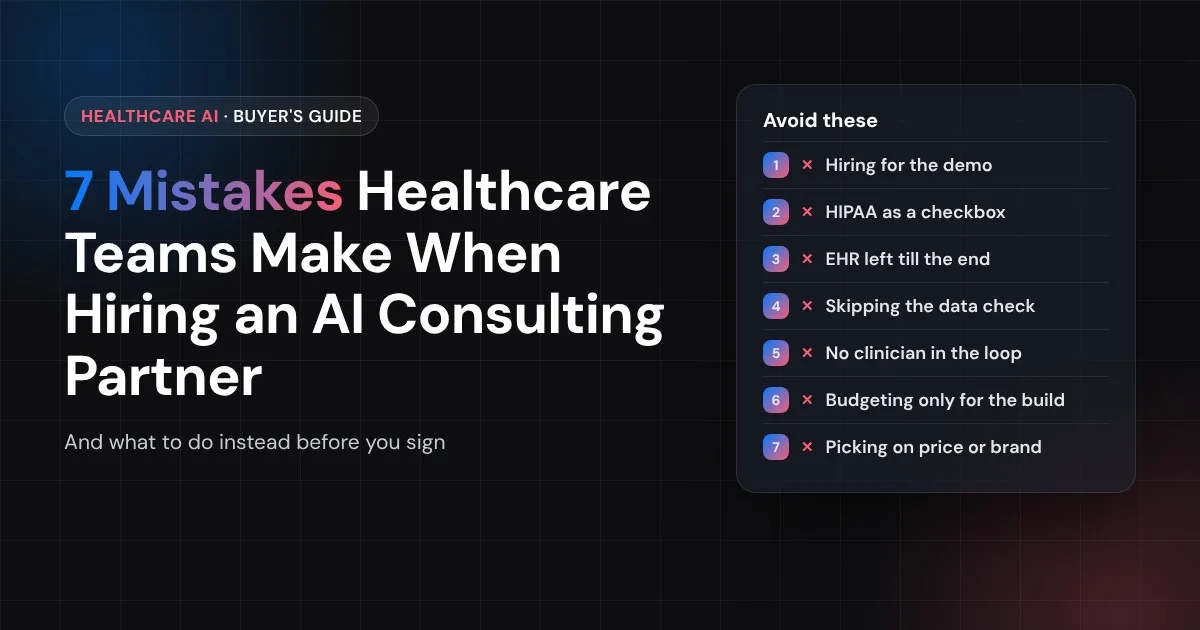
Here are seven mistakes that come up again and again, and what to do instead.
1. Hiring for the demo instead of the boring parts
Demos are easy. Almost any vendor can show a chatbot answering questions about appointment times or a model flagging risky patients on sample data.
The hard parts are the ones nobody puts in a demo: cleaning your data, connecting to your EHR, getting a BAA signed, training staff, and keeping the model accurate six months later.
When you talk to a vendor, skip the demo for the first 20 minutes. Ask them to walk you through a past healthcare project that is live today. Ask what went wrong and how long it took to fix. You’ll learn more from that answer than from any slide.
2. Treating HIPAA as a checkbox
If a partner will touch protected health information, they are a business associate under HIPAA and need to sign a Business Associate Agreement before you share any data. That part is not optional.
A signed BAA is only the first step, though. Ask where PHI is stored, who can access it, whether it is ever sent to a third-party AI API, and how prompts and model outputs are logged. If the answer to any of these is vague, treat it as a warning sign.
3. Leaving the EHR until the end
AI that sits outside the clinician’s normal screen rarely gets used. Doctors and nurses won’t open a separate tab for every new tool.
Ask early which EHRs the team has worked with (Epic, Cerner, athenahealth or others), whether they used FHIR APIs or HL7 interfaces, and how long the last integration took. If integration only shows up in the final phase of their plan, expect delays.
4. Skipping the data check
Most healthcare AI projects that stall do so because of data, not models. Notes are messy, codes are inconsistent, and the data you need is spread across three systems.
Take something as simple as a no-show prediction model. It needs clean appointment history, reliable patient contact data, and consistent visit codes. If any of those are patchy, the model will be too. A good partner will want to look at your data before promising results. One who quotes accuracy numbers on the first call, before seeing a single record, is guessing.
5. Keeping clinicians out of the loop
Any tool that affects patient care needs a human checkpoint. That means a clinician can review, override, or reject what the AI suggests, and every output is logged.
It also means clinicians should help test the tool before launch, not just receive it after. Ask your vendor who signs off on accuracy and how they test the model against real clinical cases.
There is a regulatory side to this too. Software that helps diagnose or treat patients can count as a medical device, and the FDA has now authorized more than 1,600 AI-enabled devices. Scheduling or billing tools usually don’t fall into that group, but clinical tools might. Your partner should be able to tell you early which side of that line your project sits on.
6. Budgeting only for the build
The build cost is the number everyone negotiates. The running cost is the one that surprises people later.
Plan for cloud hosting, model or API usage, monitoring, and periodic retraining. A common rule of thumb is to set aside 15% to 25% of the build cost every year for upkeep. Get these numbers in writing before you sign.
It also helps to start where the payback is quick. Admin work like appointment reminders, insurance checks, and claims follow-up is usually less risky than clinical tools, and an experienced AI automation company can often get a pilot like this running in a few weeks.
7. Choosing on price or brand name alone
The cheapest quote often hides rework. The biggest brand name often comes with junior staff and a long project timeline.
What matters more is whether the team has shipped healthcare projects like yours. A focused AI development company with real healthcare work, a clear plan for compliance, and senior engineers on your project can be a better fit than a large firm where you are one client among hundreds. Offshore teams can also cut hourly costs a lot, as long as they sign a BAA and follow the same security rules.
A simple way to compare vendors
Before your next vendor call, write these questions down and score each answer from 1 to 5:
- Can you show two healthcare projects that are live today?
- Will you sign a BAA before we share data?
- Which EHRs have you integrated with, and how?
- How will you check if our data is ready?
- Who signs off on clinical accuracy?
- Could this tool need FDA review?
- What will it cost to run each month after launch?
- Who owns the data, the trained model, and the code?
Add up the scores. The vendor with the best total isn’t always the one with the best pitch, and that’s the point.
Final thought
Healthcare AI works when it fits the way clinicians already work, keeps patient data safe, and keeps getting checked after launch. The right partner will talk about those things before you ask. If you have to drag those answers out of them, keep looking.
About the author: Lakshya Pareek works at Gaincafe Technologies, where the team builds AI products, chatbots, and automation tools for healthcare and other industries.