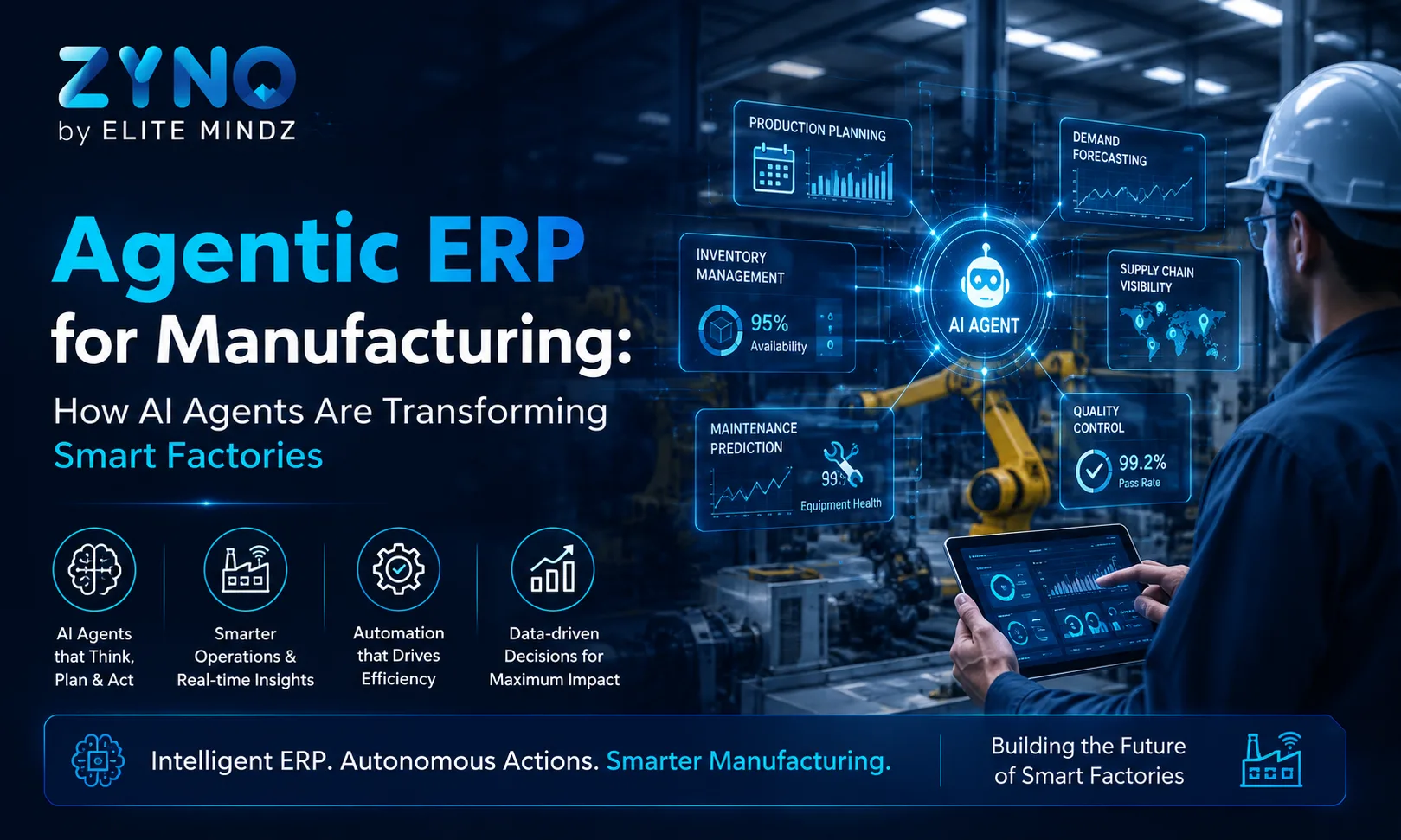
Manufacturers have spent years digitizing production, inventory, supply chains, procurement, maintenance, and finance. Yet many factories still rely on people to move information between systems, interpret reports, identify problems, and decide what should happen next.
Agentic ERP for manufacturing represents the next stage of that transformation.
Instead of using artificial intelligence only to generate reports or predict outcomes, agentic ERP introduces AI agents that can interpret information, pursue defined goals, coordinate workflows, recommend actions, and—in carefully controlled situations—execute approved business processes.
This shift could turn traditional manufacturing ERP software from a system of record into a more active system of intelligence and action.
IBM describes agentic AI in manufacturing as goal-driven AI systems capable of planning, making decisions, and acting across production environments with varying levels of human intervention. Microsoft is similarly investing in manufacturing agents that work with factory data to support operations, maintenance, production visibility, and process optimization.
So, how does agentic ERP transform manufacturing, and what does it mean for the future of smart factories?
What Is Agentic ERP for Manufacturing?
A traditional manufacturing ERP system brings together business processes such as production planning, purchasing, inventory, finance, sales, and supply chain management.
An AI-powered ERP adds capabilities such as machine learning, forecasting, anomaly detection, natural-language interaction, and intelligent recommendations.
An agentic ERP goes a step further.
Rather than simply presenting information to a manager, AI agents in ERP can work toward defined objectives.
For example, an AI agent could identify a material shortage, review outstanding purchase orders, check alternative suppliers, evaluate the production schedule, estimate the impact of different options, and recommend the most suitable response.
With proper authorization, some actions could also be executed automatically.
That movement from insight to action is what makes autonomous ERP particularly important for manufacturing.
1. AI Agents Make Production Planning More Adaptive
Production planning is difficult because factory conditions rarely remain constant.
A manufacturer may begin the day with an optimized schedule, only to experience:
- A machine failure
- An urgent customer order
- A delayed component
- Employee availability changes
- Quality issues
Unexpected demand increases
Traditional planning systems may detect these changes, but planners often need to manually evaluate their impact and rebuild schedules.
With agentic AI in manufacturing ERP, software agents can continuously monitor orders, capacity, machines, materials, labor, and deadlines.
When conditions change, the system can evaluate alternatives and recommend or initiate a revised plan.
IBM notes that agentic systems can balance constraints such as capacity, labor, and material availability while dynamically adjusting production when disruptions occur.
This makes AI-powered production planning software valuable for environments where priorities change frequently.
Instead of planning being a once-a-day activity, smart manufacturing ERP can support continuous planning.
The result is potentially faster responses to disruptions, better resource utilization, and fewer manual planning tasks.
2. AI Can Improve Inventory and Demand Decisions
Manufacturers constantly face a difficult balancing act.
Too much inventory ties up working capital and increases storage costs.
Too little inventory can interrupt production and delay customer orders.
AI-powered inventory management in manufacturing can analyze historical consumption, production requirements, supplier lead times, demand patterns, inventory levels, and other operational information.
An AI agent could identify that a critical component is likely to run short before the next scheduled delivery.
Instead of simply generating an alert, intelligent ERP software could evaluate potential responses:
- Expedite an existing order.
- Purchase from an approved alternative supplier.
- Reallocate inventory from another facility.
- Reschedule production.
- Prioritize higher-value customer orders.
The system can then present the options to a planner or automatically execute actions that fall within predefined policies.
The same principle applies to AI-based demand forecasting in ERP.
Demand forecasts can feed purchasing, production, workforce, and inventory decisions, creating a more connected planning environment.
This combination of forecasting and action is one of the major benefits of agentic ERP for manufacturing.
3. AI Agents Can Connect Maintenance With Production
Predictive maintenance is already common in discussions about AI-driven manufacturing.
However, predicting that equipment might fail is only one part of the problem.
Someone still needs to decide:
- When maintenance should happen
- Whether production should be rescheduled
- Whether spare parts are available
- Which technician should perform the work
- How customer commitments will be affected
This is where AI agents for manufacturing operations can add another layer of value.
An agent could receive information indicating that a machine requires maintenance, check current production commitments, identify an appropriate maintenance window, confirm spare-part availability, and create a maintenance request.
Microsoft highlights manufacturing AI scenarios involving predictive maintenance, production scheduling, factory operations, and the use of agents to help workers analyze industrial information.
Connecting maintenance data with digital manufacturing ERP helps organizations look beyond individual machines and understand the wider business impact of equipment decisions.
That is essential for effective ERP for smart factories.
4. Agentic ERP Automates Multi-Step Business Processes
Traditional ERP automation often relies on predefined rules:
If X happens, perform Y.
That approach works well for predictable processes, but manufacturing frequently involves exceptions.
Agentic AI can potentially manage more complex workflows by reasoning across several pieces of information.
Consider a customer order that cannot be completed because a required material is unavailable.
A traditional system might simply flag the shortage.
With AI automation in manufacturing ERP, an agent could:
- Identify the shortage
- Determine which orders are affected
- Check supplier availability
- Review alternate materials
- calculate schedule implications
- Recommend revised production dates
- Update relevant teams after approval
This illustrates how AI agents automate ERP processes differently from basic workflow automation.
Multiple agents may eventually specialize in procurement, production, maintenance, logistics, finance, and customer service while coordinating around common business objectives.
These autonomous business processes in ERP could reduce the amount of time employees spend moving information between departments.
Employees can instead focus on exceptions, supplier relationships, engineering decisions, quality improvement, and strategic work.
5. Agentic ERP Can Make Smart Factories More Responsive
A true smart factory requires more than connected machinery.
ERP, manufacturing execution systems, quality systems, IoT sensors, warehouse platforms, supply-chain applications, and business data need to work together.
Microsoft's manufacturing strategy emphasizes interoperable manufacturing data and connecting systems across information technology and operational technology so AI agents can work with relevant factory information.
That makes data integration a critical foundation for agentic ERP for smart factories.
Imagine a supplier delay affecting an assembly plant.
Instead of separate departments independently discovering the problem, an AI manufacturing ERP environment could identify the disruption and evaluate its effects across:
Procurement: Which alternative suppliers are available?
Inventory: How long will current stock last?
Production: Which jobs should be rescheduled?
Sales: Which customer orders could be affected?
Finance: What is the cost of expedited purchasing?
This coordinated response demonstrates how agentic AI improves manufacturing efficiency: not simply by automating individual tasks, but by helping different business functions respond to the same event together.
What Are the Benefits of Agentic ERP for Manufacturing?
When implemented appropriately, AI-driven ERP for manufacturing can potentially provide several advantages:
- Faster decision-making
- More responsive production planning
- Better inventory visibility
- Improved demand forecasting
- Reduced repetitive administrative work
- Faster responses to supply-chain disruptions
- Better coordination between departments
- More proactive maintenance
- Improved use of manufacturing data
- Greater operational agility
However, manufacturers should not assume that installing AI-powered manufacturing software automatically creates these benefits.
AI performance depends heavily on data quality, integrations, governance, clearly defined processes, cybersecurity, and human oversight.
IBM specifically notes that fragmented data, legacy infrastructure, governance, integration, and workforce readiness remain important challenges when deploying agentic AI in manufacturing.
What Should Manufacturers Look for in Agentic ERP Software?
Companies evaluating the best manufacturing ERP software with AI should look beyond marketing claims.
Useful intelligent ERP solutions for manufacturing should provide:
Strong manufacturing functionality: Production, BOMs, inventory, procurement, quality, maintenance, finance, and supply-chain capabilities must remain reliable.
Connected data: AI agents need trustworthy information from ERP, MES, IoT, warehouse, quality, and other systems.
Explainable recommendations: Users should understand why an agent recommends an action.
Human approval controls: High-impact decisions should have appropriate authorization and escalation processes.
Security and governance: Agents should only access and modify information they are permitted to use.
Process visibility: Organizations need logs showing what agents recommended, decided, and executed.
The most useful AI-powered ERP for manufacturing companies will not simply have the largest number of AI features. It will connect intelligence to genuine manufacturing problems.
The Future of ERP in Manufacturing
The future of ERP in manufacturing is likely to involve a gradual shift from systems that primarily record transactions toward systems that can understand context, coordinate decisions, and initiate actions.
That does not mean factories will operate without people.
Human expertise will remain essential for engineering decisions, safety, customer relationships, strategic planning, unusual exceptions, and oversight.
The more realistic model is collaboration.
AI agents handle data-intensive monitoring, analysis, coordination, and routine execution. People establish objectives, approve important decisions, manage exceptions, and provide business judgment.
This combination could make manufacturing automation significantly more intelligent.
Final Thoughts
Agentic ERP for manufacturing is more than another layer of ERP automation.
It changes the role of enterprise software from a passive database into a potentially proactive operational partner.
Through AI agents in ERP, manufacturers can connect planning, inventory, procurement, maintenance, supply chains, and production more effectively.
The biggest opportunity lies in moving from:
Data → Report → Human Action
to:
Data → Understanding → Recommendation → Approved Action → Continuous Optimization
For manufacturers building connected factories, AI in manufacturing ERP could therefore become an important foundation for the next generation of industrial operations.
Successful adoption, however, will depend on more than AI. Companies need high-quality data, connected systems, clear governance, skilled employees, measurable objectives, and appropriate human oversight.
Manufacturers that get those fundamentals right will be better positioned to use agentic ERP software, intelligent manufacturing software, and AI automation in manufacturing to create factories that are not only automated, but increasingly adaptive, responsive, and intelligent.