
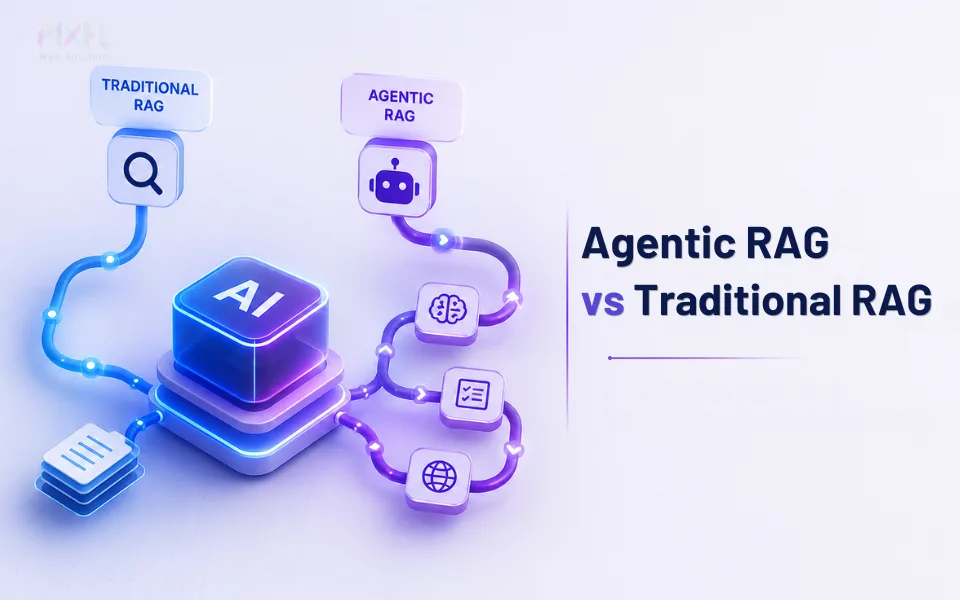
Retrieval-Augmented Generation (RAG) allows LLMs to use external knowledge instead of relying only on information stored in model parameters.
Traditional RAG typically follows a predictable pipeline:
User Query → Retrieval → Context Construction → Generation
This works well when a query can be answered through a single, predefined retrieval process. However, complex questions may require multiple documents, query reformulation, database lookups, APIs, or verification. This is where Agentic RAG becomes useful.
What Is Agentic RAG?
Agentic RAG adds a decision-making layer to the retrieval process. Instead of following a fixed path, the system can dynamically determine:
- Whether retrieval is required
- Which retrieval method to use
- How to reformulate a query
- Whether to break a question into subtasks
- Whether to call an external tool
- Whether additional evidence is needed
- When the task should terminate
A typical Agentic RAG workflow can look like:
Query → Understand → Decide → Retrieve/Tool → Inspect → Decide → Synthesize → Verify → Answer
The key difference is that retrieval becomes part of an adaptive inference-time control loop.
Traditional RAG vs Agentic RAG
Traditional RAG offers predictable execution, simpler testing, easier latency and cost estimation, and a smaller operational failure surface.
Agentic RAG provides greater flexibility for complex information-seeking tasks, but introduces additional model calls, state management, variable latency, security considerations, and observability requirements.
Traditional RAGAgentic RAGMostly fixed executionDynamic executionPredefined retrievalAdaptive retrievalUsually single-passCan perform multiple iterationsLimited tool usageTool calls can be part of executionLower complexityHigher complexityMore predictable latencyVariable latencySimpler observabilityRequires trajectory tracingWhen Should You Use Agentic RAG?
Agentic RAG is particularly useful for:
- Multi-hop questions
- Multi-document research
- Multiple knowledge sources
- Database and API access
- Query decomposition
- Iterative evidence gathering
- Complex synthesis workflows
For straightforward questions where one retrieval pass is enough, traditional RAG may remain the better engineering choice.
Production Considerations
Agentic RAG requires clear boundaries around what the model can control. Production systems should consider:
- Execution and token budgets
- Maximum retrieval and tool calls
- Timeouts and retry limits
- Tool allowlists
- Permission boundaries
- Context management
- Authentication and authorization
- Audit logging
- Prompt-injection defenses
- Evaluation and observability
The important principle is:
The model can propose an action, but the application should determine whether that action is permitted.
Final Takeaway
Agentic RAG is not simply a more advanced version of traditional RAG. The fundamental difference is how much decision-making happens during inference.
Traditional RAG prioritizes predictability, while Agentic RAG prioritizes adaptive execution.
The right choice depends on the workload. If a fixed retrieval pipeline delivers the required accuracy, latency, and cost, traditional RAG may be preferable. If the system needs to dynamically determine what information to obtain, where to obtain it, and whether the evidence is sufficient, Agentic RAG can justify the additional complexity.
Read the full technical guide:
https://mathibharathi.medium.com/agentic-rag-vs-traditional-rag-architecture-workflows-3d6d8d22a435