A visitor lands on your website.
They are interested.
They've read your homepage.
They've looked at your services.
They've clicked through a few pages.
Then they have a question.
A simple one.
But they can't find the answer.
So they look for a contact page.
Fill out a form.
Or maybe they don't.
Maybe they just leave.
And that's the part most website owners never see.
You can see traffic in your analytics.
You can see page views.
You can see how long people stayed.
But you usually can't see the questions they wanted to ask before they disappeared.
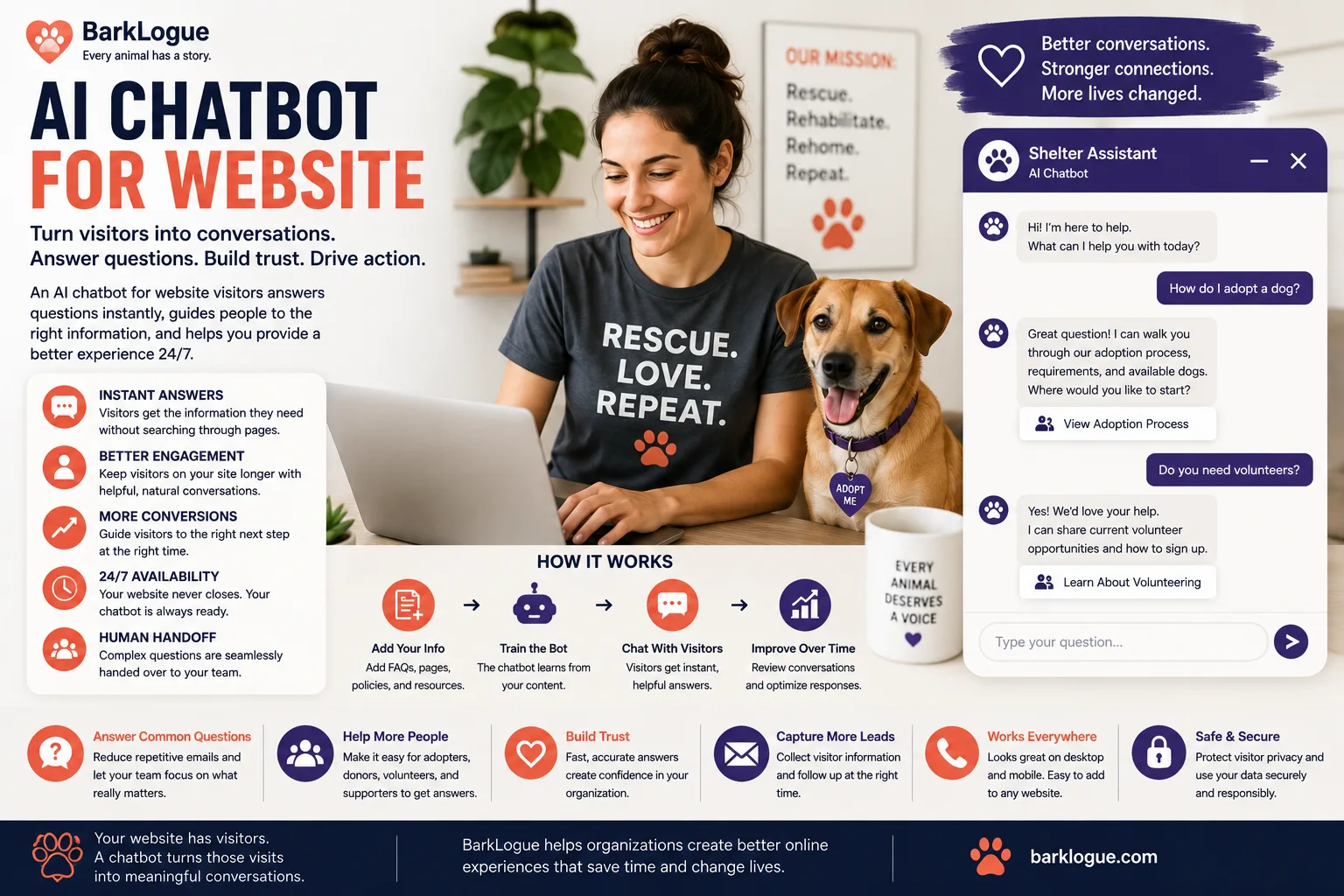
That's where an AI chatbot for website visitors becomes useful.
Not because every website needs more technology.
Because visitors sometimes need someone to talk to.
Your Website Has Information. That Doesn't Mean It Has Answers.
Most websites already have plenty of content.
Homepage.
About page.
Services.
FAQs.
Contact information.
Blog posts.
The problem is that visitors don't always know where to look.
Imagine someone asking:
"Which service is right for me?"
That answer might technically exist somewhere on your website.
Maybe across three different pages.
But the visitor doesn't want to spend ten minutes searching.
They want an answer.
That's the difference between a website and a conversation.
A website gives people information.
A good AI chatbot for website visitors helps them find the information that matters to them.
Every Question Is a Sign of Interest
This is something businesses often forget.
A question is usually a good sign.
Someone asking:
"How does this work?"
is interested.
Someone asking:
"What does this cost?"
is interested.
Someone asking:
"Can this help with my problem?"
is interested.
The worst thing that can happen is not getting a difficult question.
The worst thing is never getting the question at all.
Because then the visitor leaves.
And you don't know why.
An AI chatbot gives those visitors a place to ask before they disappear.
What an AI Chatbot for Website Visitors Actually Does
Forget the complicated definition.
At its best, a website chatbot does something simple.
It helps people get answers.
A visitor can ask questions naturally.
For example:
- What does your company do?
- Which service should I choose?
- How much does it cost?
- How do I get started?
- Can I speak with someone?
- Where can I find more information?
The chatbot can then guide them toward the right answer or page.
That creates a smoother experience.
Less clicking.
Less searching.
Less frustration.
Before and After
Let's look at a simple example.
Before
A visitor wants to know whether a service is right for them.
They read the homepage.
Still unsure.
They open the services page.
Still unsure.
They visit the FAQ.
Still no clear answer.
They leave.
After
The visitor opens the chatbot.
They type:
"I'm not sure which service I need."
The chatbot asks a few relevant questions.
Then it explains the available options and points them in the right direction.
The visitor stays engaged.
That's the real value.
The chatbot didn't magically create a sale.
It removed friction from the conversation.
Your Website Never Closes
Your team has working hours.
Your website doesn't.
People visit at night.
During weekends.
Between meetings.
While sitting on their couch.
A visitor may discover your organization at 11:30 p.m.
If they have a question, they probably don't want to wait until tomorrow morning.
An AI chatbot for website visitors can provide immediate help.
That doesn't mean it needs to solve every problem.
It simply keeps the conversation moving.
And sometimes that's enough to keep someone interested.
The Best Chatbots Don't Try to Answer Everything
This is important.
A good chatbot knows its limits.
If it has the answer, great.
Give the visitor a clear response.
If it doesn't know, it shouldn't invent something.
It should say so.
Then guide the visitor to a human.
For example:
"That's a great question. Our team can give you the most accurate answer. Here's how to contact them."
That builds more trust than pretending to know everything.
AI should make communication easier.
Not create confusion.
What I Learned Building BarkLogue
Building BarkLogue taught me something interesting.
The technology gets attention.
But the conversation creates the value.
At BarkLogue, the idea is simple.
Shelter staff already know their animals.
They know their personalities.
Their habits.
Their stories.
The problem was that website visitors couldn't always access that knowledge.
So instead of adding more generic information, we focused on conversation.
A visitor could ask questions.
The animal's story could become easier to discover.
That lesson applies to almost every website.
You probably already have the knowledge your visitors need.
The question is whether they can find it easily.
An AI Chatbot Can Help Different Types of Website Visitors
Not every visitor arrives with the same goal.
One person wants to buy.
Another wants information.
Someone else wants support.
A website chatbot can help guide each person.
Potential Customers
They can ask about products, services, pricing, and next steps.
Existing Customers
They can find support information and answers to common questions.
Donors and Supporters
Nonprofit visitors can ask about donations and programs.
Volunteers
They can learn about opportunities and requirements.
Animal Adopters
Shelter visitors can ask about adoption processes and individual animals.
The same website can support many different conversations.
What Makes a Good AI Chatbot for a Website?
Before choosing one, keep the basics in mind.
A useful chatbot should:
- Understand natural questions
- Use accurate website information
- Guide visitors toward useful pages
- Work well on mobile devices
- Answer common questions quickly
- Capture leads when appropriate
- Hand complex questions to humans
- Be easy to update
You don't need the chatbot with the longest feature list.
You need one that makes your website easier to use.
Common Questions
What is an AI chatbot for a website?
An AI chatbot for a website is a conversational assistant that helps visitors ask questions and find information directly through a chat interface.
Can an AI chatbot improve website engagement?
Yes. It can encourage visitors to interact with your website instead of searching through multiple pages for answers.
Does an AI chatbot replace customer support?
No. It can handle common questions and guide visitors while human staff handle complex or sensitive conversations.
Can a website chatbot work after business hours?
Yes. An AI chatbot can provide answers and guidance 24/7 using the information available to it.
Can small businesses use AI chatbots?
Yes. Many modern chatbot platforms are designed to be simple enough for small teams to manage.
What should an AI chatbot know?
It should understand your business, services, products, policies, and the common questions visitors ask.
What to Do Next
Open your website.
Pretend you're visiting it for the first time.
Then ask yourself:
What questions would I have before taking the next step?
Write down five.
Then ten.
Those questions are where your chatbot should begin.
Because your visitors don't always need more pages.
They don't always need more content.
Sometimes they just need an answer.
And an AI chatbot for website visitors gives them a simple way to ask.
That's where a static website starts becoming a conversation.