
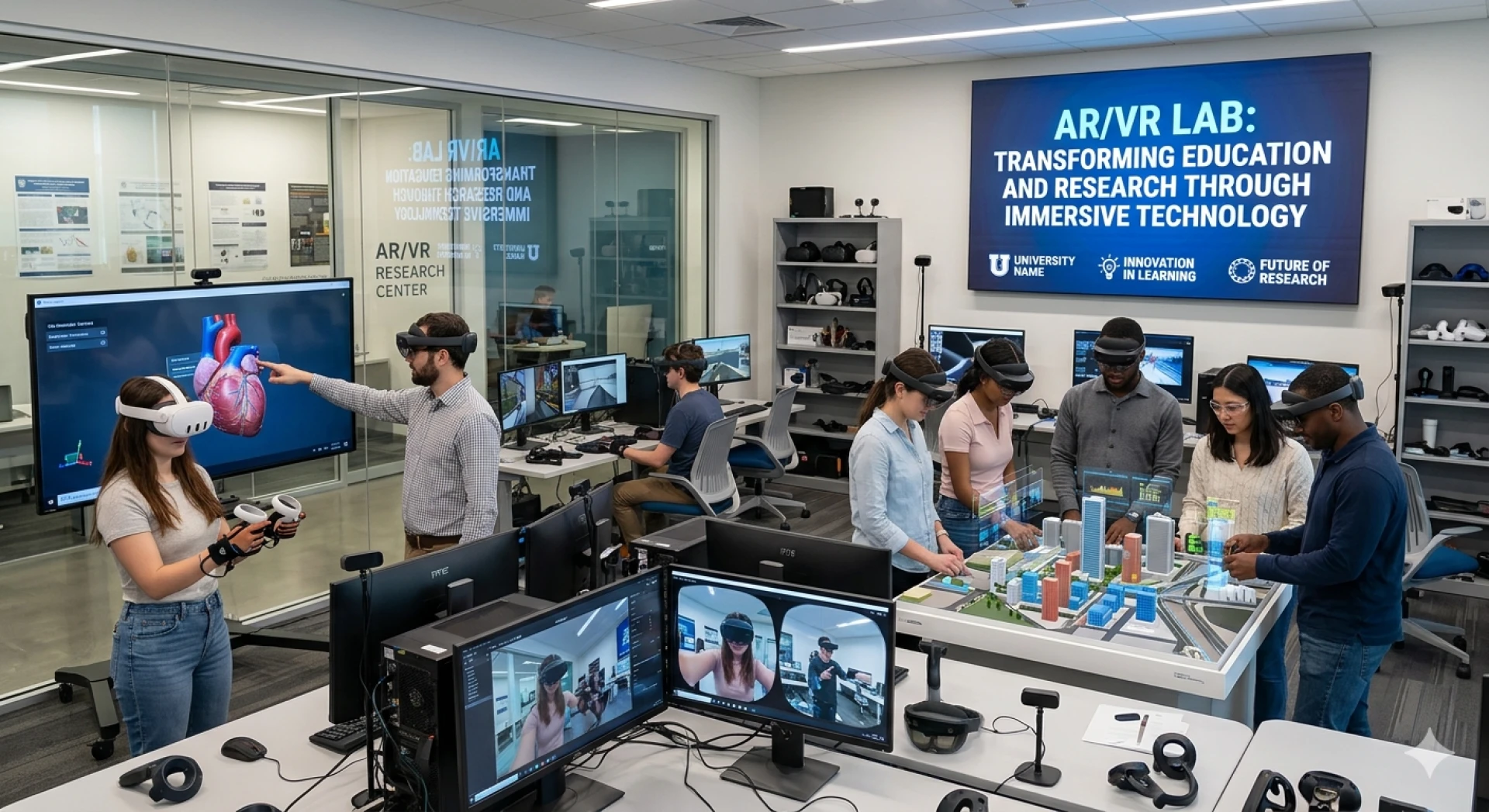
The way we learn, teach, and conduct research is undergoing a radical transformation. At the center of this shift is the AR/VR lab, a dedicated space where augmented reality and virtual reality technologies come together to create deeply immersive, interactive experiences. From visualizing complex molecular structures to walking through a virtual human heart, AR/VR labs are redefining what is possible inside a classroom or research facility.
Whether you are a school administrator, a university dean, or a corporate training manager, understanding what an AR/VR lab is, how it works, and how to set one up is increasingly relevant to your institution's future.
What Is an AR/VR Lab?
An AR/VR lab is a purpose-built environment equipped with augmented reality and virtual reality technologies that allow users to interact with simulated or digitally enhanced environments. While the terms are often used together, they refer to distinct experiences.
Virtual reality (VR) immerses users in a fully digital environment, cutting them off from the physical world through a headset. Augmented reality (AR), on the other hand, overlays digital elements onto the real world, typically through a screen or smart glasses. A combined VR/AR lab supports both, offering a flexible platform for a wide range of learning and research applications.
Key components of a virtual reality lab include VR headsets, motion tracking systems, high-performance computers or workstations, haptic feedback devices, and AR/VR development software. Together, these tools enable experiences that are simply impossible in a traditional lab or classroom setting.
Why Schools and Universities Need AR/VR Labs
AR/VR Labs in Schools
For K-12 education, an AR/VR lab in school creates opportunities that go far beyond textbooks and lectures. Students can explore the surface of Mars, walk through ancient Rome, or conduct virtual chemistry experiments without any physical risk. This kind of experiential learning has been shown to dramatically improve engagement, retention, and conceptual understanding.
VR lab setups for schools are increasingly designed to be affordable and easy to integrate. With the right planning, even smaller schools can introduce immersive learning without overhauling their entire infrastructure. The benefits extend across subjects history, biology, physics, geography making the AR VR lab a cross-curricular investment.
AR/VR Labs in Higher Education
Universities worldwide are investing in AR/VR research labs to support both academic instruction and cutting-edge research. Medical schools use virtual reality anatomy labs to let students dissect and study the human body in three dimensions. Engineering departments use simulation environments to test designs before physical prototypes are ever built.
Several of the world's leading universities with AR/VR labs including Harvard, Stanford, and NYU have integrated immersive technology into core curricula and research programs. These institutions demonstrate how augmented reality labs and VR environments support innovation across medicine, architecture, aerospace, design, and the social sciences.
Key Applications of AR/VR Labs in Education
Virtual Reality Science Labs
One of the most impactful applications is the virtual reality science lab. Students can perform experiments that would otherwise require expensive equipment, rare materials, or hazardous conditions. A high school student can simulate a nuclear reaction; a university student can explore quantum physics through interactive 3D models. These experiences build genuine scientific intuition in a safe, repeatable, and cost-effective environment.
Medical and Anatomy Learning
The virtual reality anatomy lab is arguably the most well-established application of immersive technology in education. Medical and nursing students can examine every layer of the human body at their own pace, rotate organs, trace nerve pathways, and practice surgical procedures all before they ever enter an operating room. This deepens understanding and accelerates skill development in ways that cadaver labs and 2D illustrations simply cannot match.
Engineering and Design Training
AR/VR labs also play a major role in engineering education. Students can work with digital twins of machines and infrastructure, perform stress tests on virtual materials, and collaborate with peers in shared simulated environments. Architecture students can walk through their own designs at full scale. Design students can prototype and iterate in real time. The result is faster learning with deeper practical application.
AR/VR Lab Setup: Components and Requirements
Setting up an AR/VR lab requires careful planning across hardware, software, and physical space.
On the hardware side, institutions typically need standalone or PC-tethered VR headsets, motion controllers, spatial tracking sensors, and high-performance computers with dedicated graphics cards. Interactive displays and AR-capable devices may also be part of the setup depending on the intended use cases.
Software requirements include AR/VR development platforms, subject-specific simulation content, and management systems for multi-user environments. Many vendors offer ready-made content libraries for education alongside tools for custom content development.
For physical space, a dedicated room with sufficient clearance for movement is ideal. Padded flooring, cable management, and ventilation are practical considerations. Many institutions integrate AR/VR labs into existing computer labs or science rooms through modular setups.
AR/VR Lab Setup Cost in India
The cost of setting up an AR VR lab in India varies based on the scale and scope of the installation. For a basic school-level setup with a small number of headsets and core software, costs can range from a few lakhs to approximately ₹15–20 lakhs. For a fully equipped university-grade virtual reality research lab with advanced hardware, custom content, and multi-station configurations, costs can extend to ₹50 lakhs or more.
Key factors influencing cost include the number and quality of VR headsets, software licensing and content subscriptions, server or workstation specifications, installation, calibration, and training, and ongoing technical support.
VR labs in India are becoming more accessible as domestic vendors emerge and global hardware prices decrease. Government initiatives supporting digital education and smart classrooms have also helped drive adoption, making this an opportune moment for institutions to invest.
Leading AR/VR Labs Around the World
Some of the world's most influential AR/VR research labs are housed in top-tier academic institutions. The Stanford AR/VR Lab has pioneered research into social presence and immersive storytelling. The Harvard AR/VR Lab explores applications in medical training, historical reconstruction, and data visualization. The NYU AR/VR Lab focuses on creative computing and the intersection of art and emerging technology.
On the corporate side, IBM AR/VR labs have integrated immersive technology into enterprise training, remote collaboration, and design workflows, demonstrating that AR VR labs are not limited to academic contexts but are increasingly central to workforce development.
The Future of AR/VR Labs
As artificial intelligence becomes more deeply integrated with immersive technologies, the capabilities of AR/VR labs will expand significantly. AI-powered virtual tutors, adaptive simulations that respond to learner behavior, and fully collaborative metaverse classrooms are already in development. The boundary between the digital and physical learning environment will continue to blur.
Augmented reality labs will become more lightweight and wearable. Virtual reality labs will become more socially connected and contextually aware. The institutions that begin building this infrastructure today will be far better positioned to lead in the education and research landscape of tomorrow.
How to Set Up an AR/VR Lab for Your Institution
Begin with a clear assessment of your learning or research objectives. What subjects or skills will the lab support? Who will use it, and how often? From there, develop a budget framework, select a technology partner with experience in educational deployments, and plan for staff training alongside student onboarding.
Pilot with a small cohort before scaling. Gather feedback, measure learning outcomes, and iterate on both the technology and the pedagogy. A successful AR/VR lab is not just about the hardware it is about building a culture of immersive, curiosity-driven learning.
Conclusion
The AR/VR lab is no longer a futuristic concept reserved for elite research institutions. It is a practical, increasingly affordable, and educationally transformative tool available to schools, universities, and training organizations of all sizes. Whether through a virtual reality science lab, a medical simulation suite, or an engineering design environment, immersive technology is changing how knowledge is acquired and applied. Institutions that embrace this shift today are building the foundations for a smarter, more capable generation of learners and innovators tomorrow.