
Mental maths helps primary school children work with numbers confidently, without depending on written methods or calculators for every step. It supports quicker thinking, stronger memory, better focus, and a more positive attitude toward maths in everyday life. For parents exploring child math learning options, including an abacus class or math classes online, understanding the benefits of mental math can make it easier to choose the right support.
Why does mental maths matter in primary school?
Mental maths matters because primary school is when children build the number sense they will use for years. At this stage, they are not just memorising answers; they are learning how numbers behave, how patterns work, and how to choose efficient strategies. The benefits of mental maths for primary school children become clear when a child can estimate, compare, add, subtract, multiply, and divide with less fear and more independence.
Strong mental maths also helps children participate more actively in class. When they can follow a teacher’s explanation without getting stuck on every calculation, they have more mental space to understand the concept being taught. This is especially useful as they move from basic arithmetic into word problems, fractions, measurements, and early problem-solving tasks.
Mental maths builds number sense, not just speed
Many people think mental maths is only about answering quickly. Speed can improve, but the deeper value is number sense. A child with good number sense understands that 49 + 26 can be handled as 50 + 25, or that 8 × 6 is connected to 4 × 12. These flexible strategies make maths feel less rigid and more manageable.
This flexibility is one of the most important mental maths benefits for children. Instead of seeing every question as a new challenge, they begin to notice relationships between numbers. They learn to break problems into smaller parts, adjust numbers to make calculations easier, and check whether an answer sounds reasonable.
For example, if a child mentally estimates that 198 + 203 is close to 400, they are less likely to accept an answer like 601 without questioning it. That habit of checking is valuable in school and in real life.
Key benefits children gain from mental maths
The benefits of mental math go beyond the maths workbook. Regular practice can support academic growth, confidence, and everyday decision-making.
Children often develop:
- Better concentration: Mental calculations require children to hold numbers in their mind, follow steps, and stay focused until they reach an answer.
- Stronger memory: Remembering number facts, patterns, and intermediate answers exercises working memory in a practical way.
- Improved confidence: When children can solve problems without always asking for help, they begin to see themselves as capable learners.
- Sharper problem-solving skills: Mental maths encourages children to choose strategies, compare methods, and adapt when one approach feels difficult.
- Faster classroom participation: Children who can calculate mentally often respond more readily during lessons and group activities.
- Useful everyday skills: Estimating money, time, distance, scores, and quantities becomes easier when children are comfortable with numbers.
These skills build gradually. The goal is not to pressure children into instant answers, but to help them think clearly and efficiently.
How can an abacus class support mental maths?
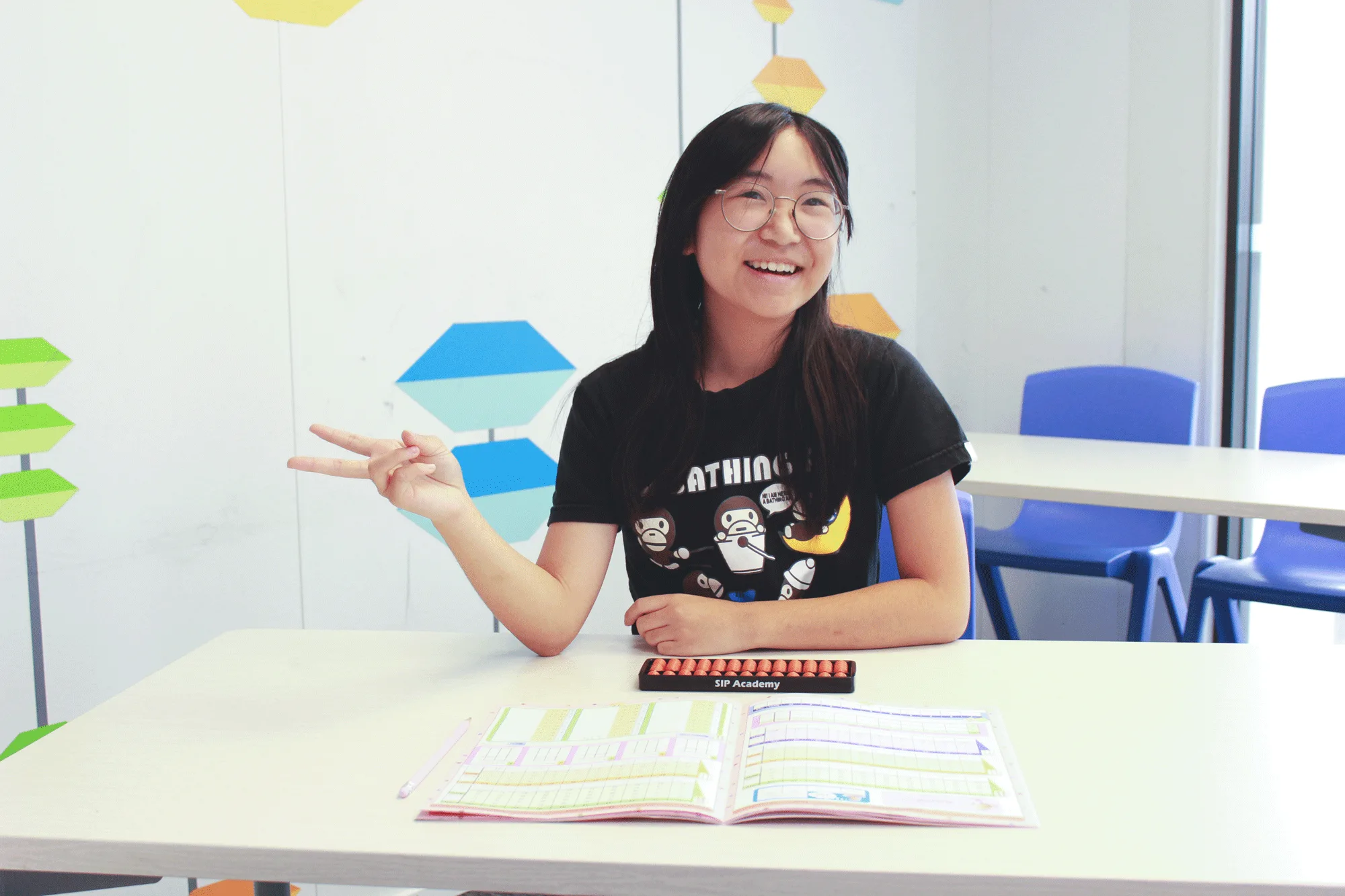
An abacus class can support mental maths by giving children a visual and hands-on way to understand numbers before they begin solving calculations mentally. With practice, children learn to picture the abacus in their mind, which can help them perform calculations without physically using the tool. This makes the learning process more concrete, especially for young children who benefit from seeing and touching what numbers represent.
The abacus approach can be helpful because it connects place value, movement, and calculation. Instead of treating numbers as abstract symbols only, children learn how units, tens, hundreds, and larger values are structured. This can strengthen the foundation for addition, subtraction, multiplication, and division.
For many children, abacus-based learning also adds a sense of rhythm and engagement. The repeated movement of beads, followed by mental visualisation, can turn practice into a more active experience. When taught patiently, it helps children progress from physical calculation to mental strategy.
Mental maths supports better school performance
Primary school maths often becomes challenging when children rely only on counting or memorised steps. Mental maths gives them more tools. A child who can mentally double, halve, round, estimate, and split numbers is better prepared for multi-step problems.
This matters because classroom maths is rarely only about one calculation. A word problem may require reading carefully, identifying the operation, calculating, and checking the answer. If basic calculations take all of a child’s effort, they may struggle to understand the larger problem. Mental maths reduces that burden.
It also supports written methods. Children who understand numbers mentally are more likely to notice when they have made a carrying, borrowing, or place-value mistake. In this way, mental maths and written maths work together rather than replacing each other.
Practical ways parents can encourage mental maths at home
Parents do not need to turn every evening into a formal lesson. Short, regular practice in everyday situations can be more effective and less stressful.
Try simple activities such as:
- Use shopping moments: Ask your child to estimate the total cost of two or three items or work out simple change.
- Play number games: Practise doubles, number bonds, or times tables during car journeys or walks.
- Ask strategy questions: Instead of only asking for the answer, ask, “How did you work that out?”
- Use time naturally: Discuss how many minutes are left before dinner, school, or bedtime.
- Celebrate effort: Praise clear thinking and persistence, not just quick answers.
- Keep practice short: Five to ten focused minutes can be enough for younger children.
The key is consistency. Children learn best when practice feels achievable, encouraging, and connected to real life.
Are math classes online effective for child math learning?
Math classes online can be effective for child math learning when they are interactive, age-appropriate, and guided by clear teaching methods. A good online class should not simply show answers; it should help children understand the steps, practise regularly, and receive feedback. For mental maths, online learning can work well when lessons include live interaction, visual tools, structured practice, and opportunities for children to explain their thinking.
Online classes may also suit busy families because they reduce travel time and allow children to learn from home. However, parents should look for programmes that balance screen-based instruction with active participation. Mental maths improves through doing, not passive watching.
When choosing support, consider whether the class:
- Matches your child’s current level rather than rushing ahead
- Explains concepts clearly before increasing speed
- Includes regular revision of number facts and strategies
- Encourages confidence instead of creating pressure
- Offers progress feedback that parents can understand
Whether you choose an abacus class, school support, home practice, or math classes online, the best option is one that keeps your child engaged and steadily improving.
A balanced approach creates lasting confidence
Mental maths is most powerful when it is taught as a thinking skill, not a race. Children need time to understand patterns, practise strategies, make mistakes, and try again. When learning is calm and consistent, they begin to see maths as something they can work through rather than something to avoid.
The Benefits of Mental Maths for Primary School Children include stronger number sense, better focus, improved confidence, and practical problem-solving skills. With the right mix of classroom learning, home encouragement, and supportive programmes, children can build a foundation that helps them well beyond primary school.
A strong start in maths is not about producing perfect answers every time. It is about helping children think clearly, trust their abilities, and approach numbers with curiosity instead of fear.