The manufacturing industry has changed significantly with advanced machines and automation technologies. Today, many industries use CNC (Computer Numerical Control) machines to manufacture components with greater accuracy, consistency, and efficiency. These machines are commonly used in automotive, aerospace, engineering,g and other manufacturing sectors.
As CNC technology spreads, companies increasingly need skilled professionals who can both operate and program these machines. For students interested in mechanical engineering and manufacturing, learning CNC programming can be a good step toward building a technical career.
If you are searching for the best CNC programming training institute in Faridabad, choose one that offers a clear understanding of programming concepts along with practical learning.
What Is CNC Programming?
CNC programming is the process of creating instructions that tell a computer-controlled machine how to perform specific machining operations. These instructions control cutting tool movement, spindle speed, feed rate, and other machine functions.
The machines perform operations such as turning, milling, drilling, and cutting. They help manufacturers produce components according to specific measurements while maintaining quality and accuracy.
To understand this programming, students need to learn basic programming codes, machine coordinates, tool selection, engineering drawings, and machining parameters. This knowledge helps learners understand how a design or drawing becomes a finished component.
Why Should You Learn CNC Programming?
The technology has become an important part of modern manufacturing. Companies use these machines to improve production quality, reduce manual effort, and complete machining operations more efficiently.
Learning CNC programming can be useful for several reasons:
- Practical technical knowledge: Understand how CNC machines work and how different machining operations are performed.
- Better understanding of manufacturing: Learn about cutting tools, machine movements, and production processes.
- Career opportunities: Explore job roles in machining, production, and manufacturing industries.
- Skill development: Improve your knowledge of engineering drawings, programming codes, and machine operations.
- Further learning opportunities: Build a foundation for advanced CNC, VMC, and CAD/CAM-related courses.
What Will You Learn in a CNC Programming Course?
A good CNC programming course should cover the concepts required to understand machine operations and programming. Students should learn how different instructions work in real machining processes.
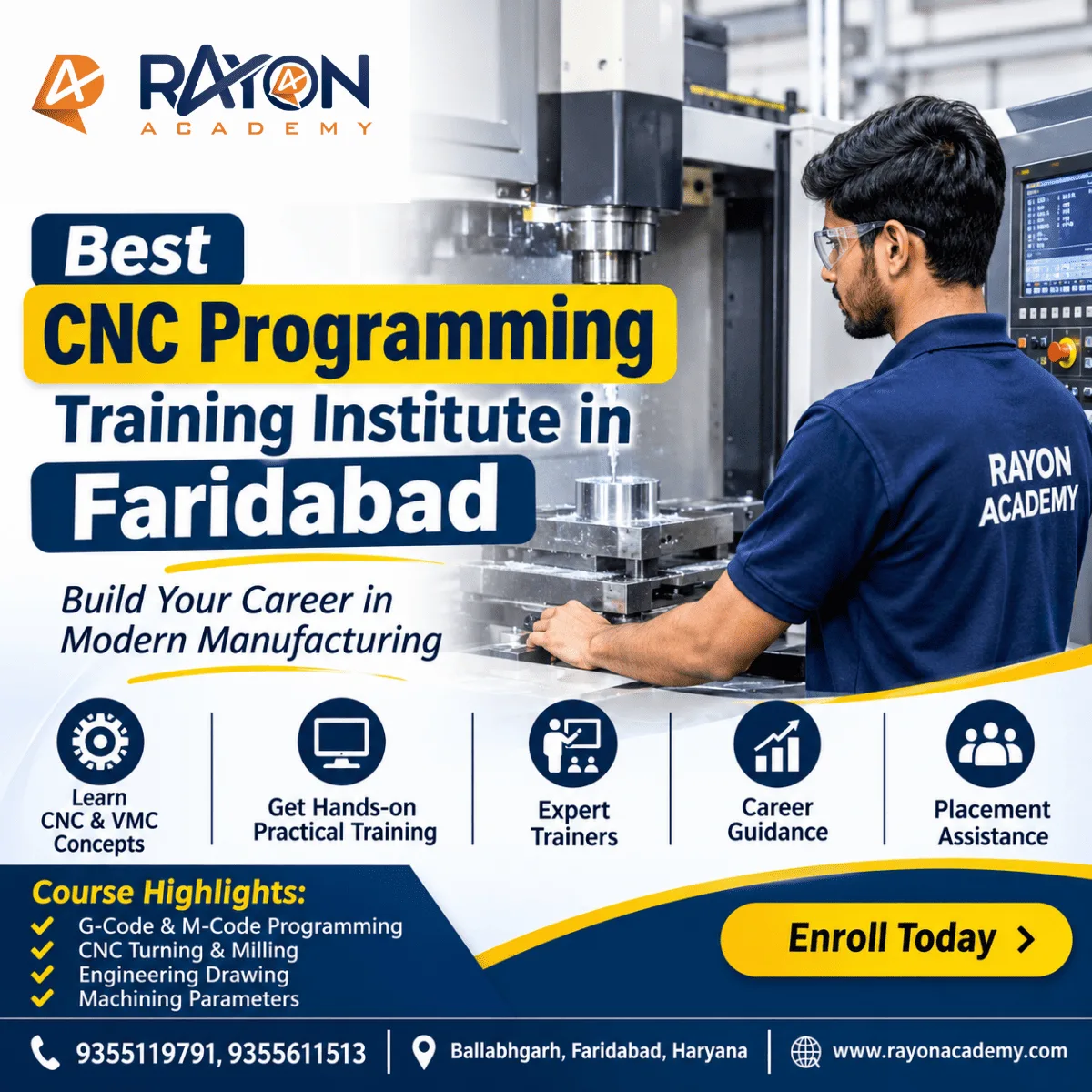
At Rayon Academy, learners can develop their understanding of important CNC and VMC concepts, including:
1. Introduction to CNC Machines: Learn about CNC machine components, working principles, different machine types, and their applications in manufacturing.
2. G-Code and M-Code: Understand the basic programming codes used to control machine movements, spindle operations, and other functions.
3. CNC Turning and Milling: Learn about turning, milling, drilling, and other machining operations used to manufacture different components.
4. Engineering Drawing Interpretation: Understand technical drawings, dimensions, measurements, and component specifications required for machining.
5. Cutting Tools and Machining Parameters: Learn about tool selection, spindle speed, feed rate, cutting depth, and tool offsets.
6. Machine Setup and Operations: Develop an understanding of workpiece positioning, tool setting, machine preparation,n and basic safety procedures.
These topics help students build a strong foundation and understand how CNC programming is applied in manufacturing.
Who Can Join a CNC Programming Course?
CNC programming suits students who want to develop technical skills in mechanical engineering and manufacturing.
The course can be useful for:
- Mechanical Engineering students and graduates
- Diploma and Polytechnic students
- ITI students from relevant technical trades
- Production Engineering students
- Freshers interested in manufacturing jobs
- Working professionals who want to improve their machining knowledge
Even students who are new to CNC technology can start with the basics. However, basic knowledge of mathematics and engineering drawings can make learning easier.
Career Opportunities After CNC Programming Training
After learning CNC programming, students can explore different job opportunities in manufacturing and engineering companies. The available positions depend on their qualifications, practical knowledge, and experience.
Some common job profiles include:
- CNC Programmer: Prepares and modifies programs according to machining requirements and engineering drawings.
- CNC Machine Operator: Operates CNC machines and monitors machining activities during production.
- CNC Setter: Sets up the machine, prepares the tools, and positions the workpiece.
- VMC Operator: Operates Vertical Machining Centre machines used for milling and other machining processes.
- Production Technician: Supports manufacturing operations and helps maintain production quality.
- CAD/CAM Assistant: Works with engineering drawings, component designs, and manufacturing-related data.
With experience and additional technical skills, professionals can gradually move towards more advanced responsibilities in the manufacturing sector.
Salary and Career Growth in the CNC Field
CNC salaries vary based on several factors, including qualifications, technical skills, work experience, job location, and company requirements.
Freshers usually start in entry-level roles such as CNC operator or production technician. As they gain experience in programming, machine setup, and machining operations, they can explore more specialized roles.
Learning advanced CNC programming and CAD/CAM software can also improve professionals’ career prospects.
How to Choose the Right CNC Programming Training Institute in Faridabad?
Choosing the right institute is an important part of learning any technical skill. Before enrolling, students should check whether the institute provides proper guidance and covers the concepts the industry requires.
Here are a few things to consider:
- Practical learning: Look for training that includes practical demonstrations and machining-related exercises.
- Experienced trainers: Learn from trainers who understand CNC programming and manufacturing processes.
- Updated course content: Make sure the syllabus covers G-Code, M-Code, machining parameters, and machine operations.
- Industry-related knowledge: Choose a course that explains how CNC technology is used in actual manufacturing environments.
- Career guidance: Check whether the institute provides interview preparation and placement assistance.
- Certification: Understand the course completion and certification details before enrolling.
These factors can help you make a better decision when selecting a CNC training institute.
Why Choose Rayon Academy?
Rayon Academy provides technical education that helps students build skills relevant to today’s job market. Its CNC/VMC training introduces learners to machining concepts, programming fundamentals, and manufacturing processes.
Students can benefit from industry-focused course content, trainer guidance, practical learning, technical assignments, interview preparation,n and placement assistance.
The aim is to help learners strengthen their technical understanding and prepare for opportunities in manufacturing and engineering.
Start Learning CNC Programming with Rayon Academy
CNC programming offers a learning path for students who are interested in machining, mechanical engineering, and modern manufacturing technology. With the right training, consistent practice, and technical guidance, learners can build the knowledge needed to enter this field.
If you are looking for a CNC Programming Training Institute in Faridabad, connect with Rayon Academy to learn more about its CNC/VMC training programs.
Contact Rayon Academy
Website: https://rayonacademy.com/courses/cnc-programming
Phone: 9355119791, 9355611513
Location: Ballabhgarh, Faridabad, Haryana