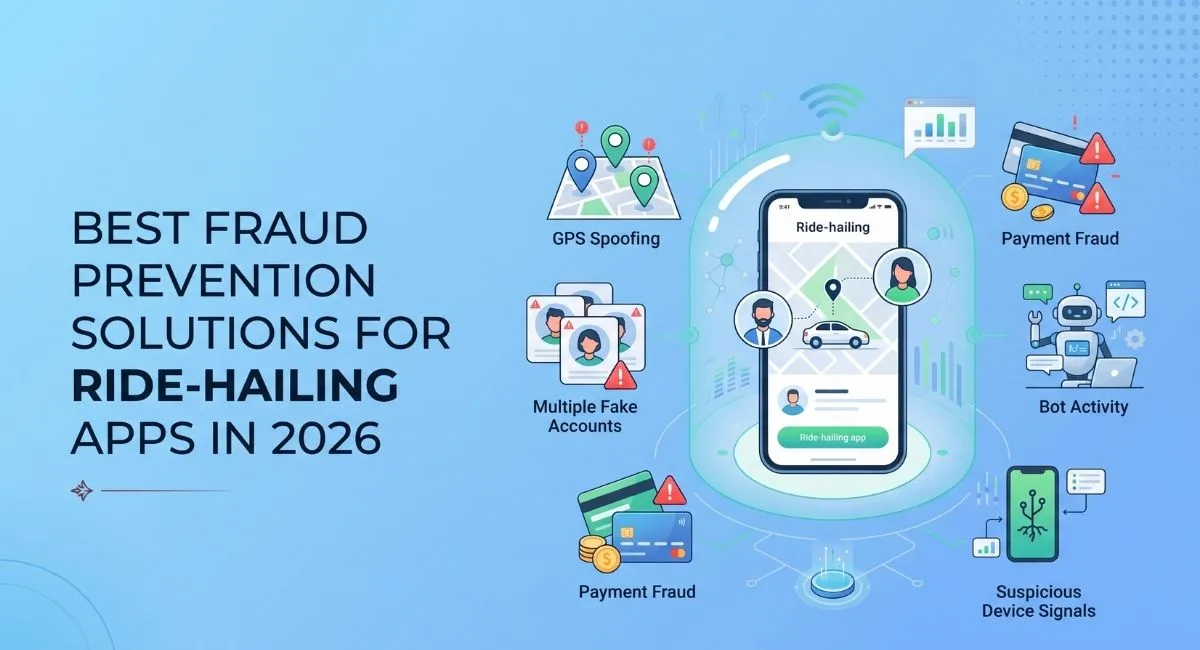
Ride-hailing fraud is no longer limited to stolen cards or suspicious transactions. Fraudsters can create multiple accounts, manipulate GPS locations, exploit promotions, take over legitimate accounts, or collude with drivers to abuse platform incentives.
For ride-hailing businesses, the challenge is identifying these threats without adding friction for genuine drivers and riders. This is where modern ride-hailing fraud prevention solutions come in, combining real-time risk signals, device intelligence, behavioral analytics, and other detection capabilities to identify suspicious activity across the user journey.
But with numerous fraud prevention providers available, how do you know which one fits a ride-hailing platform?
What to Look for in Ride-Hailing Fraud Prevention Solutions
The best solutions should go beyond transaction monitoring and provide visibility into the broader ecosystem. Key capabilities include:
- Real-time fraud detection to identify suspicious activity as it happens
- Device intelligence to detect repeat offenders, manipulated devices, and multi-accounting
- GPS spoofing detection to identify location manipulation
- Driver fraud detection and collusion monitoring
- Account takeover prevention across rider and driver accounts
- AI and behavioral analytics to identify unusual patterns
- Scalability across large user bases, geographies, and mobile environments
With these capabilities in mind, here are some of the leading fraud prevention solutions for ride-hailing apps in 2026.
1. SHIELD
SHIELD takes a device-first approach to fraud prevention, identifying the physical device behind user activity rather than relying solely on account, transaction, or behavioral signals.
Its SHIELD Device ID persistently identifies devices, while SHIELD Fraud Intelligence provides real-time signals that help platforms detect malicious tools and techniques across the user journey. The platform supports more than 20 risk indicators, including GPS spoofers, app cloners, emulators, VPNs, screen sharing, auto-clickers, and device manipulation.
Key Strengths
- Persistent device identification: Connects activity back to the underlying device, even when fraudsters attempt to manipulate the device environment.
- GPS spoofing detection: Helps identify location manipulation, a major concern for ride-hailing platforms.
- Multi-accounting detection: Links multiple accounts to the same physical device to uncover coordinated abuse.
- Real-time fraud intelligence: Identifies malicious tools and suspicious device behavior during active sessions.
- Driver-passenger collusion detection: Device-level intelligence can help uncover relationships between accounts and devices involved in coordinated abuse.
- Global Intelligence Network: SHIELD’s GIN continuously updates with fraud patterns and malicious techniques observed across markets. It covers 231+ countries and screens 1.5B+ devices and 5B+ activities annually.
Best for:
Ride-hailing and mobility platforms dealing with GPS spoofing, multi-accounting, promo abuse, account takeovers, driver-passenger collusion, and other device-enabled fraud.
2. DoveRunner
DoveRunner is primarily positioned around mobile application security, including protections against app tampering, code hooking, repackaging, and other forms of application manipulation. Its threat detection capabilities can help identify compromised or manipulated mobile environments that may be used to facilitate fraud.
Best for: Ride-hailing apps concerned with mobile app integrity, tampering, and compromised application environments as part of their broader fraud defenses.
3. BioCatch
BioCatch focuses on behavioral biometrics, analyzing how users interact with digital services to identify behavioral patterns associated with fraud. Its platform provides visibility into session activity and behavioral anomalies and can support decisions around suspicious transactions and account activity.
Best for: Platforms prioritizing behavioral analytics for account takeover, social engineering, and suspicious user-session detection.
4. Shufti Pro
Shufti Pro combines identity verification with fraud prevention capabilities across onboarding and ongoing user activity. Its current fraud platform includes device fingerprinting, behavioral signals, biometric verification, and checks for threats such as synthetic identities, account takeover, multi-accounting, and promo abuse.
Best for: Mobility platforms that want to combine identity verification and fraud prevention, particularly during driver or rider onboarding.
5. Kount
Kount provides AI-driven fraud prevention and identity protection across areas such as payments, account creation, and account protection. Its technology combines device data, transaction information, machine learning, and network intelligence to generate risk assessments and support configurable fraud policies.
Best for: Ride-hailing platforms looking for broader transaction and account-level fraud screening with device and identity signals.
6. SpyCloud
SpyCloud takes an identity-exposure approach to fraud prevention. It uses intelligence from compromised credentials, session cookies, and other exposed identity data to help businesses identify users at risk of account takeover and take actions such as step-up authentication or session remediation.
Best for: Ride-hailing companies looking to strengthen account takeover prevention by identifying compromised customer identities before they are exploited.
7. Ping Identity
Ping Identity provides identity and access management capabilities, including identity verification through PingOne Verify. Its verification flow uses government-issued IDs, selfie matching, liveness detection, and deepfake detection to establish that a user is who they claim to be during onboarding or higher-risk actions.
Best for: Ride-hailing platforms that need stronger identity verification and authentication for drivers, riders, onboarding, or high-risk account actions.
8. CredoLab
CredoLab combines device and behavioral metadata with machine learning to generate risk and fraud insights. Its capabilities include identifying suspicious devices, device-account linkages, anomalies, and velocity patterns, with integrations available across mobile and web environments.
Best for: Platforms looking to add device and behavioral risk signals to existing fraud or decisioning models.
9. Riskified
Riskified is primarily focused on eCommerce risk management, with products covering payment fraud, account protection, policy abuse, and chargebacks. Its platform uses transaction, device, and behavioral data to support automated risk decisions.
Best for: Ride-hailing businesses looking to strengthen payment, account, and policy-abuse controls, particularly where transaction risk is a major concern.
10. SkyLight
SkyLight, from Euronet, provides a broader fraud and financial-crime platform covering real-time fraud detection, transaction monitoring, customer risk rating, and case management. Its fraud capabilities use behavioral analysis, device and transaction signals, rules, and network intelligence to identify suspicious activity.
Best for: Ride-hailing businesses with significant payment or transaction risk that also need broader fraud, AML, and investigation capabilities.
How to Choose the Right Fraud Prevention Solution for a Ride-Hailing App
The right solution depends on where fraud is occurring and how much visibility the platform has into the underlying activity.
For example, payment-focused fraud prevention can help address stolen payment methods and transaction abuse, while identity solutions can strengthen onboarding. Behavioral analytics can help detect unusual account activity.
But ride-hailing fraud often extends beyond any single checkpoint. A rider or driver may appear legitimate during registration and later activate a GPS spoofer, create additional accounts, exploit promotions, or participate in coordinated abuse.
That makes device-level visibility and continuous fraud intelligence increasingly important. By connecting activity to the device behind it and analyzing risk throughout the user journey, platforms can move from reacting to individual incidents toward identifying fraud at its source.
For ride-hailing businesses evaluating fraud prevention for ride-hailing apps, the strongest approach is therefore one that combines identity, behavioral, transaction, and device intelligence—while remaining scalable enough to protect the platform as it grows.
FAQs
1. What are the most common types of fraud in ride-hailing apps?
Common threats include GPS spoofing, multi-accounting, promo abuse, account takeover, payment fraud, and driver-passenger collusion.
2. How can ride-hailing apps prevent fraud?
Ride-hailing apps can combine device intelligence, real-time fraud detection, behavioral analytics, identity verification, and transaction monitoring to detect and prevent fraud across the user journey.
3. How does device intelligence help prevent ride-hailing fraud?
Device intelligence links activity to the underlying device, helping platforms identify repeat offenders, fake accounts, GPS spoofing, malicious tools, and coordinated fraud beyond what account-level signals can reveal.
4. What is the best fraud prevention solution for ride-hailing apps?
The best solution depends on the platform’s fraud exposure, but an effective solution should provide real-time detection, device-level visibility, scalable intelligence, and coverage across multiple fraud types.
5. Why is real-time fraud detection important for ride-hailing platforms?
Fraud can occur during an active ride or user session, so real-time detection helps platforms identify suspicious behavior as it happens and respond before losses escalate.
6. How can ride-hailing companies detect GPS spoofing?
Platforms can use device intelligence and real-time risk signals to identify manipulated location behavior and detect GPS spoofing alongside other suspicious device or account activity.