
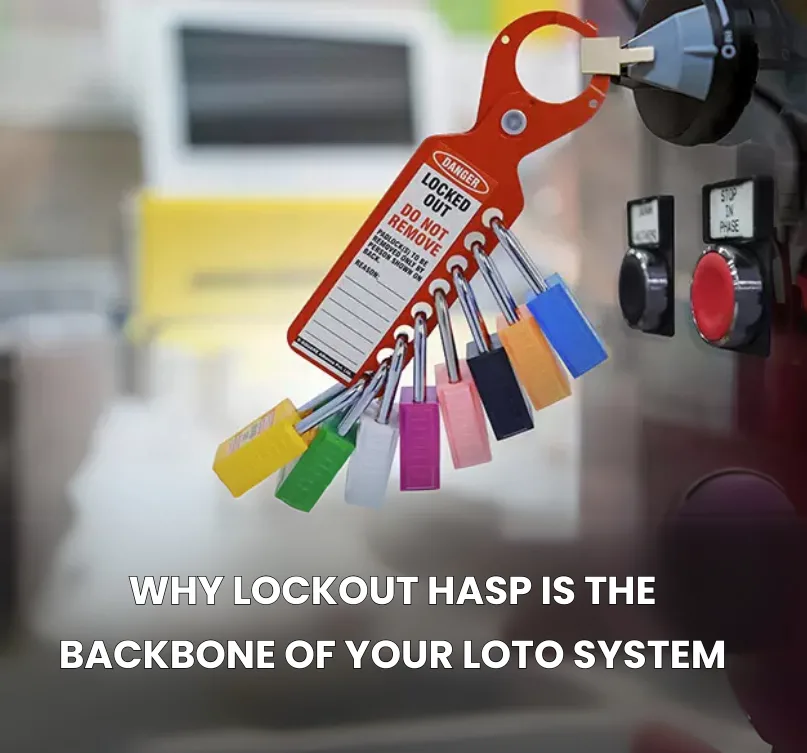
When industrial safety professionals discuss Lockout Tagout, the conversation almost inevitably gravitates toward the padlock. It is the most visible symbol of safety - a bright, red badge of authority clamped onto a switch or a valve. However, while the padlock serves as the lock, it is rarely the complete solution. In the complex reality of a modern plant, where multiple technicians, contractors, and departments often converge on a single piece of equipment, the true structural backbone of your LOTO system isn't the lock itself; it is the Lockout Safety Hasp.
To view the hasp merely as a metal accessory is to fundamentally misunderstand its role. The hasp is the mechanical "OR" gate of industrial safety. It is the device that enables group coordination, ensures individual accountability, and bridges the gap between a single energy point and a collaborative work environment.
The Anatomy of Coordination:
In a solo repair scenario, one padlock on one isolation point is sufficient. But maintenance is rarely a solo endeavor. Imagine a massive conveyor system overhaul: an electrician is working on the motor, a mechanic is replacing a belt, and a supervisor is inspecting the alignment. If each worker tried to attach their individual padlock directly to the breaker handle, they would quickly run out of space.
This is where lockout hasp becomes indispensable. By expanding a single isolation point into a multi-hole gateway, the hasp allows every person on the job to apply their own padlock. The mechanical beauty of this is absolute: the energy source remains neutralized as long as any one of those locks remains in place. It transforms a chaotic, uncoordinated attempt at lockout into a disciplined, multi-layered defense.
Individual Accountability: The Hasp’s True Power
The greatest threat to safety in a group setting is the "assumed" lockout - the belief that because someone else has secured the machine, it is safe to work. The hasp eliminates this ambiguity by enforcing the "One Person, One Lock, One Key" standard.
When every worker holds their own key and possesses their own lock on the common hasp, they own their safety. They are not relying on a supervisor’s word; they have physical, tangible proof that their specific work zone is protected. If you see a hasp with four locks on it, you know exactly who is in the machine. It removes the guesswork and, more importantly, removes the possibility of a "false start" where a well-meaning but uninformed worker removes a lock that isn't theirs.
Choosing the Right Backbone:
Because the hasp is the structural foundation of the group lockout, it must be selected with the same rigor as the padlock. A weak or inappropriate hasp can become the "weakest link" in your safety chain.
- For General Mechanical Work: steel lockout hasps are the standard. Their durability ensures they can withstand the vibrations and physical stressors of a busy shop floor.
- For Electrical Hazards: Dielectric (non-conductive) hasps are a non-negotiable requirement. Using a steel hasp in a high-voltage panel is a recipe for an arc flash accident. Nylon or insulated hasps provide the necessary barrier to keep the technician and the electrical system separate.
- For Combustible Environments: In refineries or chemical plants, spark-resistant aluminum hasps prevent the "mechanical spark" that could turn a routine maintenance task into a site-wide emergency.
The Hasp as a "Systematic" Tool
Beyond the physical hardware, the hasp acts as a management tool. It allows safety managers to implement color-coding strategies that provide instant visual cues. By assigning specific hasp colors to different departments - such as red for maintenance and yellow for outside contractors, you can identify the status of an area from across the room.
Pro Tip: Never underestimate the importance of the "full-close" check. A hasp is only as effective as its alignment. If the holes do not align perfectly, the device is compromised. Train your team to treat the "click" of the hasp as the audible confirmation that their safety perimeter is fully sealed.
Conclusion: The Foundation of Safety
We often praise the padlock for its role in Lockout Tagout, but it is the hasp that holds the structure together. Lockout hasp is the unsung hero that allows complex, multi-trade teams to work with absolute confidence in their security.
By positioning the hasp as the backbone of your LOTO system, you move away from viewing safety as a collection of individual locks and start seeing it as a cohesive, coordinated system. When the hasp is managed correctly, the work gets done, but more importantly, everyone goes home the same way they arrived.