
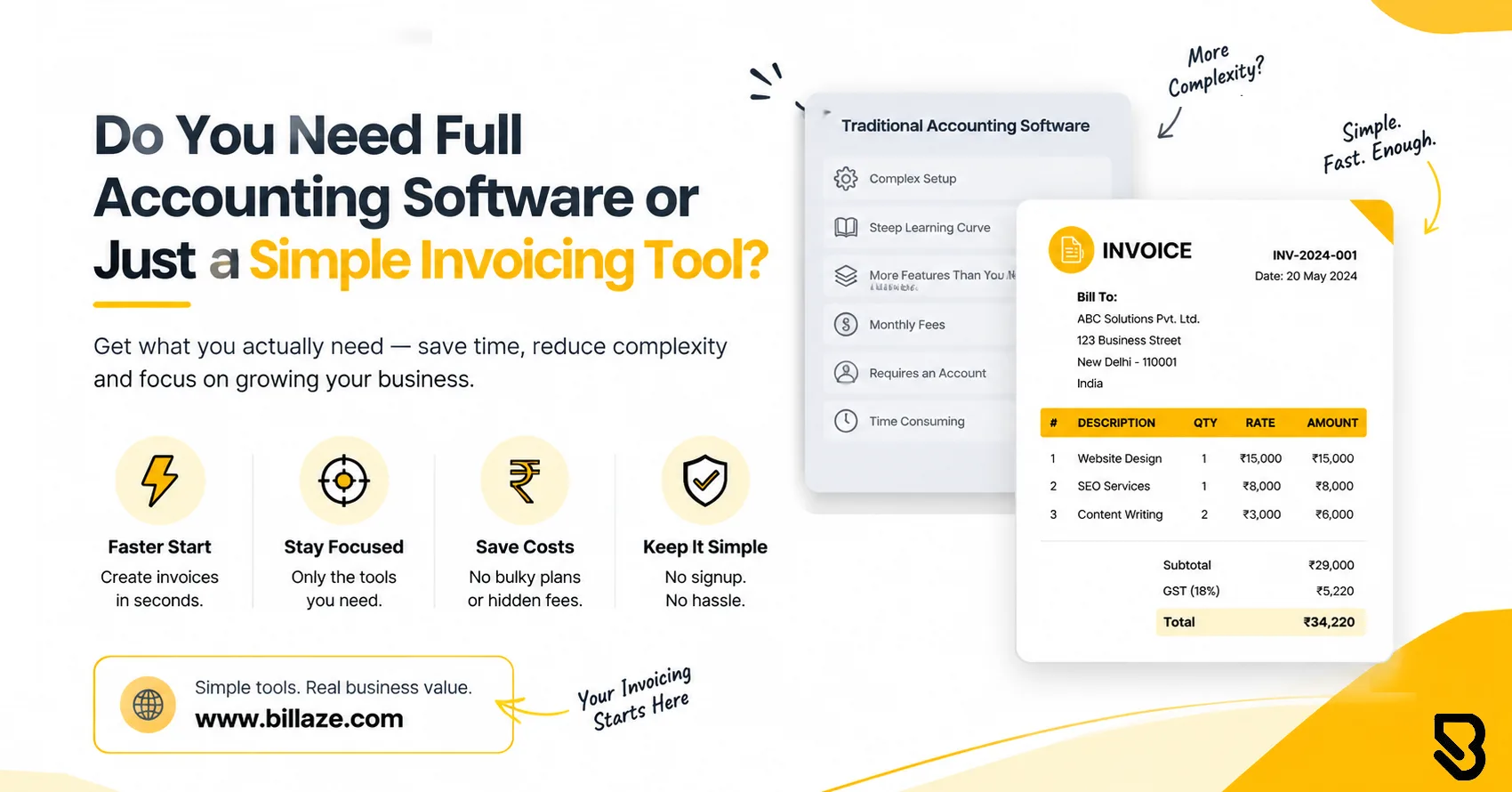
A surprising number of small businesses sign up for full accounting software when what they actually needed was a way to send a clean invoice. It's an easy mistake to make, since accounting software is heavily marketed, and it's not obvious upfront that most of its features will go unused. Here's a straightforward way to tell which one you actually need.
What Full Accounting Software Is Built For
Platforms like this are designed around a broader financial picture: expense tracking, bank reconciliation, payroll, multi-user access with permission levels, inventory management, and detailed financial reporting for accountants or investors. If your business genuinely needs several of these, this category earns its complexity and its subscription cost.
What a Simple Invoicing Tool Is Built For
A simple free invoice generator does one job: take the details of what you're billing for and turn them into a clean, professional, downloadable invoice. No inventory sync, no payroll module, no financial dashboard you'll never open. For a business whose actual need is billing clients accurately and getting paid, this is usually a better fit, not because it does less, but because it doesn't ask you to manage things you don't need managed.
A Simple Test to Figure Out Which One You Need
Ask yourself honestly: in the last three months, did you need to track inventory levels, manage payroll, give a team member restricted financial access, or generate a P&L report? If the answer is no across the board, a simple invoicing tool likely covers everything you actually do, and the rest of an accounting suite is overhead you're paying for but not using.
If you answered yes to even one or two of those, it's worth evaluating whether a lightweight accounting tool, not necessarily the most complex one, fits better than either extreme.
The Cost of Over-Tooling
Beyond the subscription price, there's a real cost to using software that's more complex than your actual workflow: more fields to fill in per invoice, a steeper learning curve for anyone else who needs to send a bill, and more places for something to go wrong. A tool that matches the size of your actual problem tends to get used consistently; one that overshoots it tends to get abandoned in favor of workarounds.
Billaze's free billing tools are built specifically for the case where you mostly just need to bill clients accurately, without the overhead of a full accounting suite you'd only use a fraction of.