A box cutter may be one of the simplest tools used in a warehouse, factory, or distribution centre, but it can also become a significant workplace hazard when designed or used poorly. Traditional utility knives with exposed blades rely heavily on workers to control blade exposure and retract the blade after every cut.
Modern box cutter knife innovations are changing that approach. Instead of relying solely on user behaviour, manufacturers are incorporating automatic blade retraction, concealed blades, ergonomic handles, controlled cutting depths and safer blade-changing mechanisms.
These developments are helping businesses make everyday cutting tasks safer while maintaining the speed and precision required in industrial environments.
Why Industrial Box Cutter Safety Matters
Opening cartons, cutting packaging tape, trimming plastic film and breaking down boxes are routine tasks across warehouses, logistics operations, manufacturing facilities and retail environments.
The repetitive nature of these jobs can increase exposure to cutting hazards. A worker may perform hundreds of cuts during a shift, making even a small safety improvement valuable over time.
Modern safety knives aim to reduce the opportunity for accidental contact with the blade. For example, automatic and self-retracting mechanisms can return the blade to the handle when the cutting action ends or contact with the material is lost.
This represents an important shift in workplace safety: rather than depending entirely on workers remembering to retract a blade, the tool itself provides an additional safety control.
1. Automatic Blade Retraction
One of the most important innovations in modern box cutters is automatic blade retraction.
Traditional retractable knives require the user to manually move the blade back into the handle. Auto-retracting designs use a spring mechanism so that the blade returns automatically when the user releases the activation mechanism.
More advanced self-retracting designs can go a step further. The blade can retract when it loses contact with the cutting surface, even if the user continues to hold the slider.
This can help reduce accidental exposure when:
- A cut finish unexpectedly
- The knife slips from the material
- The worker moves between cuts
- The tool is being put down
- The worker loses control of the cutting motion
For high-volume warehouse and packaging operations, this technology can provide an additional layer of protection.
2. Concealed Blade Technology
Another major development is the concealed blade safety knife.
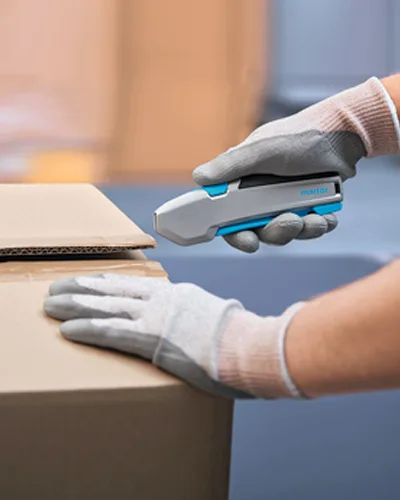
Instead of exposing a traditional cutting edge, concealed-blade cutters shield the blade inside the housing. Only the portion required to cut the packaging material is accessible.
This design is particularly useful for tasks involving cardboard, plastic film, shrink wrap, tape and similar packaging materials.
MARTOR, for example, describes concealed-blade safety knives as designs where the blade is shielded so that both the operator and packaged goods are protected from direct blade contact.
The advantage is straightforward: less exposed blade means less opportunity for accidental contact.
For workplaces were large numbers of employees repeatedly open cartons, concealed-blade cutters can therefore be an important part of a broader cutting-safety strategy.
3. Smarter Retraction Systems
Not every retractable knife offers the same level of protection.
Modern products increasingly use different retraction systems, including:
- Manual retraction: The user controls when the blade extends and retracts.
- Automatic retraction: The blade retracts when the activation mechanism is released.
- Smart or self-retraction: The blade retracts when contact with the cutting material is lost.
This progression is important because it reduces dependence on memory and consistent user behaviour.
For example, a smart-retracting mechanism can keep the blade exposed only while it is actively engaged with the material being cut.
Businesses can select the appropriate technology according to the cutting task, risk profile and workplace requirements.
4. Controlled Blade Depth
Another useful innovation is adjustable blade depth.
A conventional blade can potentially penetrate too deeply into a carton, putting the contents at risk or increasing the chance of accidental contact with the blade.
Modern industrial safety knives can provide multiple blade-depth settings. Some products offer settings designed to control how far the cutting edge extends into the packaging.
This provides two important benefits:
Protecting the product: A controlled cutting depth can reduce the chance of damaging goods inside packaging.
Improving operator safety: Limiting unnecessary blade exposure can reduce the amount of exposed cutting edge during the task.
For warehouses handling valuable, fragile or tightly packed products, controlled blade depth can therefore contribute to both safety and quality control.
5. Ergonomic Designs Reduce User Strain
Safety is not limited to the blade itself. The handle and overall design of a box cutter can influence how comfortably and securely workers perform repetitive tasks.
Modern industrial knives increasingly incorporate:
- Non-slip grips
- Contoured handles
- Angled designs
- Ambidextrous operation
- Lightweight construction
- Improved trigger or slider mechanisms
These features can help workers maintain better control during repetitive cutting tasks.
For example, current safety utility knife designs incorporate ergonomic grips and angled bodies to improve handling and reduce strain.
A knife that is difficult to hold or requires excessive force can contribute to fatigue and poor cutting technique. Ergonomic design therefore complements blade safety rather than replacing it.
6. Safer Blade Replacement
Changing blades can introduce another hazard into the workplace.
Traditional utility knives may require workers to open the housing and physically handle a sharp replacement blade. Modern designs increasingly focus on tool-free or safer blade-changing systems.
Some industrial knives provide quick-release mechanisms, while others use protected blade-changing systems that reduce direct contact with the cutting edge.
This is an important consideration when choosing a box cutter for high-volume industrial use. A knife may have excellent safety features during normal operation, but blade replacement should also be included in the workplace risk assessment.
7. Right- and Left-Handed Designs
Another innovation is greater attention to user accessibility.
Ambidextrous safety knives allow both right- and left-handed workers to use the same tool without compromising grip or cutting position. Some modern industrial safety knives are specifically designed for both hand orientations.
This can simplify workplace tool selection and ensure that employees can use equipment in a way that feels natural and controlled.
8. Sustainability Is Entering Safety Knife Design
Safety knife innovation is also moving beyond workplace protection.
Manufacturers are increasingly considering the materials used to produce handles and components. Some newer products incorporate recycled materials while maintaining the durability required for industrial applications.
MARTOR Australia, for example, highlights safety knives incorporating recycled plastic as part of its product development.
For businesses with environmental procurement targets, the next generation of industrial cutting tools may therefore contribute to both workplace safety and sustainability objectives.
Choosing the Right Box Cutter for Industrial Use
The safest box cutter is not necessarily the one with the most features. It is the one that matches the specific cutting application and workplace risk.
Before selecting a safety knife, businesses should consider:
- What materials need to be cut?
- How frequently will workers use the knife?
- How much blade exposure is actually required?
- Is automatic retraction appropriate?
- Would a concealed blade work for the application?
- Does the knife offer sufficient grip?
- Can the blade depth be controlled?
- How are replacement blades changed?
- Can both right- and left-handed workers use it?
- Does the tool suit the workplace's existing safety procedures?
A packaging warehouse may benefit from a concealed-blade or self-retracting cutter, while heavier industrial applications may require a different knife design.
The Future of Industrial Cutting Safety
The evolution of the box cutter demonstrates how relatively simple hand tools can become sophisticated safety products.
Automatic retraction, smart-retracting mechanisms, concealed blades, adjustable cutting depths, ergonomic handles and safer blade-changing systems are helping shift industrial cutting from user-dependent safety to tool-assisted safety.
However, technology should complement—not replace—proper workplace training, risk assessments, appropriate PPE and safe operating procedures.
For businesses, the goal should be to select cutting tools that make the safest action the easiest action.
Conclusion
Box cutter knife innovations are transforming industrial safety by reducing unnecessary blade exposure and improving control during repetitive cutting tasks. Features such as automatic retraction, concealed blades, adjustable depth, and ergonomic designs can help businesses create safer and more efficient cutting processes.
As warehouses, manufacturing facilities and logistics operations continue to prioritise workplace safety, choosing the right industrial safety knife can become an important part of a broader risk-management strategy.
The best approach is to assess the cutting task first, identify the associated hazards and then select a box cutter designed specifically to minimise those risks.
Frequently Asked Questions
Are safety box cutters safer than traditional utility knives?
Safety box cutters are designed to minimise blade exposure through features such as automatic retraction or concealed blades. The appropriate choice depends on the cutting application and workplace risk assessment.
What is an auto-retracting box cutter?
An auto-retracting box cutter automatically pulls the blade back into the handle when the activation mechanism is released. Some advanced designs retract when contact with the cutting material is lost.
What is a concealed-blade safety knife?
It is a cutter where the blade is shielded within the tool, limiting direct access to the cutting edge while allowing packaging materials to be cut.
What should businesses consider when choosing an industrial box cutter?
Consider the material being cut, frequency of use, required blade exposure, retraction mechanism, ergonomics, blade-changing method, and the workplace's safety requirements.
Can an ergonomic box cutter improve workplace safety?
Ergonomic features can improve grip and control and may help reduce strain during repetitive cutting tasks. They should be considered alongside appropriate blade-safety mechanisms.