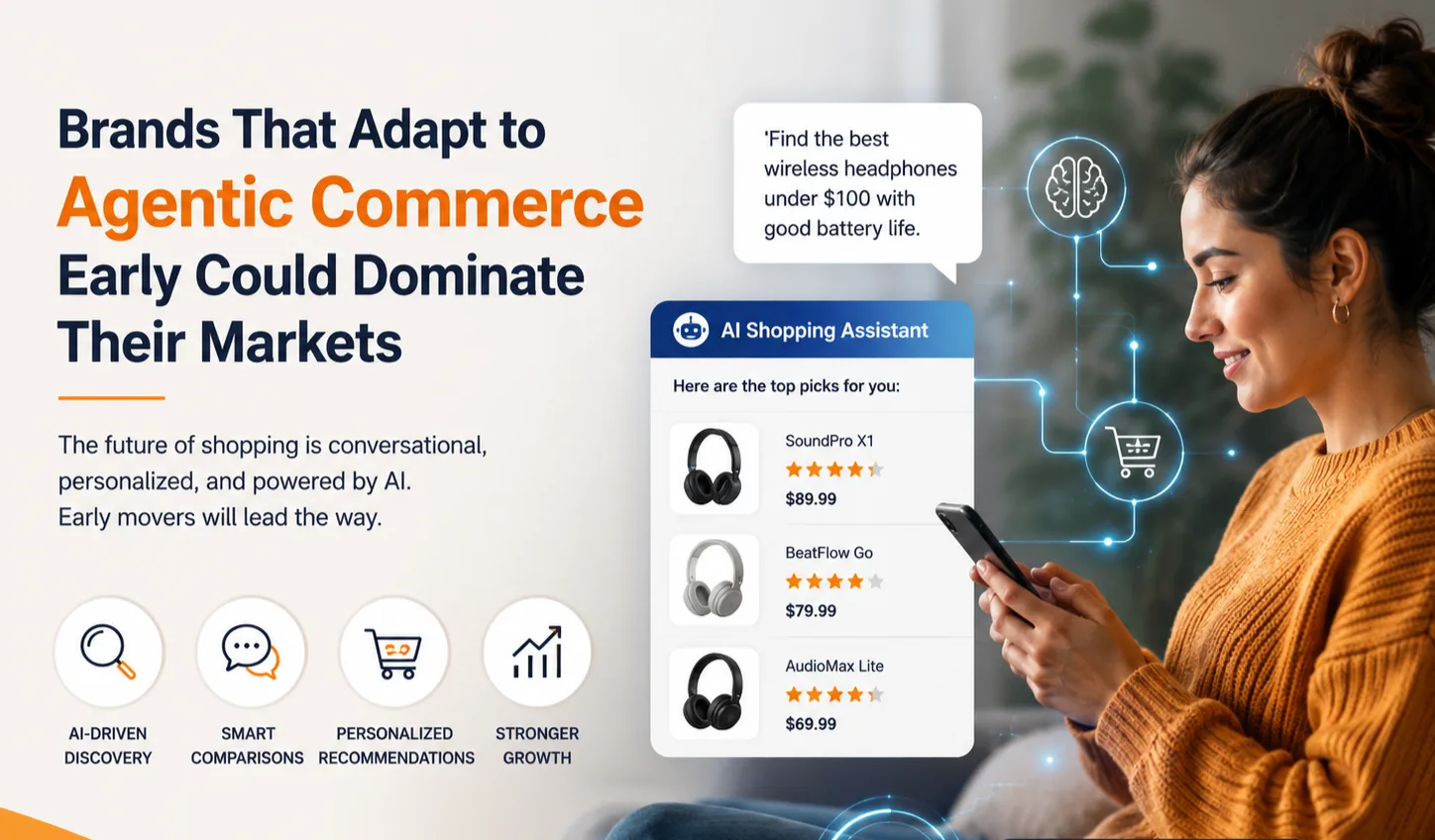
The way people shop online is changing as AI helps them research, compare, and choose products. SEO and advertising still matter, but Agentic Commerce is creating a new path to purchase. Brands that improve product data and AI visibility early could gain an edge as shopping becomes more agent-driven
Agentic Commerce refers to a shopping environment where AI agents can understand a customer's requirements, evaluate available products, compare different options, and help move the shopper toward a purchase. Instead of asking consumers to search through dozens of product pages, AI can potentially narrow the choices based on factors such as price, features, preferences, compatibility, reviews, and specific use cases. For brands, this introduces a new question that goes beyond traditional SEO: will an AI system understand and recommend your product when a shopper asks for a solution?
Why Agentic Commerce Could Change Product Discovery
Traditional eCommerce is built around the idea that shoppers actively search for products and visit websites or marketplaces to compare them. A customer might search Google, open several pages, read reviews, compare specifications, and eventually make a purchase. Agentic Commerce can simplify much of this process because AI can interpret the shopper's intent and help evaluate products on their behalf.
Imagine a customer saying, "I need a lightweight laptop for video editing under $1,000 with good battery life." Instead of manually searching through multiple websites, the customer could receive a shortlist of products that match those requirements. The products that appear in that shortlist will not necessarily be the ones with the most aggressive advertising. They are more likely to be the products that AI can understand, evaluate, and match to the customer's specific needs.
That creates a significant opportunity for brands. Product visibility will increasingly depend not only on where a product ranks, but also on whether AI systems have enough reliable information to determine when that product is relevant.
Early Adopters Could Gain an Advantage
Markets often reward companies that prepare for major changes before those changes become mainstream. The same principle could apply to Agentic Commerce. Brands that begin improving their product information now have more time to test, learn, and refine their approach while competitors are still relying primarily on traditional eCommerce strategies.
Many product catalogs contain basic information such as titles, descriptions, prices, images, and specifications, but shoppers often need much more information before making a decision. They may want to know whether a product is suitable for a particular use case, how it compares with another product, what limitations it has, whether it works with something they already own, or which type of customer it is best suited for.
AI needs that same context to make useful recommendations. A brand that provides detailed, accurate, and structured product information gives AI more material to work with. Over time, that could become a competitive advantage, particularly in categories where product comparisons are complex.
Product Data Could Become a Competitive Advantage
Product data is often treated as operational information that exists mainly to keep an eCommerce website running. In an AI-driven shopping environment, its role could become much more important. Product data may increasingly determine how effectively AI understands a catalog and matches individual products with shopper intent.
Consider a product description that says, "High-performance running shoes with advanced cushioning." It communicates a general benefit but leaves many questions unanswered. A more useful product record might explain the intended running surface, cushioning level, shoe weight, fit, durability, ideal user, weather suitability, and the type of running it supports.
The additional information gives AI a clearer picture of the product. It also helps shoppers make better decisions. This is an important point about Agentic Commerce: making product information more useful for machines often makes it more useful for humans as well.
Ranking Is Not the Same as Being Recommended
One of the biggest changes introduced by AI shopping could be the difference between ranking and recommendation. Traditional SEO is largely focused on helping a page appear for relevant searches. Agentic Commerce introduces a more specific challenge because an AI system may need to decide which products best satisfy an individual's requirements.
A product can rank highly for a broad keyword and still fail to become a recommendation if the available information does not clearly explain why it is suitable for a particular shopper. AI may consider several signals, including product attributes, specifications, reviews, pricing, availability, use cases, and the customer's stated preferences.
This means brands need to think beyond keyword optimization. They should consider whether their product information answers the questions that an AI shopping agent would need to evaluate the product accurately. Strong visibility in traditional search can still matter, but it may become only one part of a much larger product discovery ecosystem.
Customer Questions Should Become Part of Your Product Strategy
One of the most practical ways to prepare for Agentic Commerce is to understand the questions customers are already asking. Product reviews, customer support conversations, search queries, sales conversations, and product Q&A sections can reveal exactly what shoppers need to know before purchasing.
For example, someone buying skincare might want to know whether a product is suitable for oily or sensitive skin. A customer buying electronics may want to know whether a device is compatible with a particular operating system. Someone buying furniture may want information about room size, assembly, materials, or maintenance.
When these questions remain unanswered, AI may have less confidence in evaluating the product. When brands address them directly and consistently, they create richer product content that can support both human shoppers and AI systems.
Reviews Can Provide Valuable Product Context
Reviews have always influenced eCommerce purchasing decisions, but their importance could increase as AI systems become better at analyzing large volumes of customer feedback. Reviews can reveal how products perform in real-world situations and what customers consistently like or dislike about them.
A brand should therefore look at reviews as more than a collection of ratings. Repeated comments about comfort, durability, ease of installation, battery performance, sizing, or product quality can reveal useful patterns that may not appear in the official product description.
These insights can help brands identify content gaps and improve how products are positioned. They can also help ensure that product claims reflect real customer experiences rather than relying entirely on generic marketing language.
Structured Product Information Matters
AI systems need information that can be understood and connected across different fields and attributes. That makes structured and consistent product information increasingly important as AI becomes more involved in shopping.
Brands should avoid hiding critical specifications inside long blocks of promotional copy. Important information such as dimensions, materials, compatibility, ingredients, capacity, technical specifications, warranties, product benefits, and intended use should be clearly presented and consistently maintained.
This is also where Agentic Commerce Optimization, or ACO, becomes relevant. ACO focuses on making product information more useful for AI-driven discovery by improving information sufficiency, consistency, structure, and agent indexability. The goal is not simply to make a product page look better. It is to make the product easier for AI systems to understand, evaluate, and potentially recommend.
Brands Should Not Wait for AI Shopping to Become Mainstream
A common approach in digital marketing is to wait until a new channel becomes proven before investing in it. That strategy can make sense when resources are limited, but it can also mean entering a market after competitors have already built an advantage.
Agentic Commerce is still developing, which gives brands an opportunity to experiment before the market becomes crowded. Companies can start by improving their most important product pages, analyzing customer questions, strengthening product attributes, and making their catalog information more consistent.
This does not require rebuilding an entire eCommerce operation overnight. A focused approach can begin with a small group of high-value products and expand as the brand learns what works.
Preparation Should Start With the Product Catalog
Brands that want to prepare for Agentic Commerce should begin by reviewing their products from the perspective of an AI shopping assistant. The objective is to determine whether the available information is sufficient for an AI system to understand the product and decide whether it matches a shopper's requirements.
A useful audit should examine whether each product clearly communicates its purpose, benefits, specifications, use cases, limitations, compatibility, and target customer. It should also identify whether important attributes are structured consistently and whether common questions are answered without requiring the shopper to search across multiple pages.
The process can uncover surprisingly simple gaps. Sometimes the product itself is strong, but the available information makes it difficult to understand why it is a good choice. Improving that information can strengthen the overall product experience while also making the catalog more useful in AI-driven environments.
The Opportunity Is Bigger Than Another Marketing Channel
Agentic Commerce should not be viewed simply as another place where brands need to promote their products. It represents a potential change in how consumers discover, compare, and evaluate products online.
In traditional eCommerce, brands compete heavily for visibility on search engines, marketplaces, social platforms, and advertising channels. In an agentic shopping environment, they may increasingly compete to become the product that an AI system believes is the best answer to a customer's needs.
That is a different type of competition. It places greater importance on accurate product information, clear differentiation, comprehensive attributes, trustworthy reviews, and the ability to match products to specific shopper intent.
Early Preparation Could Shape Future Market Leaders
The brands that benefit most from Agentic Commerce may not be those with the biggest advertising budgets, but those that make their products easiest for AI to understand and recommend.
By preparing early, brands can improve product data, close content gaps, strengthen product pages, and better understand customer intent. Enaiblex helps brands prepare for this shift by optimizing eCommerce content for AI-driven shopping experiences.
As AI becomes more involved in purchasing decisions, being online may no longer be enough. Products must be understandable, relevant, and easy for AI to match with the right customers. Brands that adapt early can gain an advantage as Agentic Commerce grows.