
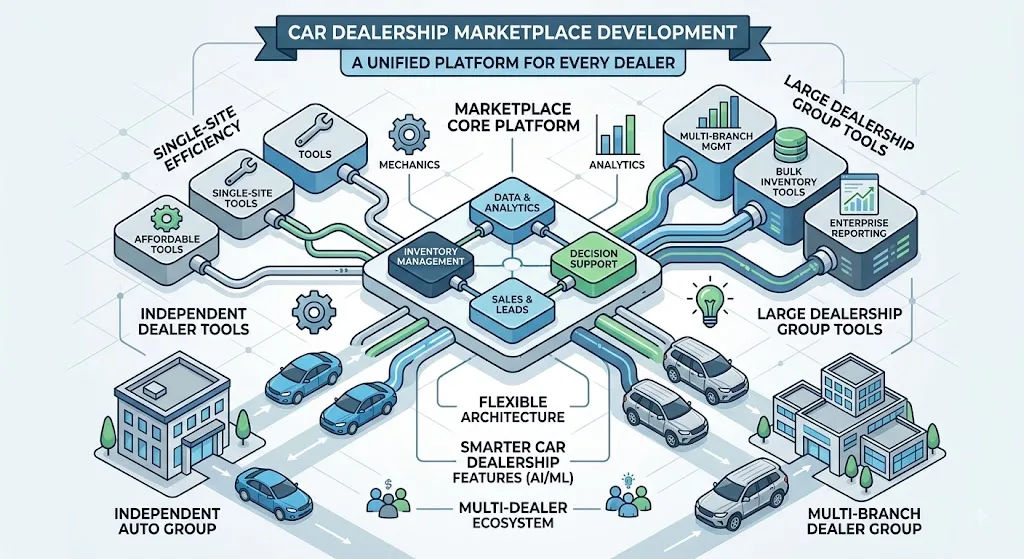
A multi-dealer car marketplace brings together businesses with very different operational needs. An independent dealership may have a small team, a limited inventory, and only one location, while a large dealership group may manage hundreds or thousands of vehicles across multiple branches with separate sales, inventory, and management teams.
Creating a marketplace that serves both types of businesses is therefore more complicated than simply giving every dealer the same dashboard and listing tools. A successful platform needs to be flexible enough to support smaller dealerships without overwhelming them, while also providing the advanced capabilities required by larger automotive groups.
This balance matters because a marketplace becomes more valuable when it can attract a diverse network of dealerships. Independent dealers bring unique inventory and local market knowledge, while larger groups can contribute significant inventory volume and established operations. Buyers benefit from having access to both.
The challenge is creating a platform where each dealership can operate efficiently without compromising the experience for buyers or creating unnecessary complexity for the marketplace operator.
In this article, we'll explore how to build a car marketplace that works for both independent dealerships and large dealership groups, from account management and inventory handling to lead management, technology, visibility, and long-term growth.
1. Understanding the Needs of Different Dealerships
The first step in building a flexible marketplace is understanding that dealerships do not operate in the same way. Their size, inventory, staffing, technology, and sales processes can vary significantly.
A platform designed around the assumption that every dealership has identical requirements can quickly become frustrating for both small and large businesses.
Independent Dealerships
Independent dealerships often operate with smaller teams and more limited resources. A dealer may have only a few employees handling sales, inventory, customer communication, and administration.
For these businesses, simplicity is extremely important.
They may not need an elaborate enterprise workflow with dozens of user roles and complicated reporting screens. Instead, they need a straightforward way to register, upload vehicles, manage listings, respond to inquiries, and monitor leads.
Inventory management is also usually more manageable in terms of volume, which means manual listing tools or simple upload capabilities may be sufficient during the early stages. Visibility is another major consideration. Independent dealers often compete with much larger dealerships that have bigger advertising budgets and significantly more inventory. A marketplace should provide opportunities for smaller dealers to reach relevant buyers without allowing marketplace visibility to depend entirely on business size.
A well-designed platform can help independent dealerships compete by giving them access to professional listing tools, buyer inquiries, analytics, and promotional opportunities without requiring a large technology or marketing team.
Large Dealership Groups
Large dealership groups have a very different set of requirements.
They may operate multiple locations, manage thousands of vehicles, and have separate teams responsible for inventory, sales, marketing, finance, and customer service. Managing all of this through a basic dealer dashboard can create unnecessary operational complexity. Large organizations need features such as multi-location management, multiple user accounts, role-based permissions, bulk inventory uploads, centralized reporting, and integration with existing dealer management or CRM systems.
For example, a regional manager may need visibility across several dealership locations, while an individual sales representative should only need access to the leads and inventory relevant to their branch.
The platform therefore needs to support a hierarchy of users and locations without making the experience unnecessarily complicated for smaller businesses.
Why One-Size-Fits-All Doesn't Work
The biggest mistake is assuming that a marketplace needs one fixed workflow for every dealer.
If the platform is designed only for small dealerships, large dealer groups may find it too limited. If it is designed primarily around enterprise organizations, independent dealers may find it too complicated or expensive.
The better approach is to create a flexible foundation with configurable capabilities. Dealers should be able to use the functions relevant to their business size while having the option to access more advanced tools as their requirements grow.
This creates a marketplace that can support businesses at different stages rather than forcing everyone into the same operational model.
For businesses planning such a platform, a customizable white label car dealership marketplace from Triple Minds can provide the flexibility to configure dealer workflows, account structures, and marketplace functionality around different dealership requirements.
The objective is not to create completely different platforms for independent and enterprise dealers. It is to create one marketplace with enough flexibility to support both efficiently.
2. Creating Flexible Dealer Onboarding and Account Management
Dealer onboarding is often the first major interaction between a business and the marketplace. If the process is complicated, slow, or designed around only one type of dealership, potential partners may decide that the platform is not worth the effort.
A flexible marketplace should therefore make onboarding straightforward while still collecting the information needed to manage more complex organizations.
Simple Onboarding for Independent Dealers
For smaller dealerships, onboarding should be quick.
A dealer should be able to create an account, provide business information, complete verification, choose an appropriate plan, and begin adding inventory without unnecessary steps. The interface should focus on the essential information needed to get the dealership operational rather than overwhelming the user with enterprise-level options they may never need.
A simple onboarding experience reduces friction and allows independent dealerships to start generating value from the marketplace sooner.
Multi-Location Support for Larger Groups
Large dealership organizations require a more structured approach.
A parent organization may operate several branches, each with its own inventory, staff, and management responsibilities. The platform should be able to represent this structure without creating separate, disconnected accounts for every location.
A centralized organization account can allow administrators to manage branches while maintaining location-level access for individual teams. This creates greater visibility for management while keeping daily operations manageable for each dealership location.
Roles and Permissions
User roles become increasingly important as dealership size increases.
An independent dealer may only need one or two user accounts, while a large dealership group might have dozens or hundreds of employees accessing the platform.
Role-based permissions allow businesses to control what each user can view and manage.
For example:
- Sales representatives can manage assigned leads.
- Inventory staff can update vehicle listings.
- Branch managers can monitor dealership performance.
- Regional administrators can view multiple locations.
- Organization administrators can manage accounts, subscriptions, and permissions.
This structure gives large dealerships the control they need without forcing smaller dealers to navigate unnecessary complexity.
Flexible Subscription and Feature Access
Not every dealership needs the same level of functionality.
A smaller dealer may only require basic inventory management and lead generation, while a large automotive group may need advanced analytics, bulk uploads, multiple locations, integrations, and additional user accounts.
Flexible subscription plans allow the marketplace to accommodate these differences while creating opportunities for dealerships to upgrade as their businesses grow. This also benefits the marketplace operator by creating a revenue structure that can serve customers with different operational requirements.
The broader principle is simple: the marketplace should adapt to the dealership rather than forcing every dealership to adapt to the marketplace.
3. Building Inventory Management That Works at Any Scale
Inventory is at the heart of a car dealership marketplace. Buyers visit the platform because they want to discover vehicles, compare options, and contact dealerships, while dealers depend on accurate listings to generate interest and leads.
The challenge is that inventory management looks very different for a small independent dealer and a large dealership group. A smaller business may manage a few dozen vehicles manually, while a large organization could have thousands of listings changing continuously across multiple locations.
A modern marketplace needs to support both situations without creating unnecessary complexity.
Simple Vehicle Listing for Independent Dealers
Independent dealerships should be able to add vehicles quickly and update listings without requiring specialized technical knowledge.
A straightforward listing workflow can allow dealers to enter vehicle details, pricing, mileage, specifications, images, videos, location, and other relevant information from a centralized dashboard. The system can also provide templates and structured fields so dealers maintain consistent listing quality across the marketplace.
For smaller businesses, simplicity is particularly important. If adding or updating a vehicle requires too many steps, dealers may allow listings to become outdated, which can reduce buyer trust and lead quality.
Bulk Inventory Management for Larger Dealerships
Large dealership groups need a different approach because manually entering every vehicle is inefficient when inventory changes frequently.
Bulk upload capabilities allow dealerships to add or update large numbers of vehicles simultaneously. Businesses can import inventory from existing dealership systems, spreadsheets, feeds, or other approved sources rather than entering each vehicle individually.
This becomes particularly valuable when a group operates multiple locations with different inventory pools. A centralized inventory system can allow organization-level administrators to monitor vehicle data while individual branches maintain control over their own listings.
Inventory Synchronization
Keeping vehicle information accurate is critical for marketplace credibility.
Prices change, vehicles are sold, new inventory arrives, and availability can vary throughout the day. If marketplace listings are not updated quickly, buyers may see vehicles that are no longer available or encounter incorrect pricing.
Integrations with dealership inventory systems can reduce this problem by synchronizing important information automatically.
The marketplace can receive updates about new vehicles, sold inventory, pricing changes, and other listing information, reducing the need for dealers to repeatedly update the same data across different systems.
This is especially valuable for large dealerships, where manual synchronization can become extremely difficult.
Managing Vehicle Data Consistently
A marketplace may contain inventory from dealerships that use different systems and formats. One dealer may provide detailed specifications, while another may submit only basic vehicle information.
The marketplace should standardize important listing fields so buyers can compare vehicles consistently.
Standardized data also improves search functionality. When vehicle information follows consistent structures, buyers can filter inventory based on make, model, year, price, mileage, fuel type, transmission, body style, location, and other criteria more effectively. Better structured inventory ultimately benefits both sides of the marketplace.
Supporting Multiple Locations
Large dealership groups may have several branches operating under one organization. Each location can have its own inventory, sales team, and operational requirements.
A scalable marketplace should allow inventory to be associated with specific dealership locations while still providing organization-level visibility.
This allows buyers to see where a vehicle is located and gives dealership managers the ability to monitor inventory across branches.
It also creates opportunities for smarter inventory management, such as identifying vehicles that could be promoted in particular markets based on local buyer demand.
4. Giving Every Dealer Useful Lead and Customer Management Tools
Generating vehicle listings is only part of the marketplace value proposition. Dealerships ultimately need qualified customer inquiries, and the platform should make it easy to capture, organize, and respond to those opportunities.
The challenge is again one of scale. An independent dealership may receive a manageable number of inquiries each day, while a large dealer group can generate hundreds or thousands of leads across different locations.
Centralized Lead Capture
Every buyer interaction should be captured consistently.
When a customer requests more information, asks about financing, schedules a test drive, or contacts a dealership about a vehicle, the marketplace should record the inquiry and associate it with the appropriate dealership and listing.
This prevents leads from being lost among emails or disconnected communication channels.
Simple Lead Management for Independent Dealers
Smaller dealerships may not have dedicated customer relationship teams, so lead management should remain straightforward.
A dealer should be able to see new inquiries, review customer information, respond to questions, and track the status of each opportunity from one dashboard.
Basic workflow stages such as new, contacted, follow-up, test drive scheduled, and closed can help independent dealers stay organized without requiring a complex CRM.
Advanced Lead Management for Large Dealerships
Larger dealerships may require more sophisticated lead workflows.
Leads can be automatically routed to specific branches, sales representatives, departments, or geographic areas based on predefined rules.
Managers can monitor response times, track conversion rates, review salesperson performance, and analyze lead sources across multiple locations. CRM integration can further improve the process by allowing marketplace leads to flow directly into existing dealership systems.
Finance and Test-Drive Inquiries
A modern marketplace can support more than general contact forms.
Buyers may want to request financing information, schedule a test drive, ask about trade-ins, or receive additional vehicle details. Capturing these interactions as structured leads gives dealerships more useful information about buyer intent and allows sales teams to prioritize opportunities.
For the buyer, it also creates a smoother experience because multiple steps of the purchasing journey can begin from the same marketplace.
Lead Analytics
As dealerships receive more inquiries, analytics become increasingly valuable.
Independent dealers can use basic reporting to understand which vehicles generate the most interest. Larger groups can analyze performance across multiple locations and sales teams.
Metrics such as lead volume, response time, inquiry-to-test-drive rates, and conversion performance can help dealerships identify where improvements are needed. This turns the marketplace from a simple vehicle advertising channel into a tool that can actively support dealership sales operations.
5. Designing a Marketplace Experience That Benefits Everyone
A multi-dealer car marketplace has to balance two different goals. Dealerships need visibility and qualified leads, while buyers need a simple way to discover trustworthy vehicles without feeling overwhelmed by thousands of listings.
The platform should therefore be designed around the buyer's journey while giving every dealership a fair opportunity to participate.
Advanced Search and Vehicle Discovery
As inventory grows, search becomes one of the most important parts of the marketplace.
Buyers should be able to narrow vehicles based on factors such as make, model, price, year, mileage, fuel type, transmission, body style, location, and other preferences.
Independent dealerships benefit because their vehicles can be discovered by customers specifically looking for what they offer. Large dealerships benefit from being able to expose extensive inventories without forcing buyers to browse through every listing manually.
Relevant sorting and filtering can make the marketplace feel manageable even when thousands of vehicles are available.
Dealer Profiles and Trust Signals
The dealership itself is an important part of the buying decision.
A strong dealer profile can display business information, locations, inventory, customer reviews, ratings, contact options, and other trust signals. This helps buyers understand who is selling the vehicle before starting a conversation.
Verified dealership indicators can further strengthen confidence, particularly when buyers are considering unfamiliar sellers.
For independent dealers, a professional marketplace profile can help establish credibility online. For larger dealership groups, structured profiles can help buyers understand the different branches and services available.
Vehicle Comparison
Buyers often compare several vehicles before making a decision. A comparison feature allows them to evaluate specifications, pricing, mileage, features, and other information side by side.
This benefits the marketplace because customers can perform more of their research without leaving the platform.
It also creates a fair environment for dealerships. Rather than competing only for attention, dealers can present complete vehicle information that allows buyers to evaluate their inventory on its actual merits.
Fair Visibility for Different Dealership Sizes
One of the biggest challenges in a multi-dealer marketplace is preventing large dealerships from dominating every search result simply because they have more inventory or advertising resources.
The platform should consider relevance, listing quality, buyer preferences, location, and other appropriate factors when determining which vehicles appear most prominently. Smaller dealerships can also be given optional promotional tools that allow them to increase visibility without making the entire marketplace dependent on paid placement.
At the same time, larger dealers can benefit from premium capabilities designed for their scale, such as enhanced reporting, multiple locations, and larger inventory management tools.
The goal is not to give every dealership identical exposure. It is to create a system where businesses of different sizes can compete based on relevant inventory and marketplace value.
Mobile-Friendly Buying
Many vehicle searches begin on smartphones. Buyers should be able to browse listings, save vehicles, compare options, contact dealers, and request services without needing to switch to a desktop.
A responsive web experience or dedicated mobile application can make the marketplace accessible throughout the buying journey.
This is especially important for large marketplaces because a poor mobile experience can make even an extensive inventory difficult to explore.
Personalization and Recommendations
As customers interact with the platform, the marketplace can become more helpful by learning about their preferences.
Personalized recommendations can highlight similar vehicles, relevant dealerships, or newly listed inventory based on a buyer's activity.
For example, a customer repeatedly searching for used SUVs within a particular price range could receive recommendations for newly added vehicles that match those preferences.
Personalization creates value for dealerships of every size because it connects inventory with buyers who are more likely to be interested in it.
6. Technology for a Marketplace With Different Business Scales
Supporting independent dealerships and large automotive groups requires a technology architecture that can handle very different levels of activity.
A small dealer may have a handful of users and a limited inventory, while an enterprise dealership group may require thousands of listings, multiple branches, large teams, and numerous system integrations.
The platform needs to accommodate both without compromising performance.
Scalable Cloud Infrastructure
Cloud infrastructure allows the marketplace to increase capacity as traffic, inventory, and dealership participation grow.
Instead of designing the platform around its initial size, businesses can use scalable infrastructure that adjusts resources based on demand. This becomes particularly important during marketing campaigns, seasonal sales periods, or major inventory updates.
Flexible User and Organization Architecture
The platform should support different account structures without requiring separate systems.
An independent dealer may operate as a single organization with a few users, while a large dealer group may need a hierarchy containing corporate administrators, regional managers, branch managers, inventory teams, and sales representatives.
A flexible architecture allows these different structures to coexist within the same marketplace.
Integrations and APIs
Large dealerships frequently rely on existing technology for CRM, inventory, accounting, finance, marketing, and customer management.
APIs and third-party integrations allow the marketplace to connect with these systems instead of forcing businesses to abandon tools they already depend on.
Independent dealers can continue using simpler workflows, while larger organizations can integrate the marketplace into their broader technology environment.
Performance and Security
A growing marketplace needs to protect customer data, dealership information, vehicle records, and business transactions.
Strong authentication, authorization, encrypted communication, secure APIs, monitoring, and appropriate data controls should be incorporated from the beginning.
Performance is equally important. Search, inventory updates, dealer dashboards, and customer interactions should remain responsive whether the platform is supporting a small network of dealers or a much larger marketplace.
A flexible technology foundation ultimately gives businesses room to expand without forcing them to choose between serving independent dealerships and enterprise automotive groups.
7. Balancing Marketplace Growth With Fairness
A marketplace that successfully brings together independent dealerships and large automotive groups needs to grow without allowing one side to overwhelm the other. This balance is important because marketplace value depends on having a diverse supply of vehicles and a healthy competitive environment.
If large dealership groups receive most of the visibility simply because they have more inventory or larger advertising budgets, independent dealers may struggle to generate results. Over time, this can reduce the diversity of the marketplace and make it less attractive to buyers.
At the same time, large dealerships should not be restricted from using the platform to its full potential simply because they operate at a larger scale.
The solution is to design marketplace rules and technology that recognize differences in dealership size while maintaining a fair experience for buyers.
Relevance Should Matter More Than Size
Search and recommendation systems should prioritize factors such as vehicle relevance, buyer preferences, location, listing quality, availability, and other meaningful signals rather than simply rewarding dealerships with the largest inventory.
For example, if a buyer searches for a particular used vehicle within a defined geographic area and budget, an independent dealer with the right vehicle should have a genuine opportunity to appear alongside larger competitors.
This creates a better experience for buyers because search results are based on what they actually want rather than simply which dealership has the biggest presence.
Creating Fair Promotional Opportunities
Featured listings and paid visibility can become useful revenue sources for marketplace operators, but these tools need to be designed carefully.
The marketplace can offer promotional options to both independent dealers and large dealership groups while maintaining clear distinctions between organic relevance and paid placement.
Smaller dealerships may use featured listings occasionally to promote high-priority vehicles, while large dealer groups may use broader promotional campaigns across multiple branches.
Providing these options gives every dealership a way to increase visibility without making paid placement the only way to succeed.
Maintaining Listing Quality
Fairness also depends on maintaining consistent listing standards.
A dealership with hundreds of incomplete or outdated listings should not automatically gain more visibility simply because it has greater inventory volume. Complete specifications, accurate pricing, recent images, availability, and overall listing quality should remain important factors.
This encourages dealerships of every size to maintain high standards and gives buyers more reliable information when comparing vehicles.
Building a Healthy Marketplace Ecosystem
A successful marketplace is not simply trying to maximize the number of dealerships. It is trying to create an environment where buyers have meaningful choices and dealerships receive enough value to remain active.
Independent dealers can bring specialized inventory, local expertise, and niche vehicles. Large dealership groups can contribute broader selection, multiple locations, and greater inventory depth.
A balanced marketplace benefits from both.
8. Building for Long-Term Growth
Once the platform can effectively support independent dealerships and larger automotive groups, the next priority is preparing it for future expansion.
A successful marketplace should not remain limited to its initial features or geography. As the network grows, businesses can introduce new technologies, services, and operational capabilities that create additional value for users.
AI-Powered Vehicle Recommendations
Artificial intelligence can improve vehicle discovery by helping buyers find listings based on their preferences and behavior.
Instead of relying entirely on manual filters, AI can analyze previous searches, saved vehicles, interactions, and other available signals to surface relevant inventory.
This can help independent dealerships gain exposure when they have vehicles that closely match a buyer's interests, while helping larger dealerships connect the right inventory with the right audience.
Automated Inventory Management
As inventory volumes increase, automation can reduce the amount of manual work required to maintain accurate listings.
AI and automated workflows can help identify outdated information, detect missing data, monitor inventory changes, and support synchronization between dealership systems and the marketplace.
This becomes particularly valuable for large dealership groups managing thousands of vehicles, but smaller dealers can also benefit by reducing repetitive administrative work.
Predictive Analytics
Marketplace data can provide valuable insights into buyer behavior and dealership performance.
Predictive analytics can help identify demand patterns, popular vehicle categories, seasonal trends, and inventory opportunities. Dealerships can use these insights to make better decisions about which vehicles to promote, while marketplace operators can use them to improve search, recommendations, and business strategy.
Expanding Automotive Services
A marketplace can eventually move beyond vehicle discovery and lead generation.
Financing, insurance, vehicle inspections, trade-in services, warranty programs, and other automotive solutions can be integrated into the buying journey.
These services create additional revenue opportunities while making the marketplace more useful to buyers and dealerships.
Geographic Expansion
A platform that starts in one city or region can eventually expand into other markets.
This requires support for additional locations, dealership networks, regional requirements, currencies, languages, and potentially different operational processes.
A scalable architecture makes this expansion much easier because the marketplace can grow without requiring a completely new platform for every market.
Conclusion
Building a car marketplace that works for both independent dealerships and large automotive groups requires flexibility at every level.
Smaller dealerships need simple onboarding, practical inventory tools, straightforward lead management, and fair opportunities to reach buyers. Large dealership groups require multi-location support, bulk inventory management, advanced permissions, integrations, and enterprise-level reporting.
The marketplace itself needs to bring these different requirements together without creating a confusing experience for either side. Flexible account structures, scalable inventory management, relevant search, fair visibility, strong lead tools, and adaptable technology provide the foundation.
Long-term success also depends on maintaining balance as the marketplace grows. Businesses that create value for dealerships of different sizes while keeping the buyer experience at the center are better positioned to build a healthy marketplace ecosystem.
For organizations planning to launch or expand a multi-dealer platform, Triple Minds offers customizable marketplace solutions designed to support different dealership structures, scalable operations, and future technologies while providing the flexibility needed for long-term growth.
Frequently Asked Questions
1. Can one car marketplace support both independent dealers and large dealership groups?
Yes. A flexible marketplace architecture can support different account structures, inventory sizes, user roles, locations, and subscription plans within the same platform.
2. What do independent dealerships typically need from a marketplace?
Independent dealers generally benefit from simple onboarding, easy inventory management, lead tracking, buyer communication, basic analytics, and affordable promotional options.
3. What features do large dealership groups require?
Larger organizations may need multi-location management, bulk inventory uploads, role-based permissions, CRM and inventory integrations, centralized reporting, and advanced analytics.
4. How can smaller dealerships compete with large dealer groups?
A marketplace can provide fair visibility through relevant search and recommendation systems, consistent listing standards, and accessible promotional tools rather than allowing inventory size alone to determine visibility.
5. Can dealership inventory be synchronized automatically?
Yes. APIs, inventory feeds, and integrations can connect dealership systems with the marketplace to synchronize vehicle information, pricing, availability, and other listing details.