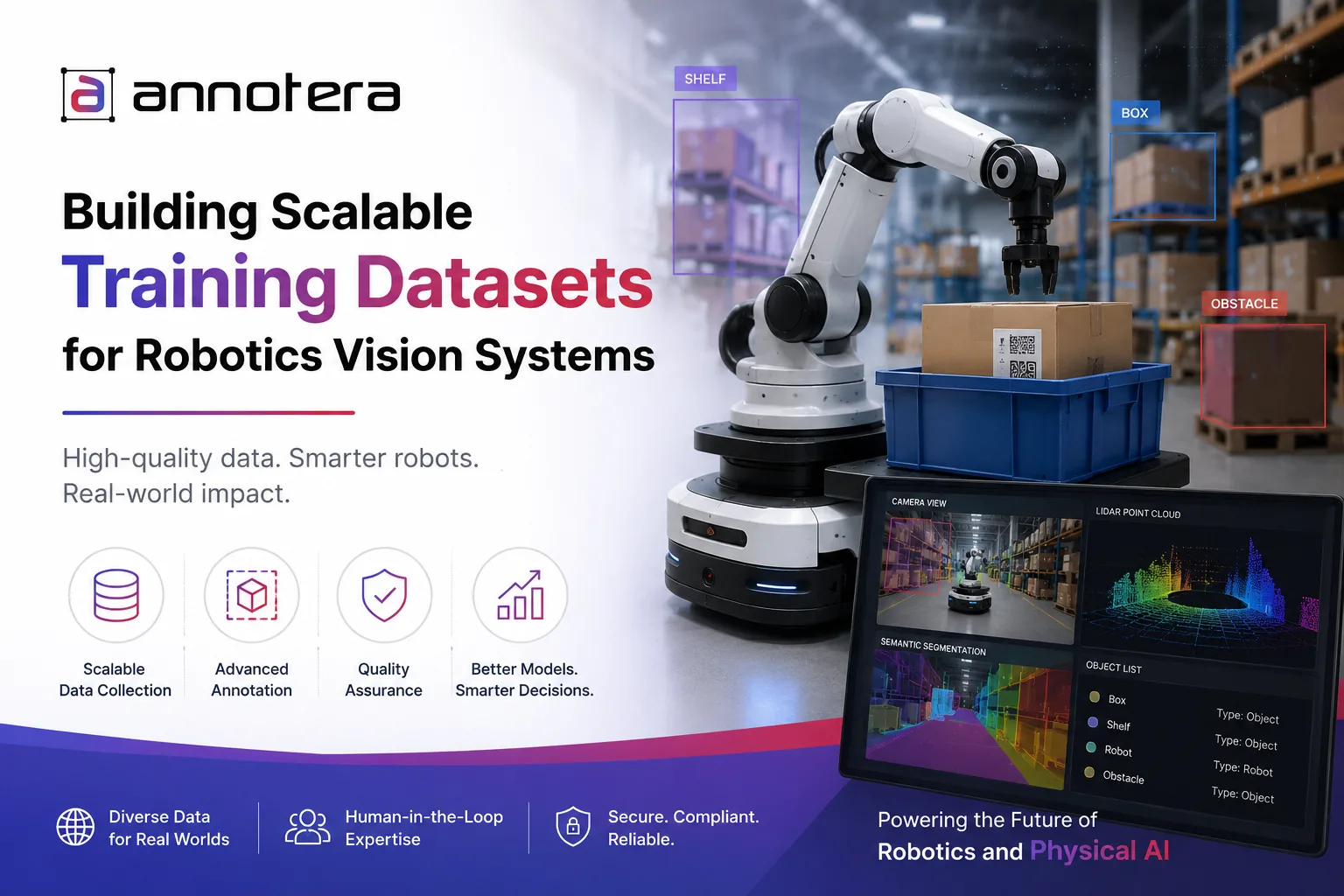
As robotics systems become increasingly autonomous, their ability to perceive and interpret the physical world accurately has become a critical success factor. From warehouse automation and industrial robotics to autonomous delivery robots and agricultural machines, vision systems are at the heart of modern robotic intelligence. However, even the most advanced computer vision models are only as good as the data used to train them.
Building scalable training datasets for robotics vision systems is one of the biggest challenges facing AI and robotics companies today. Large volumes of diverse, accurately labeled data are essential for enabling robots to recognize objects, understand environments, navigate safely, and make intelligent decisions in real-world conditions.
At Annotera, we help organizations develop high-quality, scalable datasets through specialized robotic data annotation services that accelerate AI model performance and deployment.
Why Robotics Vision Systems Depend on Large-Scale Training Data
Robotics vision systems rely on machine learning and deep learning algorithms to interpret visual information from cameras, LiDAR, depth sensors, and other perception devices. These systems must identify objects, estimate distances, detect obstacles, and understand dynamic environments.
According to the International Data Corporation (IDC), the global datasphere is expected to exceed 390 zettabytes by 2028, with machine-generated data becoming one of the fastest-growing categories. For robotics companies, this means an increasing need to organize, label, and manage vast amounts of visual data.
As AI pioneer Andrew Ng famously stated:
"AI is the new electricity, but data is the fuel."
Without properly annotated datasets, robotics vision systems struggle to generalize across different environments and operational conditions.
The Challenges of Scaling Robotics Datasets
Unlike traditional computer vision projects, robotics datasets are significantly more complex. Robots operate in dynamic, real-world environments where lighting conditions, object positions, weather, sensor noise, and human interactions constantly change.
Some common challenges include:
1. Data Volume Explosion
A single autonomous robot can generate terabytes of sensor data every day. Cameras, LiDAR systems, radar sensors, and depth cameras continuously collect information that must be processed and labeled.
2. Diverse Operating Conditions
Robots must perform reliably in various scenarios:
- Indoor and outdoor environments
- Daytime and nighttime operations
- Changing weather conditions
- Crowded and unstructured settings
- Different geographic locations
Creating datasets that represent this diversity is essential for robust model performance.
3. Multi-Sensor Data Integration
Modern robotics systems rarely rely on a single sensor. Training datasets often combine:
- RGB images
- Video sequences
- LiDAR point clouds
- Depth maps
- Thermal imaging
- Sensor fusion outputs
Managing and annotating these data streams at scale requires specialized expertise.
4. Annotation Consistency
As dataset sizes grow, maintaining annotation quality becomes increasingly difficult. Even minor labeling inconsistencies can introduce model bias and reduce accuracy.
This is where partnering with an experienced data annotation company becomes crucial.
Key Components of Scalable Robotics Vision Datasets
Building scalable datasets involves much more than collecting large volumes of data. The focus must be on creating datasets that support continuous model improvement and adaptation.
Comprehensive Data Collection
Successful robotics datasets capture a wide variety of real-world scenarios. Data collection strategies should include:
- Multiple locations
- Diverse object classes
- Various environmental conditions
- Different camera perspectives
- Rare edge cases
The broader the dataset coverage, the better the model's ability to generalize.
High-Quality Annotation Standards
Accurate labeling directly impacts model performance. Common annotation types used in robotics include:
- Bounding boxes
- Semantic segmentation
- Instance segmentation
- Keypoint annotation
- 3D cuboids
- LiDAR point cloud labeling
- Sensor fusion annotation
High-precision robotic data annotation ensures that AI systems learn meaningful visual patterns.
Dataset Versioning and Management
Scalable AI programs require continuous updates as robots encounter new environments and scenarios. Dataset versioning enables teams to:
- Track annotation improvements
- Monitor model performance
- Incorporate new data sources
- Maintain data governance standards
This creates a repeatable framework for ongoing AI development.
The Role of Human Expertise in Robotics Data Annotation
While automated labeling tools can accelerate workflows, human expertise remains essential for complex robotics applications.
Research from the Stanford Human-Centered AI Institute consistently highlights that human oversight improves dataset reliability and model robustness, particularly in edge-case scenarios.
Human annotators help identify:
- Ambiguous objects
- Occluded obstacles
- Unusual environmental conditions
- Sensor anomalies
- Rare operational events
These examples are often the most valuable training data for improving robotic decision-making.
A hybrid human-in-the-loop approach enables organizations to scale dataset production while maintaining annotation quality.
Why Data Annotation Outsourcing Accelerates Robotics AI Development
As robotics projects grow, many organizations find it difficult to maintain large in-house annotation teams.
This has led to increased adoption of data annotation outsourcing strategies.
Outsourcing offers several advantages:
Faster Dataset Production
Dedicated annotation teams can process large volumes of robotics data significantly faster than internal resources.
Access to Specialized Expertise
Experienced annotation providers understand complex robotics requirements, including:
- LiDAR labeling
- Sensor fusion annotation
- 3D object tracking
- Autonomous navigation datasets
Cost Efficiency
Building and managing internal annotation operations can be expensive. Outsourcing provides scalable resources without substantial infrastructure investments.
Quality Assurance
Professional annotation partners implement multi-stage quality control processes to ensure labeling consistency across millions of annotations.
Scalable Datasets as the Foundation of Physical AI
The rise of physical ai is transforming industries worldwide. Unlike traditional software-based AI, physical AI systems interact directly with the real world through robotic platforms.
According to industry forecasts from Goldman Sachs, the global robotics market could exceed $38 billion in annual revenue by the end of the decade as adoption accelerates across logistics, manufacturing, healthcare, and agriculture.
However, physical AI systems require enormous quantities of accurately labeled training data to operate safely and effectively.
Scalable training datasets enable robots to:
- Recognize complex environments
- Adapt to changing conditions
- Improve autonomous navigation
- Reduce operational errors
- Enhance safety and reliability
Without robust data foundations, even the most sophisticated AI architectures cannot achieve consistent real-world performance.
How Annotera Supports Scalable Robotics Dataset Development
At Annotera, we understand that building high-performing robotics vision systems begins with high-quality data. Our specialized annotation teams support organizations with scalable solutions for image, video, LiDAR, sensor fusion, and 3D perception datasets.
As a trusted data annotation company, we combine domain expertise, rigorous quality assurance processes, and flexible delivery models to help robotics innovators accelerate AI development.
Whether organizations require large-scale robotic data annotation, advanced sensor labeling, or strategic data annotation outsourcing, Annotera delivers the precision and scalability needed to support the next generation of autonomous systems.
Conclusion
Scalable training datasets are the backbone of modern robotics vision systems. As robotics applications continue expanding into increasingly complex environments, the demand for diverse, accurately labeled, and continuously evolving datasets will only grow.
Organizations that invest in high-quality data infrastructure today will be better positioned to develop reliable, intelligent, and safe robotic systems tomorrow. By partnering with an experienced annotation provider like Annotera, businesses can build the scalable data foundations necessary to power the future of robotics and physical AI.