
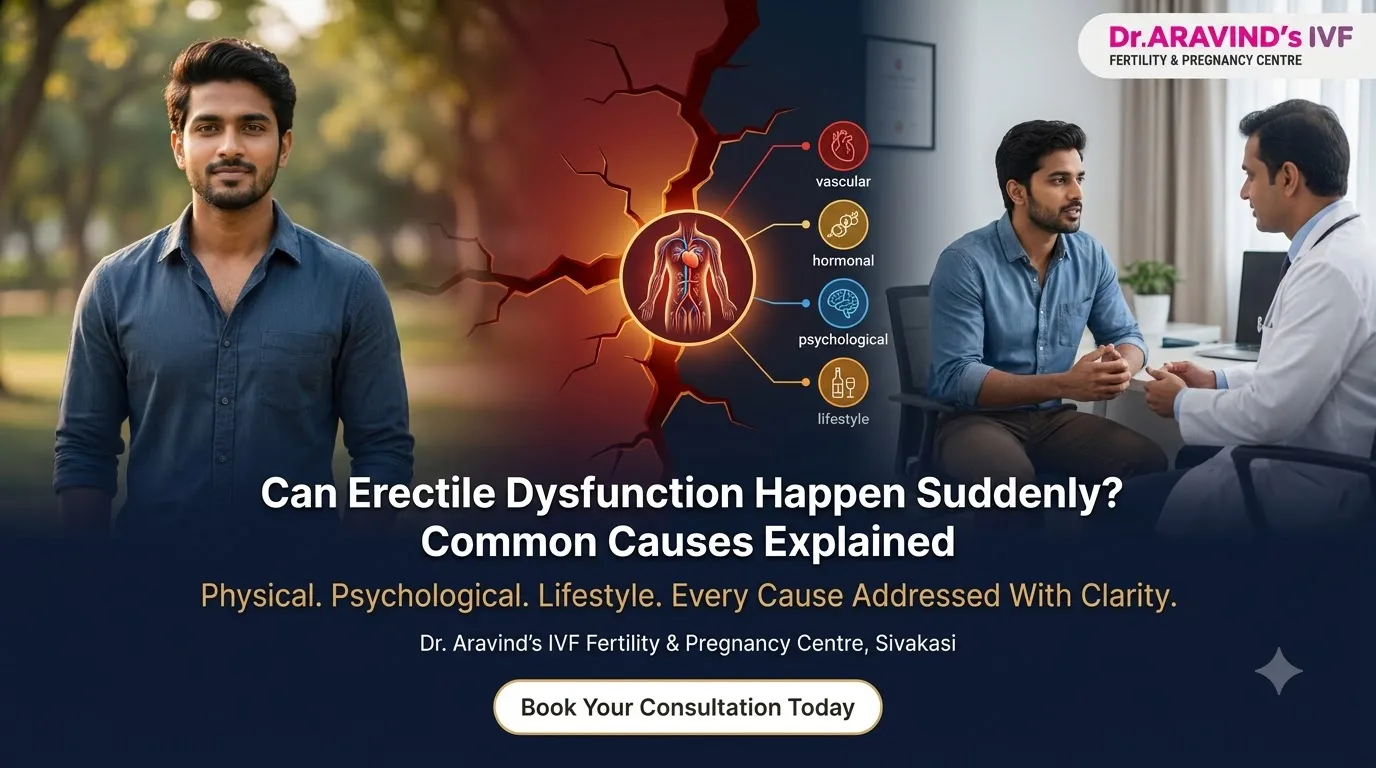
Most men assume erectile dysfunction develops gradually over years. The reality is more varied than that. While gradual onset is common, erectile dysfunction can also appear suddenly — sometimes seemingly overnight — leaving men confused about what changed and why it happened without warning.
Understanding both patterns and the causes behind each is the starting point for getting the right help at the right time.
At Dr. Aravind's IVF Fertility & Pregnancy Centre, a trusted fertility centre in Sivakasi, erectile dysfunction causes are evaluated thoroughly and honestly — because knowing the root cause is what determines the most effective treatment.
Can Erectile Dysfunction Really Happen Suddenly?
Yes. Sudden onset erectile dysfunction is a recognised clinical pattern and is actually more commonly psychological in origin than gradual erectile dysfunction, which tends to reflect progressive physical changes.
A man who had no difficulty achieving erections on a Tuesday and significant difficulty by the following weekend most likely experienced a psychological trigger — a stressful event, a performance concern, a relationship shift, or an anxiety response — rather than a sudden physical deterioration. The body's erectile mechanism is exquisitely sensitive to psychological state. A single episode of difficulty, particularly if it occurs in a high-pressure situation, can trigger enough performance anxiety to create a self-perpetuating cycle.
That said, sudden erectile dysfunction can also reflect acute physical events — a medication change, a hormonal shift, a cardiovascular incident, or a neurological change. This is why sudden onset ED, particularly in men with no prior history, always deserves clinical evaluation rather than assumption.
Physical Causes of Erectile Dysfunction
Cardiovascular and Vascular DiseaseThe most common physical cause of erectile dysfunction globally is impaired blood flow. Erection depends on the rapid filling of penile tissue with blood — a process that requires healthy, responsive blood vessels. Atherosclerosis, hypertension, high cholesterol, and diabetes all damage the small blood vessels supplying penile tissue, reducing the blood flow needed for firm erection.
Erectile dysfunction caused by vascular disease tends to develop gradually, but it can appear to arrive suddenly when a tipping point in vessel health is crossed. For men at the best IVF centre in India patient level seeking comprehensive male health assessment, erectile dysfunction in the absence of obvious psychological cause is now treated as a potential early cardiovascular warning sign requiring full evaluation.
Testosterone DeficiencyDeclining testosterone reduces libido, impairs the neurological arousal response, and reduces the sensitivity of penile tissue to stimulation. Testosterone deficiency-related erectile dysfunction typically develops gradually alongside other symptoms — reduced energy, mood changes, reduced morning erections — but can feel sudden if the hormonal decline accelerated due to illness, significant weight gain, sleep disruption, or chronic stress.
Medication Side EffectsA significant number of commonly prescribed medications carry erectile dysfunction as a side effect. Antihypertensives, antidepressants, antihistamines, and certain prostate medications are among the most frequently implicated. Erectile dysfunction that appears suddenly shortly after starting or changing a medication is very likely drug-related — and the solution may be as straightforward as a dosage adjustment or medication switch under medical supervision.
Neurological ConditionsThe erectile response requires intact neurological signalling between the brain, spinal cord, and penile tissue. Neurological conditions including multiple sclerosis, Parkinson's disease, spinal cord injury, and peripheral neuropathy from diabetes can all disrupt this signalling. Neurological ED can appear relatively suddenly following a neurological event or as a presenting symptom of a developing condition.
Diabetes and Metabolic ConditionsUncontrolled diabetes damages both the blood vessels and nerves that support erectile function simultaneously. Men with poorly controlled blood sugar often experience erectile dysfunction as one of the earlier complications — sometimes before more obvious diabetic symptoms appear. IVF treatment in Sivakasi consultations increasingly include metabolic screening for male partners because of the well-established connection between metabolic health and male reproductive function.
Psychological Causes of Erectile Dysfunction
Performance AnxietyA single episode of difficulty — regardless of cause — can generate enough performance anxiety to create a self-reinforcing pattern. The sympathetic nervous system activation that accompanies anxiety directly inhibits the parasympathetic response needed for erection. This cycle can feel entirely physical even when its origin is entirely psychological.
Depression and Anxiety DisordersBoth depression and generalised anxiety disorder carry direct physiological effects on sexual function beyond the psychological. Reduced dopamine activity in depression reduces motivation and pleasure — including sexual desire and arousal. Anxiety elevates cortisol, which suppresses testosterone and impairs the neurological arousal response. Men experiencing sudden erectile dysfunction alongside low mood, persistent worry, or significant life stress should consider whether a mental health component is driving the sexual health change.
Relationship and Situational StressRelationship conflict, communication breakdown, unresolved tension, or simply a stressful life period can create a psychological environment in which erectile function is temporarily impaired. This type of erectile dysfunction often resolves with the resolution of the underlying stressor — but it can become conditioned and persist if not addressed before performance anxiety takes hold.
Lifestyle Causes That Accelerate Erectile Dysfunction
Smoking damages blood vessel endothelium and reduces the vascular responsiveness that erectile function depends on — it is one of the most significant modifiable risk factors for ED at any age. Excessive alcohol consumption impairs neurological function acutely and reduces testosterone over time with chronic use. Obesity reduces testosterone, increases estrogen production through fat tissue aromatisation, and creates the metabolic and cardiovascular conditions that impair erectile blood flow. Chronic sleep deprivation reduces testosterone measurably and impairs the neurological recovery that sexual function depends on.
Each of these factors can individually contribute to erectile dysfunction causes — and in combination, they create a cumulative burden that often explains why ED appears to develop suddenly when in fact the foundation for it has been building over years.
When Sudden Erectile Dysfunction Needs Immediate Evaluation
While most erectile dysfunction causes are non-urgent, certain presentations warrant prompt clinical attention. Sudden erectile dysfunction following a neurological event — stroke, head injury, spinal trauma — requires immediate evaluation. ED accompanied by chest pain, shortness of breath, or leg pain should be evaluated for cardiovascular causes without delay. Sudden onset in a man with known diabetes or hypertension warrants prompt metabolic review.
For men in Sivakasi experiencing sudden erectile dysfunction without an obvious trigger, evaluation at a trusted fertility centre in Sivakasi provides the comprehensive assessment needed to identify whether the cause is psychological, hormonal, vascular, neurological, or medication-related — and what the most appropriate treatment pathway is.
Conclusion
Erectile dysfunction can happen suddenly or gradually, and understanding which pattern applies matters for identifying the cause and choosing the right treatment. As a trusted fertility centre in Sivakasi and a leading name among the best IVF centres in India, Dr. Aravind's IVF Fertility & Pregnancy Centre evaluates every erectile dysfunction cause with the clinical depth it deserves — giving men and couples the honest, thorough assessment that leads to real answers and effective care.
FAQ
Q1. Can erectile dysfunction really happen suddenly overnight?
Yes. Sudden onset erectile dysfunction is most commonly psychological in origin — triggered by a single episode of difficulty, a stressful event, or acute performance anxiety. It can also reflect medication changes, hormonal shifts, or acute physical events. Any sudden onset ED without obvious cause deserves clinical evaluation.
Q2. What is the most common cause of erectile dysfunction in young men?
In younger men, psychological causes — performance anxiety, depression, relationship stress — are the most common drivers of erectile dysfunction. Lifestyle factors including smoking, obesity, and chronic sleep deprivation are increasingly significant contributors in men under forty across India.
Q3. Can erectile dysfunction be a sign of heart disease?
Yes. Erectile dysfunction caused by vascular disease is now recognised as a potential early indicator of cardiovascular risk. Men under fifty with unexplained ED and cardiovascular risk factors should be evaluated for underlying vascular health as part of a comprehensive assessment.
Q4. Does IVF treatment in Sivakasi include evaluation for erectile dysfunction?
Male reproductive health evaluation at Dr. Aravind's IVF Fertility & Pregnancy Centre for IVF treatment in Sivakasi includes assessment of sexual function alongside standard fertility parameters — because erectile dysfunction and ejaculatory concerns are directly relevant to fertility outcomes and are addressed as part of complete couple-level care.
Q5. When should a man in Sivakasi see a doctor for erectile dysfunction?
Seek evaluation at a fertility centre in Sivakasi when erectile dysfunction has been present consistently for four or more weeks, when it appeared suddenly without obvious psychological trigger, when it is accompanied by reduced libido or other hormonal symptoms, or when it is causing significant personal or relationship distress. Early evaluation consistently produces better treatment outcomes.