Generative AI is becoming a practical part of modern software and enterprise technology. Organizations are using AI systems to support development, customer service, document processing, research, workflow automation, and internal decision-making.
As these systems grow more advanced, professionals need skills that go beyond basic prompting. They must understand how AI agents operate, how external tools connect with models, how context is managed, and how reliable AI applications are designed for real-world use.
The Claude Certified Architect – Foundations (CCAR-F) certification focuses on these technical areas. It is intended for professionals who design, build, or support Claude-powered applications within Anthropic’s ecosystem.
Instead of concentrating only on how to interact with Claude, CCAR-F examines the architectural choices involved in creating secure, scalable, and maintainable AI solutions.
What Is the CCAR-F Certification?
CCAR-F stands for Claude Certified Architect – Foundations.
The certification evaluates foundational knowledge of designing applications and workflows that use Claude. Candidates are expected to understand how different parts of an AI system work together and how to choose an appropriate solution for a particular technical requirement.
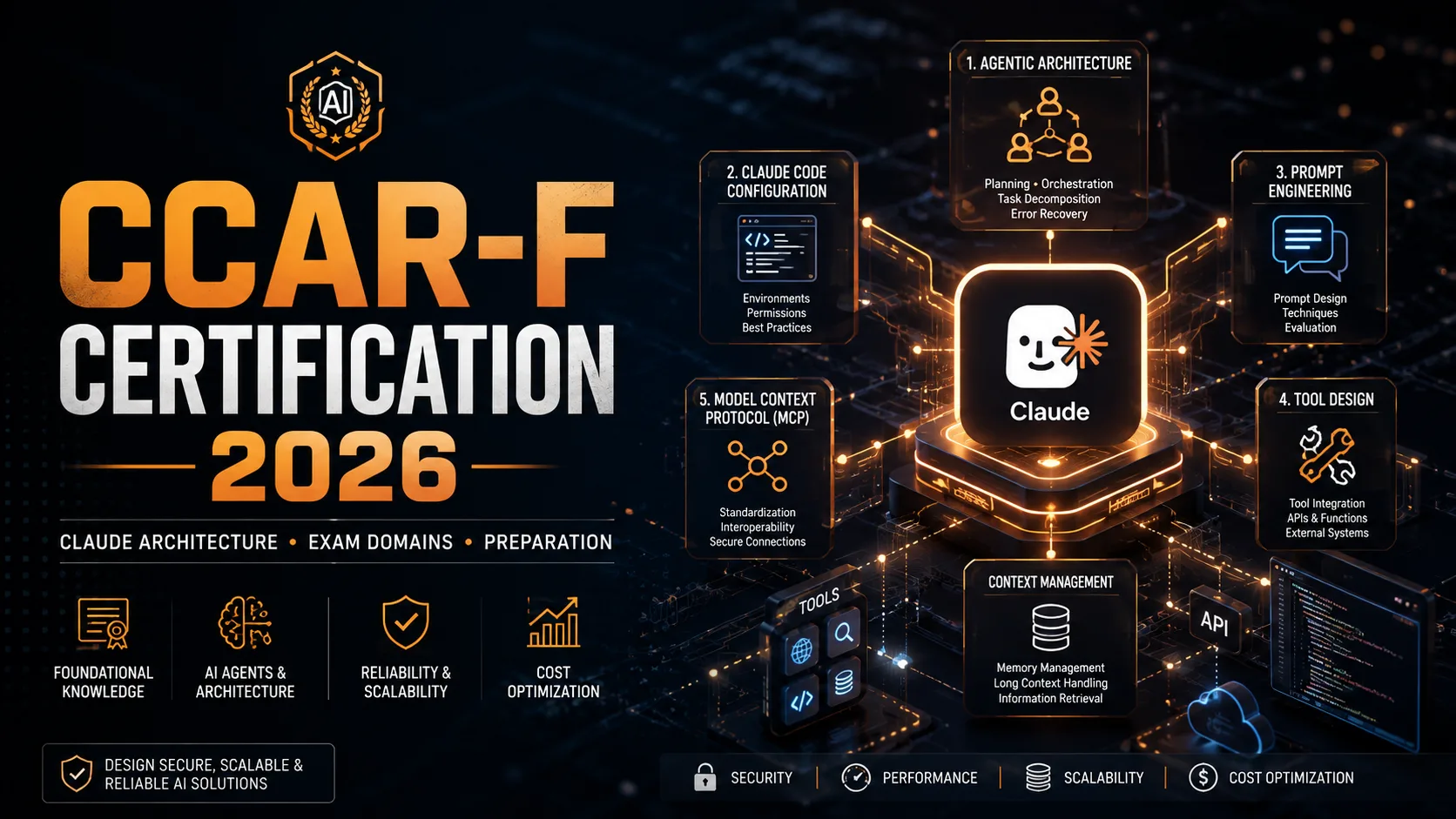
The major areas include:
- Agentic Architecture
- Claude Code Configuration
- Prompt Engineering
- Tool Design
- Model Context Protocol (MCP)
- Context Management
- Reliability and scalability
- Cost optimization
The exam places significant emphasis on practical scenarios.
For example, candidates might need to determine whether a business workflow should use a single agent, several specialized agents, or a tool connected to an external system.
The goal is to identify the architecture that solves the problem effectively without adding unnecessary complexity.
CCAR-F Exam Overview
The current CCAR-F exam information includes:
- 60 questions
- 120 minutes
- Scenario-based multiple-choice and multiple-response questions
- A scaled passing score of 720 out of 1,000
- A listed fee of US$125
- Credential validity of 12 months
- Online-proctored or approved test-center delivery
Candidates should confirm current details through official sources before registering because exam policies and requirements may change.
The scenario-based format means candidates need more than memorized definitions. Several answers may appear technically valid, so the challenge is selecting the option that provides the best balance of reliability, security, cost, performance, and maintainability.
Who Should Consider CCAR-F?
CCAR-F is particularly relevant to professionals working with Claude at a technical or architectural level.
Suitable candidates may include:
- Solution architects
- AI engineers
- Software developers
- Machine-learning engineers
- Cloud architects
- Platform engineers
- Technical consultants
- AI product engineers
- Enterprise AI specialists
Hands-on experience can be valuable during preparation.
Candidates who have worked with Claude Code, APIs, AI agents, structured outputs, external tools, or large-context applications may find the exam scenarios easier to interpret.
The certification may also help technical trainers and learning professionals understand the skills developers and architects need when working with production AI systems.
Five Core CCAR-F Exam Domains
1. Agentic Architecture (27%)
Agentic Architecture carries the largest weighting on the exam.
This domain focuses on how AI agents can plan work, divide tasks, interact with external tools, coordinate activities, and recover when something goes wrong.
Candidates should understand areas such as:
- Single-agent systems
- Multi-agent architectures
- Task decomposition
- Agent orchestration
- Workflow planning
- Error recovery
- Scalability
- Cost optimization
One important principle is that more agents do not necessarily produce a better solution.
For example, an organization building an internal support assistant could use one agent connected to several approved tools. Another option could involve separate agents for HR, IT support, and account management.
The multi-agent approach may provide greater specialization, but it also increases complexity, latency, and potential failure points.
Candidates need to determine whether the additional architecture is genuinely necessary.
2. Claude Code Configuration (20%)
Claude Code Configuration focuses on using Claude within professional software-development environments.
Important concepts include:
- Claude Code setup
- Project configuration
- CLAUDE.md
- Repository organization
- Permissions
- Team workflows
- CI/CD integration
Suppose a development team wants Claude to assist with testing, code review, or refactoring.
The team needs to consider what instructions Claude should follow, which repository information it can access, what actions require approval, and how its behavior should remain consistent across the project.
The objective is to improve development efficiency while maintaining security and software quality.
3. Prompt Engineering (20%)
Prompt Engineering continues to be an important part of reliable AI application development.
Production prompts often need to generate predictable and structured responses rather than simple conversational text.
Candidates should understand:
- System instructions
- User prompts
- Few-shot examples
- XML structures
- JSON output
- Structured responses
- Tool calling
- Output validation
For example, a customer-support platform might require Claude to identify the issue category, urgency, sentiment, summary, and recommended action.
A structured result allows another application to process Claude’s output more reliably.
Candidates should also understand when a prompt alone is not appropriate. When current inventory, account details, or live service information is needed, the application should normally retrieve that information from an authoritative external system.
4. Tool Design and MCP (18%)
Claude applications often need access to systems beyond the model itself.
This domain focuses on external tools and the Model Context Protocol (MCP).
Candidates should understand areas including:
- Tool definitions
- External APIs
- MCP servers
- Authentication
- Tool selection
- Permissions
- Security
- Error handling
Imagine an AI assistant that needs current warehouse stock information.
Instead of allowing Claude to estimate or guess product availability, the application should retrieve the latest data through an approved inventory tool.
Good tool design includes clear inputs, predictable outputs, appropriate access permissions, and useful handling when errors occur.
Candidates should also consider efficiency. Each additional tool call can increase latency, cost, and system complexity.
5. Context Management (15%)
Context Management focuses on how information is supplied to Claude during complex or long-running tasks.
Candidates should understand:
- Context windows
- Retrieval
- Summarization
- Context compression
- Conversation continuity
- Memory strategies
- Token optimization
Consider an AI system analyzing hundreds of pages of contracts or internal policies.
Sending all available documents with every request may be inefficient. A stronger design may retrieve only the sections relevant to the current question or use structured summaries from earlier stages.
Good context management helps reduce unnecessary processing while maintaining useful information.
What Makes CCAR-F Challenging?
The difficulty of CCAR-F comes mainly from architectural decision-making.
Candidates may be presented with multiple options that could technically work. They need to identify which one is more suitable based on:
- Reliability
- Security
- Cost
- Performance
- Scalability
- Simplicity
- Maintainability
This makes practical experience especially useful.
Someone who has already dealt with failed API requests, inconsistent prompts, excessive context, or complex agent workflows may better understand the trade-offs behind different exam answers.
How to Prepare for CCAR-F
A strong preparation strategy combines official study materials with hands-on practice.
Begin by reviewing all five domains and their weighting. Give particular attention to Agentic Architecture because it represents the largest part of the exam.
Then apply the concepts through small projects.
Useful practice ideas include:
- Building a Claude agent
- Creating a structured data-extraction workflow
- Connecting Claude to an external API
- Testing an MCP integration
- Working with long documents
- Configuring a Claude Code practice repository
When reviewing your architecture, consider whether the design could be simpler, whether an external tool is necessary, what happens if a component fails, and whether permissions and context are being managed appropriately.
Four-Week CCAR-F Preparation Plan
Week 1: Prompt Engineering
Study structured prompting, JSON, XML, system instructions, tool calling, few-shot examples, and output validation.
Practice creating responses that another application can process consistently.
Week 2: Agentic Architecture and MCP
Review single-agent and multi-agent architectures, task decomposition, MCP, external tools, authentication, and failure handling.
Build a basic agent that interacts with an external tool.
Week 3: Claude Code and Context Management
Focus on Claude Code configuration, repository instructions, permissions, retrieval, summarization, context windows, and token optimization.
Apply these ideas to a small software project.
Week 4: Scenario Practice
Complete mixed scenario-based questions and timed practice exams.
When reviewing incorrect answers, focus on the reason behind the mistake. Determine whether you selected unnecessary complexity, overlooked security, misunderstood tool usage, or missed a more reliable approach.
Prepare for CCAR-F with CertsGate
Official Anthropic documentation should remain the primary source for current certification objectives and technical guidance.
For additional preparation, candidates can also use CertsGate.com.
CertsGate provides independent certification study resources that can help candidates review the CCAR-F domains, practice scenario-based questions, identify weaker areas, and strengthen knowledge of Agentic Architecture, Claude Code, MCP, Prompt Engineering, and Context Management.
A useful study approach combines official documentation, practical Claude projects, CertsGate practice resources, and mock exams.
The focus should be on understanding architectural decisions rather than simply memorizing answers.
Final Thoughts
The CCAR-F certification reflects the growing technical maturity of generative AI development.
Building useful Claude applications requires more than creating effective prompts. Professionals also need to understand agents, tools, external systems, context management, permissions, reliability, scalability, and cost.
Candidates preparing for CCAR-F should therefore combine study with practical experimentation.
Build small projects, connect Claude to external tools, practice structured responses, test context strategies, and learn how systems behave when something fails.
These activities can help candidates prepare for the certification while developing architecture skills that are also valuable in real-world Claude-powered applications.