
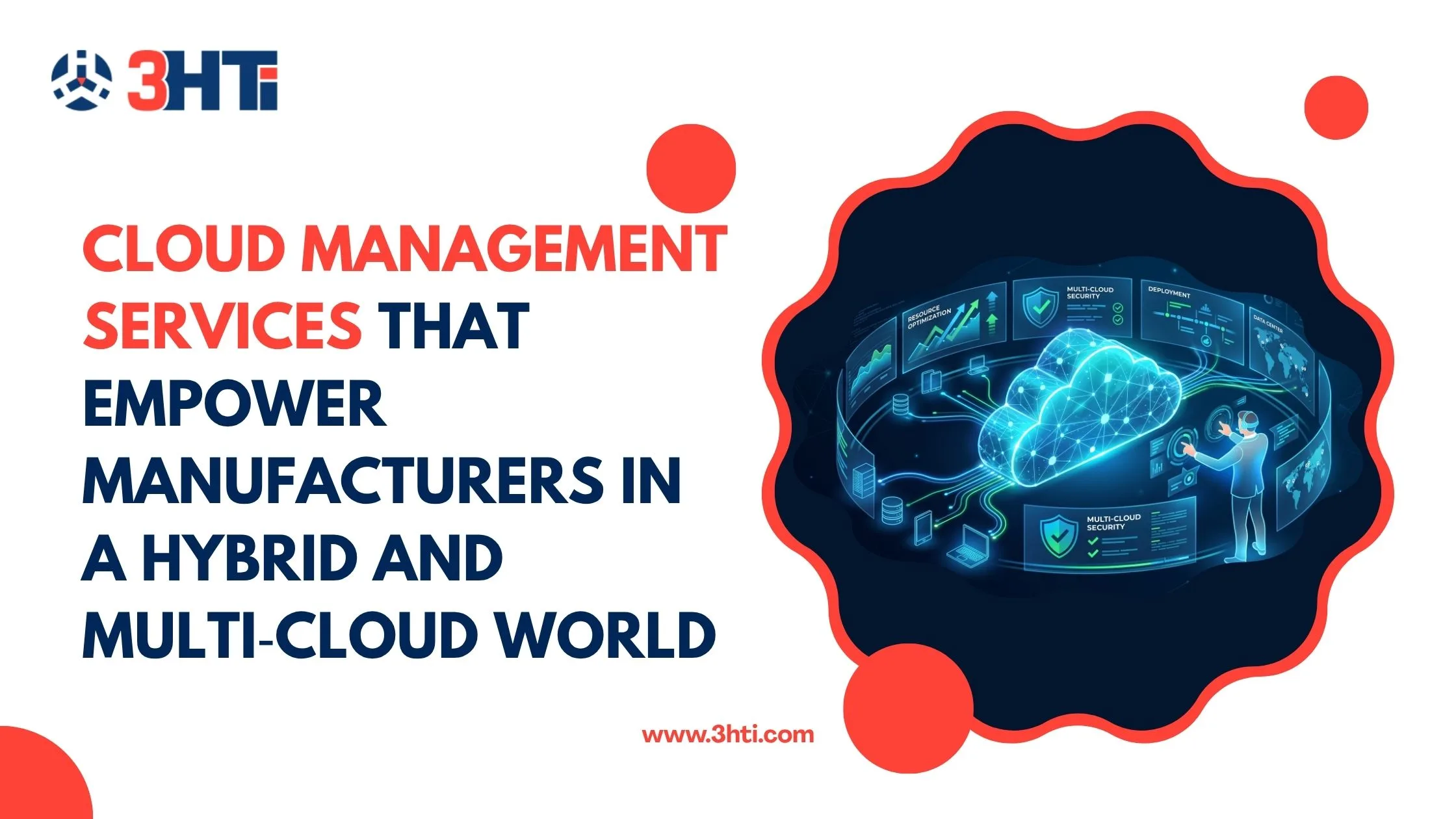
Modern manufacturing and engineering firms are generating more data than ever before. From intricate 3D CAD models and massive finite element analysis (FEA) simulations to enterprise-wide product lifecycle management (PLM) databases, the digital weight of modern product development is staggering. Relying on legacy, on-premise servers to handle these workloads is no longer viable. As a result, the industry has aggressively shifted toward flexible, decentralized infrastructures.
However, operating across multiple platforms introduces serious operational friction. To maintain control over highly complex environments, engineering leaders are increasingly turning to professional cloud management services to secure their intellectual property, optimize computing performance, and drive sustainable growth.
What Are Cloud Management Services in Manufacturing?
Cloud management services refer to the integrated oversight, administration, and continuous optimization of an organization's remote computing infrastructure. For manufacturing and engineering organizations, these services specifically focus on handling the intense computing demands of heavy product development software.
Rather than treating the network as a static storage drive, these comprehensive frameworks actively monitor resource allocation, enforce strict security protocols, and ensure that hybrid (a mix of on-premise and public infrastructure) and multi-cloud environments operate seamlessly as a single, unified digital thread.
The Unique Challenge of Engineering Data
Why do product developers require specialized oversight? Unlike standard business applications, engineering platforms like Windchill PLM or Creo CAD demand exceptional processing power and ultra-low latency. When mechanical engineers attempt to load a massive, multi-level bill of materials (BOM), even a few seconds of network lag can derail productivity and cause system timeouts.
Without dedicated cloud management services, manufacturers frequently experience isolated data silos, unpredictable hosting costs, and dangerous vulnerabilities in their supply chain communication. Managing these sophisticated ecosystems requires far more than basic IT support; it requires deep domain expertise in both network architecture and mechanical engineering workflows.
Core Benefits of Expert Cloud Management Services
Transitioning to a modernized infrastructure is a significant investment. Partnering with seasoned professionals to oversee this architecture delivers a measurable, long-term return on investment across several critical areas.
Uncompromising Security and Compliance
For manufacturers, intellectual property is the lifeblood of the business. Utilizing top-tier cloud management services ensures that highly sensitive design data is protected by zero-trust security architectures. Furthermore, expert administrators configure environments to meet stringent industry regulations, such as ITAR for defense contractors or FDA requirements for medical device manufacturers, ensuring compliance is never left to chance.
Performance Optimization for Heavy Workloads
Simulation and rendering tasks consume massive amounts of computing power, but often only for short periods. Effective cloud management services utilize dynamic resource scaling, automatically spinning up high-performance computing (HPC) nodes during heavy stress tests and spinning them down when inactive. This ensures engineers always have the power they need without the company paying for idle server time.
Navigating the Shift with Cloud Migration Service Providers
Before an organization can manage a modern infrastructure, it must safely get there. Simply executing a "lift and shift" strategy moving raw data from a local server to AWS or Azure without restructuring it frequently results in broken file links and corrupted CAD assemblies.
This is why engaging experienced cloud migration service providers is a mandatory first step. These specialists conduct deep architectural audits, mapping out complex software dependencies before a single file is moved. By properly refactoring databases and optimizing PLM architectures for remote environments, expert migration teams ensure zero critical downtime and prevent the catastrophic data loss that plagues poorly planned transitions.
Overcoming IT Strain with Cloud Managed Services
Internal IT departments at manufacturing firms are often stretched incredibly thin, caught between resetting passwords and patching factory floor hardware. Expecting them to also master the nuances of multi-environment server architecture is a recipe for burnout.
By leveraging dedicated cloud managed services, organizations offload the burden of routine infrastructure maintenance. External experts handle continuous threat monitoring, automated data backups, software patching, and disaster recovery testing. This strategic delegation allows internal IT and engineering teams to shift their focus away from server uptime and redirect their energy toward core product innovation and digital transformation initiatives.
Driving Agility in a Multi-Cloud Reality
No single provider is perfect for every single workflow. A company might prefer AWS for raw computing power, Azure for seamless Microsoft enterprise integration, and a private hosted server for highly classified defense projects. Comprehensive cloud management services act as the central nervous system for this decentralized strategy.
By unifying diverse platforms under a single pane of glass, these services eliminate vendor lock-in. Engineering executives gain total visibility over their infrastructure spend, performance metrics, and security postures, allowing them to remain agile and adapt instantly to shifting market demands.
Key Takeaways
- Legacy on-premise servers cannot efficiently handle the massive data loads required by modern CAD, PLM, and digital twin technologies.
- Specialized cloud management services provide the active resource scaling required to keep heavy engineering applications running without latency.
- Partnering with expert cloud migration service providers ensures that complex software dependencies are not broken during the transition to remote environments.
- Offloading daily infrastructure maintenance to cloud managed services frees internal IT teams to focus entirely on strategic business growth.
- Unified oversight of hybrid environments guarantees strict regulatory compliance and protects invaluable intellectual property from cyber threats.
Frequently Asked Questions (FAQs)
Q. What exactly do cloud management services provide?
Professional cloud management services deliver continuous monitoring, resource optimization, and security administration for an organization's decentralized computing infrastructure. They ensure that heavy engineering applications run smoothly, securely, and cost-effectively across private, public, and hybrid network environments without experiencing workflow-disrupting latency.
Q. Why are cloud migration service providers necessary for manufacturers?
Manufacturing software relies on intricate, interconnected data structures. Cloud migration service providers possess the specialized expertise to safely transfer heavy CAD files and PLM databases without breaking links, corrupting assemblies, or causing extended operational downtime during the transition.
Q. How do cloud managed services benefit internal engineering teams?
By taking over routine maintenance tasks like security patching, threat monitoring, and server backups, cloud managed services eliminate immense IT burdens. This allows internal engineers and IT staff to focus entirely on designing products and executing strategic digital transformation initiatives.
Q. What is a hybrid multi-cloud approach in manufacturing?
A hybrid multi-cloud approach utilizes a mix of private on-premise servers and various public providers (like AWS or Azure). This allows manufacturers to keep highly sensitive data on private networks while leveraging public infrastructure for scalable, high-performance computing tasks.
Conclusion
The complexity of modern product development requires an IT infrastructure that is as dynamic and resilient as the engineers using it. Attempting to navigate the hybrid and multi-cloud landscape without specialized oversight inevitably leads to bloated costs, severe security vulnerabilities, and frustrated design teams. By investing in professional cloud management services, manufacturers establish a highly secure, optimized, and scalable foundation. This strategic partnership removes the friction of digital infrastructure, empowering engineering teams to innovate faster, collaborate seamlessly, and bring superior products to market with absolute confidence.