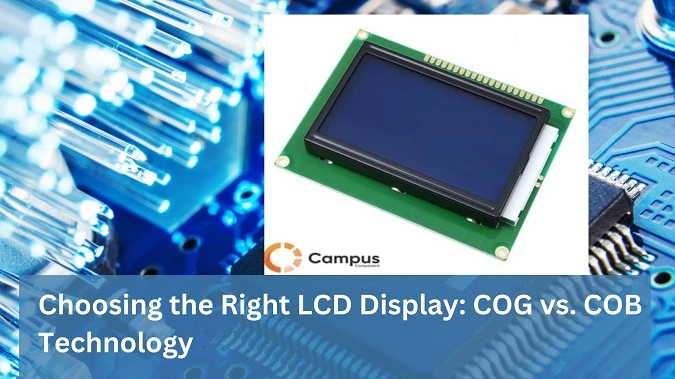
Selecting the right LCD display for your project is crucial, as different assembly methods offer distinct advantages. Two widely used LCD module assembly techniques are Chip-on-Glass (COG) and Chip-on-Board (COB). Each method has unique features that determine its suitability for various applications.
This guide will explore the differences between COG and COB LCD displays to help you choose the best option for your specific needs. Campus Component, a trusted supplier of electronic components, provides a variety of COG and COB LCD displays for industrial and consumer applications.
What is a COG LCD Display?
A Chip-on-Glass (COG) LCD display integrates the driver IC directly onto the glass substrate, resulting in a compact, lightweight design. This makes COG displays perfect for modern devices where space is a key concern.
Advantages of COG LCD Displays
- Slim and Lightweight: The IC is directly mounted on the glass, leading to a sleek profile suitable for portable devices.
- Low Power Consumption: Consumes less energy, making it ideal for battery-powered applications.
- High Reliability: With fewer interconnections, there is a lower risk of mechanical failure.
- Excellent Visual Performance: Offers high contrast and sharp display quality.
Common Applications of COG LCD Displays
- Medical equipment
- Industrial control systems
- Automotive displays
- Handheld communication devices
What is a COB LCD Display?
A Chip-on-Board (COB) LCD display has the driver IC mounted on a printed circuit board (PCB) and then connected to the LCD module. This traditional assembly technique is preferred for larger displays and applications requiring enhanced durability.
Advantages of COB LCD Displays
- Easy Integration: The PCB allows multiple connection options for simplified design.
- Enhanced Durability: More rugged and resistant to mechanical stress, making it ideal for industrial use.
- Better Heat Dissipation: The PCB helps manage heat effectively, ensuring long-term stability.
- Supports Larger Displays: Suitable for large LCD panels where direct glass mounting is impractical.
Common Applications of COB LCD Displays
- ATM machines
- Industrial machinery
- POS terminals
- Home electronics
COG vs. COB LCD Displays: Key Differences
Feature
COG LCD Display
COB LCD Display
Design & Size
Slim, compact
Bulkier due to PCB
Power Usage
Low power consumption
Slightly higher power consumption
Reliability
Fewer interconnections, more stable
More durable but more points of failure
Heat Management
Moderate, varies by design
Better heat dissipation
Cost
Higher due to advanced tech
More affordable
Best For
Small, high-performance devices
Large, industrial applications
How to Choose the Right LCD Display?
Go for COG LCD if:
- Your project requires a slim, compact design.
- Low power consumption is essential.
- High contrast and sharpness are needed.
- Applications include medical devices, automotive displays, or portable electronics.
Opt for COB LCD if:
- You need a robust and durable display.
- Your application involves mechanical stress or industrial use.
- You require a larger display with multiple connection options.
- Your design allows for PCB integration.
Where to Buy High-Quality COG and COB LCD Displays?
For reliable COG and COB LCD displays, Campus Component offers an extensive range of LCD modules tailored for different applications. One recommended product is the Sinda COG White LCD Display, known for its excellent contrast, energy efficiency, and durability ideal for industrial and commercial use.
Final Thoughts
Both COG and COB LCD displays have unique benefits, and your choice depends on your project requirements. COG displays are best for compact, power-efficient applications, while COB displays are ideal for rugged, large-scale implementations.
No matter your needs, Campus Component provides high-quality LCD and LED display solutions to match your project specifications.