
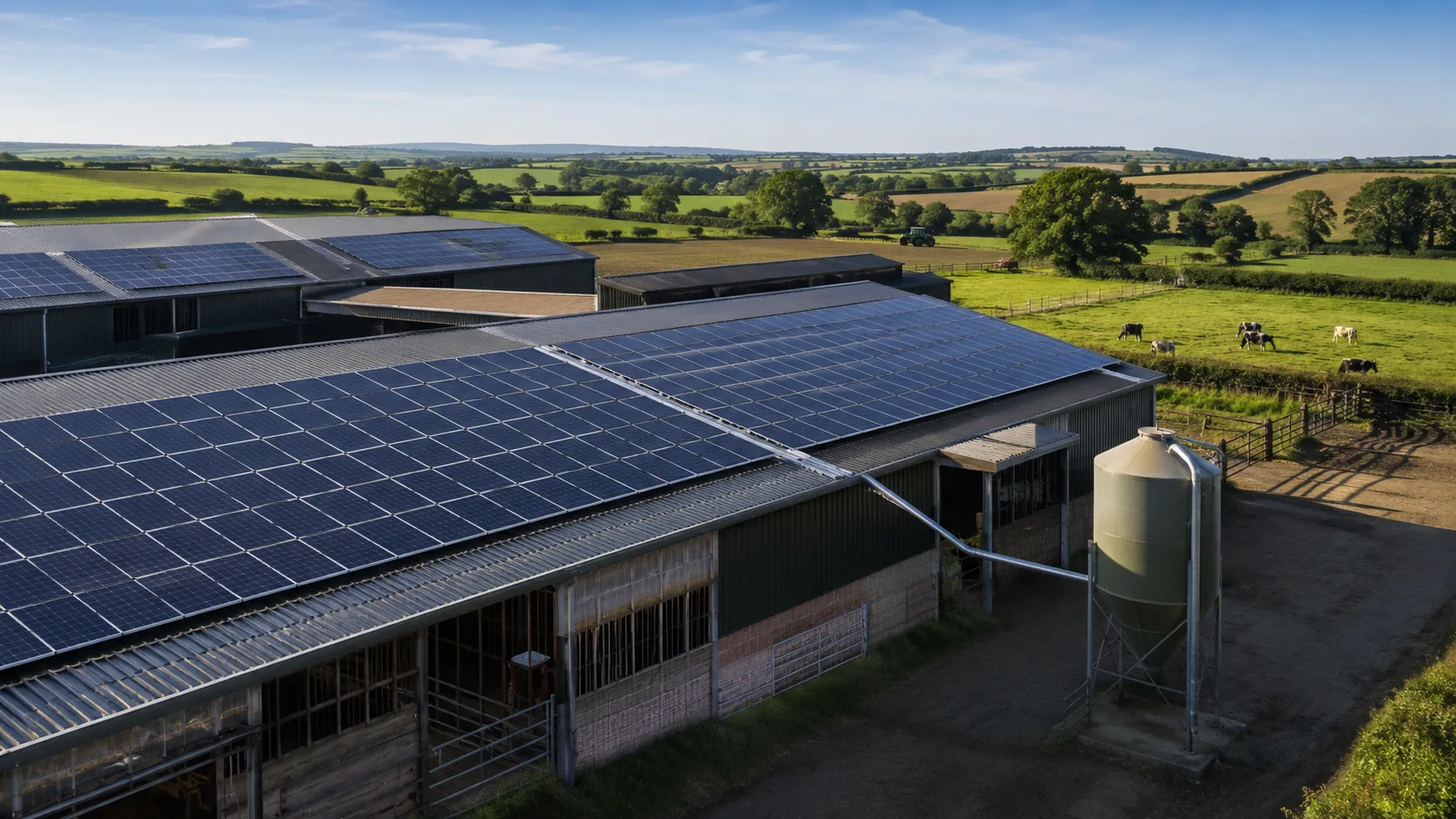
Farms and agricultural businesses require substantial amounts of electricity to operate irrigation systems, refrigeration units, milking equipment, ventilation, lighting, grain dryers, workshops and automated machinery. As energy prices remain difficult to predict, generating electricity on-site can help agricultural businesses gain greater control over operating costs.
By investing in commercial solar solutions for farms, we can convert unused roof space or suitable areas of land into productive energy-generating assets. A properly designed solar photovoltaic system can reduce dependence on grid electricity, support long-term financial planning and lower the carbon footprint associated with agricultural operations.
Why Commercial Solar Is Well Suited to Agricultural Businesses
Agricultural sites often have characteristics that make them particularly suitable for commercial solar installations. Large barns, livestock buildings, machinery sheds, packing facilities and cold-storage units can provide extensive roof space that may otherwise have no direct commercial use.
Many farms also consume considerable electricity during daylight hours, when solar panels are actively generating power. This can create a strong match between on-site generation and operational demand.
Common daytime electricity requirements include:
- Milking and dairy-processing equipment
- Ventilation and cooling systems
- Water pumps and irrigation equipment
- Refrigerated storage
- Poultry-house lighting and climate control
- Grain handling and processing
- Packing and grading machinery
- Workshop tools
- Electric vehicle and machinery charging
- Office and security equipment
When we align the size of a solar installation with the farm’s electricity profile, a significant proportion of the generated power can be consumed directly on-site. This can reduce the amount of electricity purchased from an energy supplier.
Reducing Farm Energy Costs with Solar PV
Electricity is a major operating expense for many modern farms. This is particularly true for dairy, poultry, horticultural and cold-storage businesses that rely on energy-intensive equipment throughout the year.
A commercial solar PV system produces electricity without requiring fuel to be purchased for every unit generated. Once installed, the system can continue producing renewable electricity for many years, subject to maintenance, environmental conditions and the performance of its components.
The financial value of a solar project depends on several factors, including:
- The farm’s annual and seasonal electricity consumption
- Daytime energy demand
- Available roof or land area
- Roof orientation, condition and pitch
- Shading from trees, silos or nearby structures
- Local grid capacity
- Solar system size
- Electricity tariffs
- Financing arrangements
- Maintenance and equipment replacement costs
We should not select a system based only on the maximum number of panels that can fit on a building. A detailed energy assessment allows us to identify a suitable capacity based on consumption patterns, site limitations and financial objectives.
Businesses considering an installation can explore professionally designed commercial solar solutions for information about the assessment, design and delivery of systems for commercial properties.
Rooftop Solar Panels for Barns and Agricultural Buildings
Rooftop solar is often the first option considered on an agricultural site. Barns, warehouses, stables and livestock buildings may offer enough space for a substantial system without taking productive land out of agricultural use.
Before installing solar panels on an agricultural roof, we must assess more than its dimensions. The structure should be inspected to determine whether it can safely support the proposed system and withstand the additional loads created by the mounting equipment.
A comprehensive rooftop assessment should consider:
- The structural condition of the building
- Roof age and remaining service life
- Roofing material
- Load-bearing capacity
- Panel orientation and inclination
- Wind and snow loads
- Shading throughout the year
- Safe access for installation and maintenance
- Fire safety and emergency access
- Cable routes and electrical connection points
- Potential exposure to dust, moisture or ammonia
Agricultural environments can be demanding. Poultry and livestock buildings may contain higher levels of moisture, dust or corrosive gases. Equipment, cabling and mounting components should therefore be selected with the operating environment in mind.
Where a roof is approaching the end of its useful life, it may be more practical to complete necessary repairs or replacement work before installing the solar array. This reduces the likelihood that panels will need to be removed prematurely for roof maintenance.
Ground-Mounted Solar for Farms
Where roof space is unavailable, structurally unsuitable or insufficient, a ground-mounted solar system may offer an alternative. Panels can be positioned on appropriately selected land and oriented to achieve effective solar exposure.
Ground-mounted installations may provide greater flexibility in relation to:
- Panel orientation
- Row spacing
- Maintenance access
- System expansion
- Equipment placement
- Shading management
- Cleaning and vegetation control
However, the suitability of agricultural land must be evaluated carefully. Planning requirements, visual impact, drainage, soil quality, biodiversity, grid access and the existing use of the land can all influence whether a proposal is appropriate.
Government planning guidance explains that renewable energy development must be considered alongside environmental protections and the concerns of local communities. Larger projects may require detailed surveys and planning assessments before construction begins.
For projects extending beyond a standard on-site commercial installation, specialist solar farm development services can support feasibility assessments, planning, system design, grid considerations and long-term project delivery.
Commercial Solar Versus a Solar Farm
Although the terms are sometimes used interchangeably, commercial rooftop solar and solar farms usually serve different project objectives.
A commercial solar installation is generally designed to generate electricity primarily for use by the business operating at the site. Panels may be installed on barns, warehouses, offices or nearby land. The main objective is often to reduce purchased electricity and improve energy resilience.
A solar farm is typically a larger ground-mounted development designed to generate electricity at scale. Depending on the project structure, electricity may be exported to the grid, supplied through a private connection or delivered under a power purchase arrangement.
The right approach depends on:
- Available space
- Electricity consumption
- Grid capacity
- Land classification and current use
- Planning requirements
- Investment objectives
- Project scale
- Environmental constraints
- Export opportunities
Some agricultural businesses may begin with rooftop solar and later consider a larger ground-mounted installation. Conducting a site-wide energy review can prevent individual projects from conflicting with future expansion plans.
Solar Battery Storage for Agricultural Operations
A battery storage system can retain some of the electricity generated during sunny periods for use later in the day. This may benefit farms with electricity demand in the early morning, evening or overnight.
For example, dairy farms may experience high demand during morning and evening milking periods. Cold-storage facilities and ventilation systems may operate continuously. Battery storage can potentially increase the proportion of solar electricity consumed on-site rather than exported.
Commercial battery storage may support:
- Evening and overnight energy demand
- Peak-demand management
- Increased use of on-site solar generation
- Time-of-use tariff management
- Selected essential equipment during an outage, where an appropriate backup system is designed
- Future electric vehicle or machinery charging
A battery does not automatically improve every solar project. We must compare its capacity, usable energy, power output, operating strategy, warranty, projected degradation and replacement cost against the potential financial benefit.
Backup operation also requires specific electrical design. A standard grid-connected solar and battery system may still shut down during a power cut unless suitable islanding, protection and backup arrangements have been installed.
Earning Revenue from Surplus Solar Electricity
When a farm generates more electricity than it can use or store, surplus power may be exported to the electricity network, subject to the connection agreement and metering arrangements.
The Smart Export Guarantee provides a route through which eligible small-scale low-carbon generators in Great Britain can receive payments from participating electricity suppliers for exported electricity. According to Ofgem’s Smart Export Guarantee guidance, suppliers set their own tariff rates, contract periods and conditions, while eligible exports must be measured using appropriate metering.
Export income should be treated as one part of the financial assessment rather than the sole reason for installing solar. In many cases, using generated electricity on-site can offer greater value than exporting it, depending on the difference between the farm’s import tariff and the available export rate.
A feasibility study should therefore estimate:
- Annual solar generation
- Direct on-site consumption
- Battery charging and discharge
- Potential electricity exports
- Import cost savings
- Export tariff revenue
- Network charges
- Maintenance requirements
- Equipment replacement allowances
Grid Connection and Electrical Capacity
Grid capacity can significantly affect the design and timetable of an agricultural solar project. An installer may need to submit an application to the relevant Distribution Network Operator before connecting a commercial system.
The network operator may approve the proposed capacity, require export limitations or request additional infrastructure. On some rural networks, available capacity may be constrained.
An export-limitation system can restrict how much electricity is sent to the grid while allowing the farm to use a larger amount of solar energy on-site. This may be useful where electricity consumption is high but the network cannot accept the full potential export.
We should investigate grid requirements early, particularly for larger systems. Designing an entire project before understanding the available connection capacity can lead to avoidable delays or redesign costs.
Planning Permission and Agricultural Solar Development
Planning requirements vary according to the location, scale and design of the installation. Some rooftop systems may fall within permitted development rights when applicable conditions are satisfied, while others may require prior approval or full planning permission.
Additional scrutiny may apply where a property is:
- Listed
- Located within a conservation area
- Situated in a national park
- Close to protected habitats
- Within an area of archaeological interest
- Affected by landscape or heritage constraints
Ground-mounted projects generally require a more detailed planning assessment. This can include landscape and visual studies, ecological surveys, drainage plans, access arrangements, glint and glare assessments, heritage reviews and agricultural land considerations.
Tenant farmers must also check their lease or tenancy agreement and obtain the necessary landowner approval before progressing with an installation.
Protecting Productive Agricultural Land
Solar development should be planned in a way that respects food production and the long-term use of farmland. Rooftop systems are particularly valuable because they generate electricity without occupying fields.
Where ground-mounted solar is considered, site selection should account for soil quality, land grade, drainage, farming activity, public access and environmental value. Less productive or difficult-to-use areas may sometimes offer more appropriate locations than high-quality agricultural land.
In suitable circumstances, land around and beneath panels may remain useful for grazing, habitat creation or carefully managed vegetation. This approach requires proper spacing, fencing, access and land-management planning.
Biodiversity measures may include:
- Native hedgerow planting
- Wildflower areas
- Pollinator-friendly habitats
- Bird and bat boxes
- Wildlife corridors
- Sensitive lighting
- Reduced chemical use
- Managed grazing
These measures should be based on the actual ecology of the site rather than added as generic features.
How We Assess the Financial Case for Farm Solar
A credible solar proposal should provide clear assumptions instead of relying on a simple headline payback figure. Electricity consumption, generation and equipment performance change over time, so the financial model should include realistic variables.
We should examine:
- Historical electricity consumption: At least 12 months of bills or half-hourly data can help establish demand patterns.
- Daytime usage: Electricity used while the panels are generating often provides the strongest direct saving.
- Seasonal demand: Irrigation, drying, heating, cooling and storage requirements may vary throughout the year.
- Solar generation forecasts: Predictions should reflect location, orientation, pitch, shading and system losses.
- Electricity price assumptions: Forecasts should use transparent and defensible figures.
- Maintenance costs: Cleaning, inspections, monitoring and component replacement should be considered.
- Financing costs: Loans, leases, asset finance and power purchase agreements can produce different cash-flow outcomes.
- Export arrangements: Export revenue should be based on an available tariff and expected surplus generation.
The objective is to establish whether the project remains financially sensible across a range of realistic scenarios.
Choosing a Commercial Solar Provider
Agricultural solar projects require expertise in electrical design, structural conditions, rural access, health and safety, grid applications and long-term system performance.
Before appointing a provider, we should request:
- A detailed site survey
- An analysis of electricity consumption
- A system layout
- Expected annual generation
- Self-consumption and export estimates
- An itemised quotation
- Equipment specifications
- Warranty information
- Monitoring details
- Maintenance recommendations
- Grid-connection responsibilities
- Planning support where required
- A realistic project timetable
The proposal should clearly state what is included, what remains the client’s responsibility and which assumptions have been used in the financial projections.
Businesses seeking an initial assessment can learn more about renewable energy planning and commercial project delivery through AEG Energy.
Building a More Energy-Resilient Agricultural Business
Commercial solar can help farms reduce exposure to electricity price fluctuations while making productive use of barns, warehouses and suitable areas of land. When combined with accurate monitoring, battery storage or carefully scheduled equipment use, solar generation can become part of a broader agricultural energy strategy.
The strongest projects begin with an understanding of how the farm consumes electricity. From there, we can determine whether rooftop panels, a ground-mounted array, battery storage or a larger solar farm project offers the most appropriate solution.
By assessing structural conditions, planning requirements, grid capacity and financial performance before installation, we can develop a system that supports both day-to-day agricultural operations and long-term business objectives.