in today’s digital economy, most startups eventually need a mobile app. Mobile applications have become one of the most important ways brands connect with customers, deliver services, process transactions, and create convenient digital experiences for people who increasingly rely on smartphones throughout the day.
But recognizing the need for an app is only the beginning. Simply building and publishing a mobile application is not enough to create meaningful results in a crowded digital marketplace. Your startup needs the right app, built around a clear purpose, real audience needs, and a product strategy that supports sustainable business growth.
Successful mobile development involves far more than writing code and releasing software. It means creating an experience that fits your customers, your competitive environment, and your long-term business model. That requires development services that begin before coding starts and continue long after the first version reaches users.
Understanding these services can help startups make better decisions and reduce unnecessary development risk. Your goals, target audience, technical resources, and growth plans should determine which mobile app development services you need and how they should work together to create long-term value. A well-planned process also helps founders control scope, protect budget, and avoid investing heavily in functionality that has not yet been validated by real customer demand.
Why the Right Mobile App Matters in Today's Digital Environment
Yes, your startup may need a mobile app. But the more important question is what the application should accomplish. Users already have countless apps competing for limited attention, which means downloads alone cannot be treated as a meaningful measure of success. An app must provide a reason for users to install it, return to it, and continue receiving value.
Building an application only to increase download numbers rarely creates lasting business impact. Startups need to solve real customer problems, remove friction, and create experiences that encourage people to return regularly instead of opening the app once and forgetting about it.
This is especially important for startups competing with established brands that already have customer awareness, larger budgets, and stronger market positions. A startup app needs a clear value proposition that reflects user expectations, and every important feature and interaction should reinforce that promise. Retention matters just as much as acquisition. If customers cannot understand the app quickly or receive clear value from using it, even strong marketing will struggle to create sustainable growth.
What Type of App Development is Right for You?
Your product’s value proposition helps determine what type of mobile application you should build. But it is only the first step in identifying the development services required to turn that idea into a reliable product.
Some companies already have internal engineering teams capable of handling most app development and maintenance. Many startups, however, have limited technical resources. They usually fall into one of two common situations:
- A small internal development team can manage part of the work but needs outside specialists to fill technical or platform-specific gaps.
- No dedicated development team exists, so an external partner is needed to manage strategy, design, engineering, release, and ongoing maintenance.
Many early-stage startups fall into the second category. They need support across the full product lifecycle, which makes choosing a development partner with broad capabilities especially important. The right partner should cover each major service area while keeping the final product aligned with both customer expectations and business objectives.
What to Look for When Browsing Mobile App Development Services as a Startup
Before comparing specific development services, startups should understand what qualities make a mobile app development partner reliable. The decision involves more than technical skills and should include several important considerations:
- Proven experience delivering mobile applications in the service areas relevant to your product.
- Strategic thinking that prioritizes customer and business needs instead of simply completing a requested feature list.
- A customized development process built around your audience, goals, and product requirements rather than a generic template.
- Transparent communication about progress, risks, timelines, technical decisions, and costs.
The relationship should be viewed as a strategic partnership rather than a basic vendor arrangement. You may already have a strong product idea, but an experienced development partner should also provide research, technical guidance, and practical recommendations. That balance helps create an application capable of supporting real startup growth. Ask how the company handles changing requirements, quality assurance, documentation, security, and post-launch support. These details often reveal whether a team is prepared for long-term product ownership or focused only on reaching the initial release. The best partner should also understand that startup priorities can change quickly. New customer feedback, investor requirements, market opportunities, or technical constraints may reshape the roadmap after development begins. A flexible team can respond to those changes without losing sight of product quality, budget discipline, and the experience the application is intended to deliver.
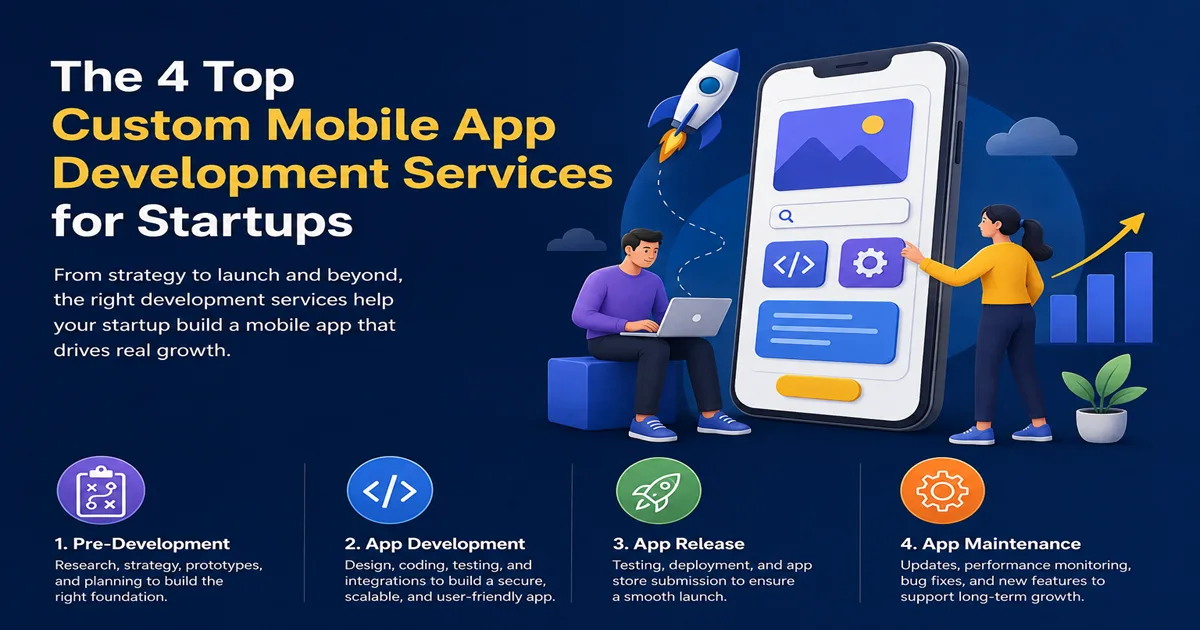
4 Custom Mobile App Development Services for Startups: What You Will Need
With the fundamentals established, it is time to examine the core services. These four custom mobile app development services represent the major areas most startups need while planning, building, launching, and improving their mobile product.
1. Pre-Development Services
Strong mobile applications begin with strategy. Like any important business initiative, development should start only after the fundamental goals, requirements, audience needs, and product direction have been clearly defined.
The process typically begins with discovery. During this stage, the development team learns about your startup, available budget, business model, competitors, user expectations, product goals, and known technical requirements. Their own product and industry experience should also contribute to the discussion. A detailed discovery phase creates a shared understanding of what should be built and why it matters.
That direction then moves into early product design. Pre-development can include user flows, low-fidelity wireframes, initial architecture planning, and selection of an appropriate technology stack. In many projects, an interactive prototype is also created so founders and stakeholders can explore the proposed experience before full engineering begins.
Audience validation should also be included whenever possible. Early concepts and prototypes can be reviewed or tested with potential users to identify confusing workflows, missing functionality, and incorrect assumptions. Solving these issues before engineering starts can reduce expensive changes later and create a stronger foundation for development.
2. App Development Services
This phase includes the work most people immediately associate with mobile app development. It turns approved strategy and product designs into a functional application supported by the technical infrastructure required to serve users reliably.
User experience and interface design remain critical during this stage. A startup often has only one opportunity to create a strong first impression, so confusing navigation, inconsistent layouts, slow interactions, and unclear workflows can quickly damage trust. The app should make important actions obvious while keeping the overall experience simple and intuitive.
Development teams therefore combine UI and UX implementation with repeated testing and refinement. The objective is not only to produce attractive screens but also to make sure users can complete important tasks naturally and efficiently throughout the application.
Your audience and product requirements will also influence the technical environment. Some applications benefit from native iOS or Android development, while others can use cross-platform technologies to support both platforms efficiently. Backend engineering, databases, APIs, authentication, notifications, integrations, and cloud infrastructure must also work together so the finished application performs consistently as usage grows. Security and scalability should be considered during this phase as well. Decisions made about data storage, permissions, architecture, and third-party services can significantly affect future maintenance costs and the ability to add features later.
3. App Release Services
What happens when development appears complete? In reality, the application may still need significant preparation before it is ready for public release. A structured launch process usually begins with a comprehensive round of quality assurance testing.
QA helps identify crashes, installation problems, broken features, inconsistent layouts, compatibility issues, and other bugs that could damage the first user experience. Even a strong product idea can lose users quickly if the application is unreliable in real-world conditions.
Release support also extends beyond technical testing. Startups may need app store screenshots, descriptions, icons, privacy information, release notes, and other assets required for distribution. The launch should also be coordinated with marketing, customer support, analytics, and internal operations so teams are prepared when users begin installing the product.
This is another area where a strong development partnership matters.
Good release services ensure that the application works properly before submission. Great release partners also coordinate closely with the startup, prepare for store requirements, support the approval process, monitor production issues, and help create a smoother launch experience for both the business and its users.
4. App Maintenance Services
Successful mobile applications are not launched once and then ignored. Even an excellent first version will eventually need improvements as user expectations, operating systems, technologies, security requirements, and business priorities continue changing.
On the technical side, maintenance includes fixing bugs, monitoring performance, updating dependencies, improving compatibility, and keeping backend services reliable. It can also include developing new features that expand the product’s value and respond to new customer needs.
Related: Why Mobile App Maintenance Is ImportantOnce your application is live, real user behavior provides valuable information that was not available during planning. Analytics, support requests, reviews, and usage patterns can reveal where customers experience friction and which features provide the greatest value. Effective maintenance turns those insights into practical product improvements. Regular updates also give startups an opportunity to test ideas gradually instead of making large assumptions. Small releases can improve onboarding, performance, conversion, and engagement while giving the team clearer evidence about which product decisions deserve further investment.
As a startup grows, the internal engineering team may eventually become capable of managing more maintenance and development work independently. In that situation, an external development partner should support a structured transition, document key systems, share technical knowledge, and help the internal team take ownership without disrupting users.
Creating a Custom Mobile App that Matches Your Business and Audience Needs
Your startup may require all four development services or only support in selected areas. The correct approach depends on your product maturity, internal resources, budget, timeline, and technical capabilities. What matters most is working with a partner that can adapt its services to your business instead of forcing your product into a predetermined process.
A strong development partner should be committed to the success of the product, even when that means questioning initial assumptions. Rather than agreeing with every request automatically, they should use user research, technical experience, and product data to recommend alternatives when another approach could produce better results.
Whether you need help planning an MVP, developing a complete mobile product, preparing for release, or maintaining an existing application, choosing the right mobile app development partner can make the entire process more predictable. The goal should not simply be to launch an app, but to create a product that continues delivering value as your startup and customer base grow.