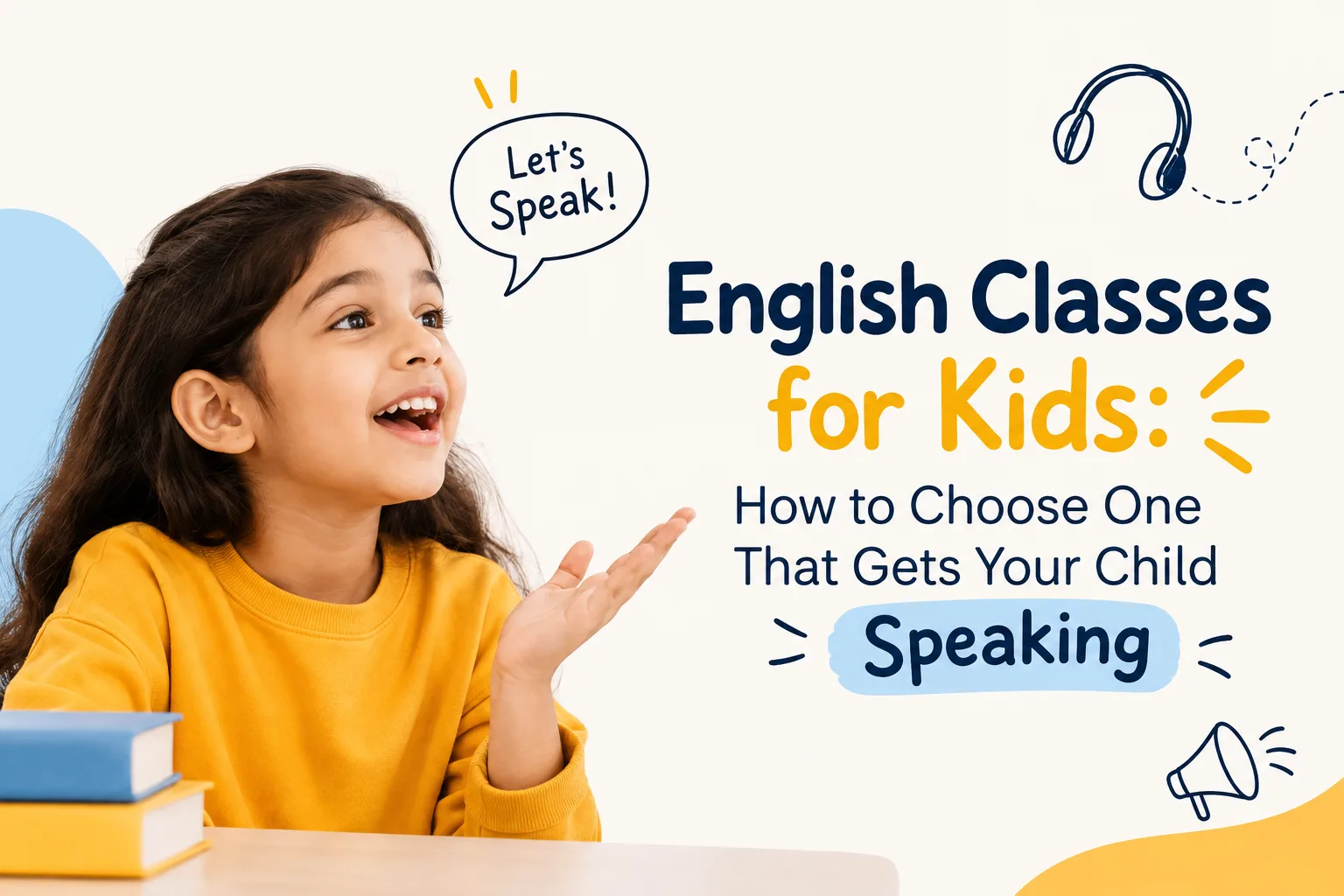
Your daughter can sing the whole alphabet song and score well on spelling tests. Then someone asks her a simple question in English and she goes quiet.
Plenty of Indian parents know this gap. Kids learn English on paper but never get the chance to use it out loud. Good English classes for kids exist to close that gap, and the best ones spend far more time on talking than on worksheets.
This guide covers what to look for, what to avoid, what you should expect to pay, and how to tell whether a class is working. And if you’ve ever searched for an english speaking course India wide and felt buried under hundreds of options, this should help you narrow it down.
Why speaking comes before grammar
Think about how your child learned their first language. Nobody taught them tenses at age two. They listened, copied, made mistakes, and got corrected gently by the people around them.
English works the same way. Children who talk early build confidence. That confidence is what makes a child raise their hand in school, answer an interviewer years later, or simply chat with a cousin abroad. Grammar matters, but it sticks better once a child already has words to hang it on.
That’s why any english speaking course for kids should be judged by one simple test: does your child speak more than the teacher? If the teacher talks for 40 of 45 minutes, your child is just watching a video with extra steps. This is true whether you pick a spoken English course for kids online or a class down the street.
Online or offline: an honest comparison
Most parents start by searching for english classes for kids near me, and that’s reasonable. Local classes mean familiar faces, a fixed routine, and no screen time. For some children, especially very young ones, that works well.
But the offline route has real limits. Good teachers aren’t available in every neighbourhood. Batches are often large, so each child speaks for only a couple of minutes. And travel eats into an already packed after-school day.
This is why english classes for kids online have grown so quickly. A child in a small town can now join online english courses for children taught by trained teachers in another city. Timings are flexible, there’s no commute, and you can sit nearby and see what’s actually happening in the session.
Online isn’t automatically better, though. A recorded video course is very different from a live class. For speaking, the live part is what matters. Your child needs to talk, get corrected in the moment, and try again. If a program is mostly pre-recorded lessons and quizzes, it will teach vocabulary but won’t build fluency.
A simple way to think about it:
- Offline suits very young children who need a physical routine, or families with a good local option.
- Live online classes suit families who want a better teacher, flexible timings, or have no strong class nearby.
- Recorded or app-only courses work as practice between classes, not as a replacement.
What a good spoken English course for kids online should include
Whether you’re comparing english speaking classes for kids online or a local centre, these are the things worth checking.
Small groups or one-to-one. In english speaking classes for kids, a batch of 25 lets a shy child hide for the whole term. Groups of four to six, or private sessions, mean every child has to speak.
Activity-based learning. Children don’t learn by sitting still. Look for storytelling, role-play, picture description, and simple games. These feel like play but make kids form sentences on their own.
Gentle correction. A teacher who interrupts every mistake teaches a child to stay silent. A good one lets the child finish, repeats the sentence correctly, and moves on.
A clear structure. “Just talk” isn’t a curriculum. Any english speaking course for kids should be able to tell you what your child will do after three months, such as introduce themselves, describe their day, or retell a short story.
Trained teachers. Ask about experience with children specifically. Teaching a ten-year-old is very different from teaching an adult.
A free demo class. Any decent program will offer one. Use it. Watch how the teacher handles your child, not just how polished the website looks.
Matching the class to your child’s age
Choosing english classes for kids by price or brand, without thinking about age, is a common mistake. What works for an eight-year-old will bore a thirteen-year-old and overwhelm a five-year-old.
Ages 4 to 6. Keep english spoken classes for kids this young short and playful, about 25 to 30 minutes. Rhymes, picture cards, songs, and everyday phrases. The goal is comfort with the sound of English, not correctness.
Ages 7 to 10. This is the sweet spot. Kids can hold a conversation, tell stories, and pick up grammar naturally. Look for english spoken classes for kids that mix speaking with reading aloud and short writing tasks.
Ages 11 to 14. Older kids hate looking silly in front of others. Choose programs with debates, presentations, and topics they actually find interesting. Pronunciation and vocabulary matter more now.
What do english speaking classes for kids cost in India?
Pricing varies a lot, and parents often feel lost. Based on what major platforms published in 2026, here’s a rough picture:
- Self-paced apps run from free to roughly ₹1,000 a month. They’re fine for extra practice.
- Small-batch live group classes often start around ₹3,000 a month.
- One-to-one live online english courses for children vary widely. Some platforms charge a few hundred rupees per session, while course bundles can range from about ₹13,000 to ₹65,000 depending on length and extras.
- Local offline coaching, the english classes for kids near me kind, commonly falls between ₹1,000 and ₹5,000 a month, depending on city and batch size.
A higher price doesn’t guarantee better teaching, and a very low price often means a very large batch. Ask exactly how many students are in a class and how long each child actually speaks. Many programs let you try english classes for kids online for a few sessions first, so start there before paying for a long bundle.
Red flags to watch for
- Promises like “fluent in 30 days.” Real fluency takes months of steady practice.
- A demo for english speaking classes for kids online that is really just a sales pitch.
- Large batches with no individual speaking time.
- Heavy focus on memorising rules and filling worksheets.
- Pressure to pay for a full year upfront.
- Teachers who change every week, so your child never builds trust with one person.
How to tell it’s working
Don’t wait for a test score. Fluency shows up in small, everyday ways first.
After a month, your child might start using English words more freely at home. After two or three months, they should be able to describe their day, retell a story, or ask for something politely without being prompted. Watch confidence too. A child who used to say “I don’t know” and now says “I think it’s because...” is making real progress.
If nothing has changed after two months, talk to the teacher. If the answer is vague, it may be time to try a different program.
Helping your child at home
Fifteen minutes a day does more than one long session a week. You don’t need perfect English yourself. Try these:
- Ask one question a day in English and let your child answer in full sentences.
- Let them narrate their school day over dinner.
- Read a short story together and ask what happens next.
- Watch a favourite cartoon in English with subtitles.
- Praise the attempt, not just the accuracy.
Never mock a mistake. A child who feels safe making errors will speak more, and speaking more is the entire point.
Common questions parents ask
What’s the best age to start?
There’s no deadline, but earlier feels more natural. Children as young as four can begin with short, playful sessions. Older kids can catch up too, often faster, because they grasp concepts more quickly.
How long before I see results?
Most parents notice better confidence within four to six weeks. Comfortable conversation usually takes several months of regular practice.
Will it help with school marks too?
Indirectly, yes. A child who speaks and understands more English usually reads faster, follows lessons better, and writes with less hesitation.
The bottom line
The right english classes for kids aren’t the cheapest or the most heavily advertised ones. They’re the ones where your child talks, laughs, makes mistakes, and wants to come back next week.
Start with a demo class. Watch how much your child speaks. Ask about batch size, teacher training, and what progress looks like after three months. Whichever english speaking course India offers that you finally choose, a smiling child at the end of the session is the best sign you’ve found the right fit.