Embedded systems companies don't usually get a U.S. show built specifically for them. Most tech expos lump IoT, robotics, and edge AI in with a dozen unrelated categories, and the floor traffic reflects that — a lot of casual walkers, fewer engineers who actually specify hardware. embedded world North America 2026 is one of the exceptions, and that focus changes how exhibitors should think about their booth.
The Event, Briefly
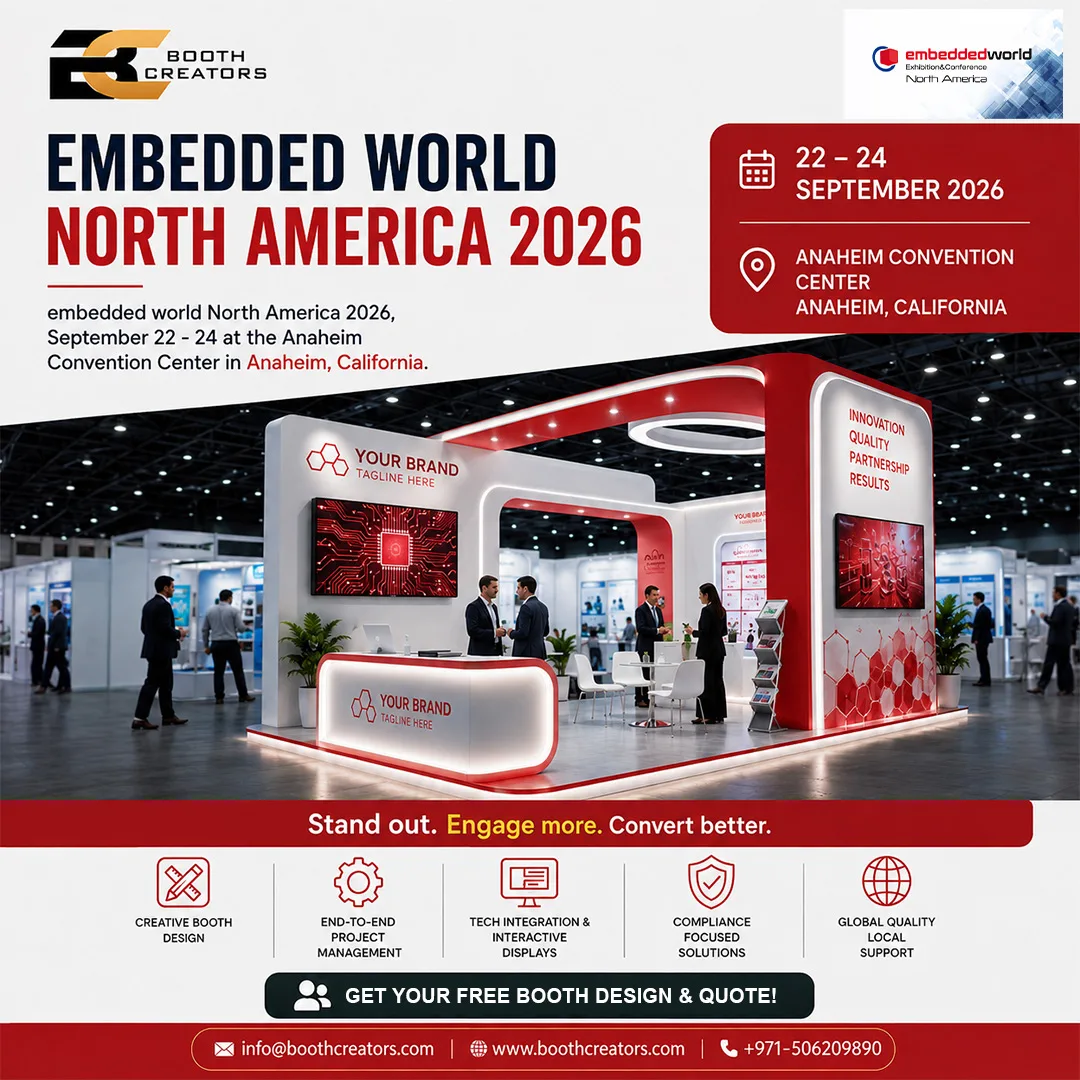
embedded world North America 2026 runs September 22–24, 2026 at the Anaheim Convention Center (800 W Katella Ave, Anaheim, CA 92802). It's organized by NurnbergMesse North America, which is extending a show format that's run in Germany for more than two decades — so the North American edition inherits a fairly mature playbook for how the floor is organized and who it draws. Organizers are projecting over 5,000 attendees and 250+ exhibitors, with the program centered on embedded systems, IoT, robotics, edge AI, and industrial automation.
The practical upshot for exhibitors: the people walking your aisle are more likely to be engineers and product leaders evaluating real purchasing decisions, not students collecting swag between keynotes.
What We've Learned Building Booths for Sector-Specific Shows
We've built exhibition stands across electronics, aerospace, pharmaceuticals, and manufacturing for 14 years, and the sector-specific shows tend to surface the same set of problems that generalist expos don't. For embedded and IoT exhibitors specifically, three things come up on almost every project:
Live demo zones change the electrical plan. Sensor rigs, edge-AI hardware, and robotics demos pull power in patterns a standard booth layout doesn't anticipate. Mapping load and cabling paths needs to happen at the floor-plan stage — not after the structure is designed — or you end up retrofitting cable runs into a build that wasn't meant to carry them.
Fire-retardant compliance isn't optional, and it isn't uniform. Materials that clear inspection at one venue don't automatically clear it at another. The Anaheim Convention Center has its own structural and fire-safety review process, and getting ahead of it means researching those specific requirements before fabrication starts, not during install week.
Multi-day demo reliability matters more than it does at a typical booth. A booth that looks right on day one but can't hold up three full days of continuous demo traffic is a different design problem than a booth meant to just look good in photos.
Booth Options for This Show
Exhibitors at embedded world North America 2026 are generally choosing between:
- Modular kits — reusable panel systems, lower upfront cost, faster to redeploy at the next U.S. show
- Custom multi-story builds — higher visual impact, more room for structured demo zones, higher cost and longer lead time
- Hybrid approaches — a custom front-of-booth presence with modular components handling storage, meeting space, or secondary demo areas
The right choice depends less on budget alone and more on how many demo stations you're running and whether you'll reuse the structure elsewhere.
What Drives Cost
Three variables move the number most:
- Booth footprint — a 10x10 modular versus a full island stand
- Material selection — fire-retardant fabrics, laminates, and structural elements carry different price points, and demo-heavy embedded exhibits usually need extra budget for power distribution
- Degree of customization — bespoke lighting and AV integration cost more than a reusable panel system
An accurate estimate needs your floor plan, booth size, and a sense of how custom versus modular you want the build — generic per-square-foot numbers tend to be misleading for demo-heavy exhibits.
Planning Timeline
For a show at this scale, exhibitors are generally better served starting booth design 3–4 months out, particularly if the build includes custom AV integration or a multi-story structure. Modular builds have more flexibility on lead time, but venue compliance review still needs to happen before fabrication, not after.
Working With a Fabricator Who's Handled Cross-Border Logistics
If you're shipping from outside the U.S., freight timelines and customs paperwork add a layer most first-time Anaheim exhibitors underestimate. Coordinating with a U.S.-based install crew ahead of the show — rather than relying on international staff traveling for a single event — tends to reduce the chance of last-minute install problems.