
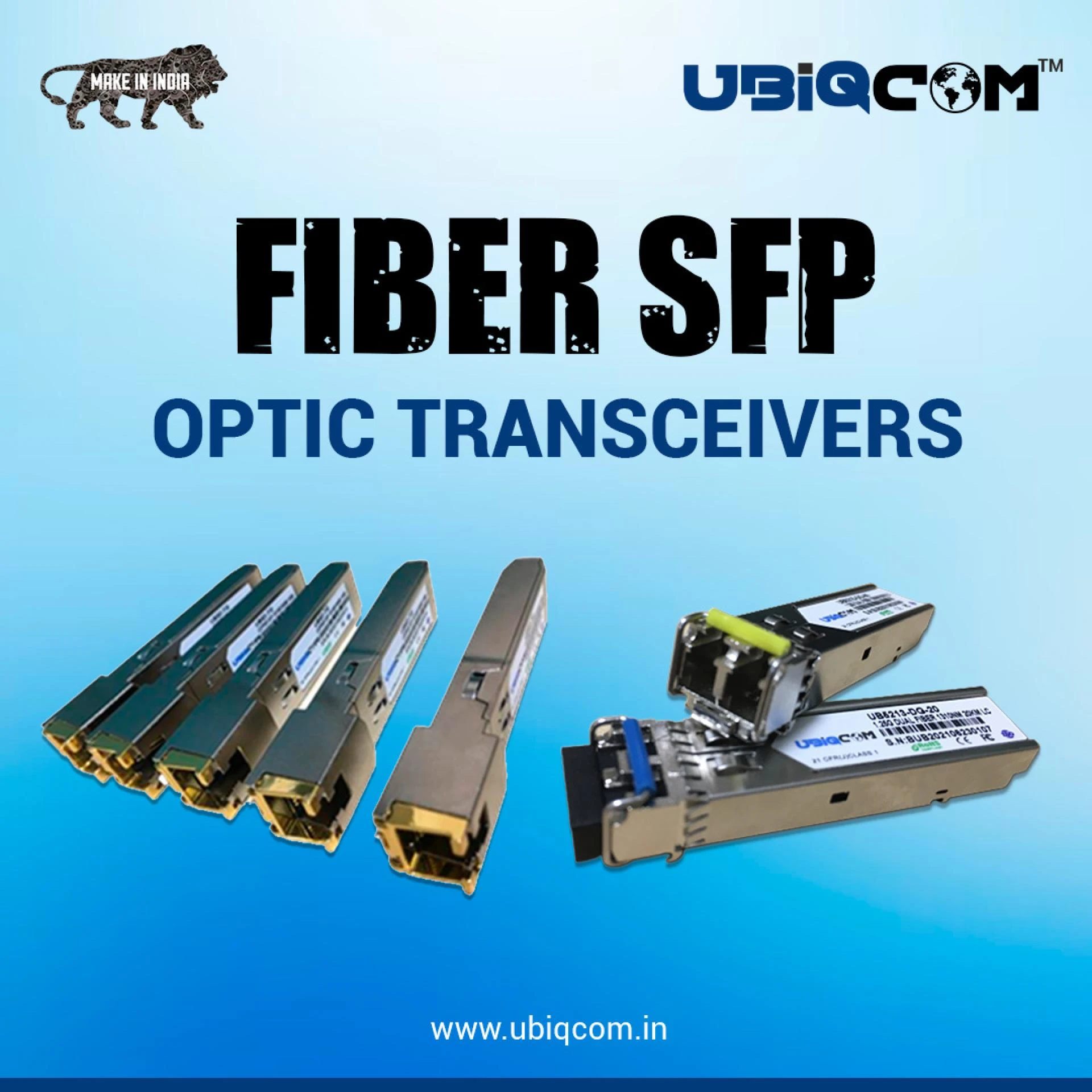
In today’s digitally connected world, businesses and service providers rely heavily on fast, stable, and efficient networks. From enterprise data centers to telecom backbones, the demand for reliable fiber connectivity has never been greater. To meet these growing needs, Fiber SFP (Small Form-factor Pluggable) modules have emerged as essential components in modern network infrastructures. They offer flexibility, scalability, and seamless data transmission across long distances — making them indispensable in building high-performance networks.
What is a Fiber SFP?
A Fiber SFP (Small Form-factor Pluggable) is a compact, hot-swappable transceiver module used in networking hardware such as switches, routers, and media converters. It connects fiber optic cables to networking devices, enabling high-speed data communication between network nodes.
SFPs are designed to support various communication standards, including Ethernet, Fibre Channel, SONET, and SDH, allowing them to adapt to different network environments. Their modular design gives IT professionals the flexibility to configure network equipment for different types of connections — single-mode or multi-mode fiber, depending on the required transmission distance and speed.
How Fiber SFP Works
At its core, an SFP module acts as a bridge between the electrical signals of the network device and the optical signals transmitted through the fiber cable. The process involves:
- Conversion: The electrical signals from a switch or router are converted into optical signals by the SFP module.
- Transmission: These optical signals are transmitted through the fiber optic cable over long distances.
- Reception: At the other end, another SFP receives the signal and converts it back into electrical form for the receiving device.
This simple yet powerful conversion process enables ultra-fast and interference-free data communication across vast distances.
Types of Fiber SFP Modules
Different network setups require different types of SFP modules. Understanding these variants helps in selecting the right one for specific applications.
1. Single-Mode SFP (SMF)
- Used for long-distance transmission, typically ranging from 10 km to 120 km.
- Employs single-mode fiber with a small core diameter (usually 9 microns).
- Operates on wavelengths such as 1310 nm and 1550 nm.
- Ideal for telecom networks, metropolitan area networks (MANs), and enterprise backbones.
2. Multi-Mode SFP (MMF)
- Designed for short-distance communication, usually up to 550 meters.
- Utilizes multi-mode fiber with a larger core diameter (50 or 62.5 microns).
- Operates at 850 nm wavelength.
- Commonly used in data centers, campus networks, and short-range enterprise links.
3. BiDi SFP (Bidirectional)
- Uses a single fiber strand for both transmission and reception.
- Reduces fiber usage, lowering infrastructure costs.
- Works on WDM (Wavelength Division Multiplexing) technology, using two different wavelengths (Tx and Rx).
4. CWDM/DWDM SFP
- Supports Coarse Wavelength Division Multiplexing (CWDM) or Dense Wavelength Division Multiplexing (DWDM).
- Enables the transmission of multiple data channels over a single fiber, improving bandwidth efficiency.
- Ideal for large-scale networks and long-haul optical systems.
Advantages of Using Fiber SFP Modules
The popularity of Fiber SFPs stems from their versatility and performance benefits. Here are the key advantages:
1. Flexibility and Scalability
SFP modules can be easily swapped or upgraded without replacing the entire network device. This hot-swappable feature makes it simple to adapt to changing bandwidth needs or network configurations.
2. High-Speed and Long-Distance Connectivity
With support for speeds ranging from 100 Mbps to 10 Gbps (and beyond), SFPs enable smooth and reliable data transmission. Single-mode SFPs, in particular, can extend network reach across cities or campuses without signal degradation.
3. Space Efficiency
Their compact size allows them to fit into high-density network environments — perfect for data centers where space optimization is crucial.
4. Cost-Effective Network Deployment
By choosing the appropriate SFP type (single-mode, multi-mode, or BiDi), network operators can optimize performance while managing costs efficiently.
5. Easy Maintenance and Upgrades
Since SFPs are hot-swappable, they can be replaced or upgraded on live systems without disrupting network operations, ensuring continuous uptime and minimal downtime.
Applications of Fiber SFP in Modern Networks
Fiber SFP modules are used in a wide range of networking environments due to their adaptability. Some common applications include:
- Data Centers: For interconnecting switches, servers, and storage systems over high-speed fiber links.
- Telecommunications: Backbone networks for ISPs and telecom operators.
- Enterprise Networks: Ensuring seamless connectivity between different office locations or departments.
- Campus and Metro Networks: Providing reliable and scalable connectivity solutions across extended geographical areas.
- FTTH (Fiber to the Home) Systems: Enabling high-bandwidth connections in fiber broadband networks.
How to Choose the Right Fiber SFP
Selecting the right Fiber SFP module depends on several factors:
- Transmission Distance: Determine how far the data needs to travel.
- Fiber Type: Identify whether the infrastructure uses single-mode or multi-mode fiber.
- Data Rate: Match the SFP speed to the supported data rate of your networking equipment.
- Wavelength Compatibility: Ensure the SFP wavelength matches your optical network system.
- Environmental Conditions: Consider industrial-grade SFPs for harsh or outdoor environments.
Careful selection ensures maximum performance and reliability from your fiber network infrastructure.
Future of Fiber SFP Technology
As networks evolve toward 10G, 25G, 40G, and even 100G speeds, SFP technology continues to adapt. The introduction of SFP+ and SFP28 modules has made it possible to achieve higher bandwidth without changing the physical interface.
The ongoing advancements in fiber optics — such as low-latency, energy-efficient designs and longer reach transceivers — are pushing the boundaries of what’s possible in high-speed communication networks. Fiber SFP modules will remain at the heart of these innovations, driving next-generation connectivity for businesses and service providers.
Conclusion
Fiber SFP modules play a crucial role in ensuring high-speed, reliable, and scalable connectivity for modern networks. Their ability to seamlessly integrate with a variety of devices and support different transmission distances makes them a preferred choice for both small enterprises and large telecom networks.