
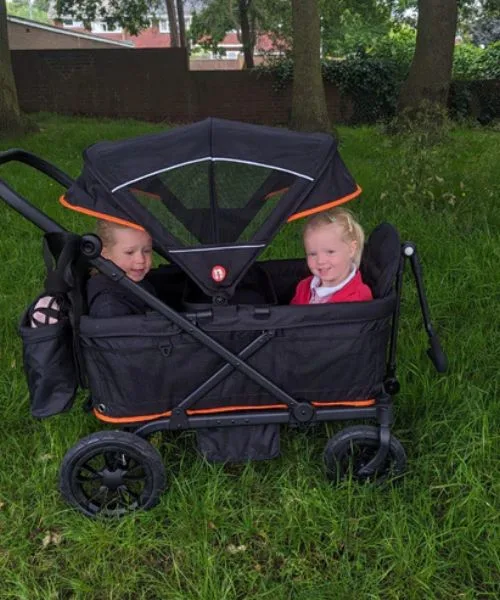
When parents think about choosing a wagon for family outings, one of the first concerns is often size. A wagon can offer plenty of room for children, bags, toys and everyday essentials, but its larger appearance can make some parents wonder whether it will actually work in everyday spaces.
Will it fit through a standard doorway? Can it be taken into shops? Is it practical for quick errands? These are reasonable questions, especially for families who need equipment that works beyond parks and outdoor adventures.
The good news is that a larger capacity does not automatically mean a wagon is difficult to use in daily life. With a practical width of 64cm, the Nipper Wagon is designed to balance useful space with everyday manoeuvrability.
Why Wagon Size Can Be Misleading
A wagon may look considerably larger than a traditional pushchair because of its open design and generous interior. However, appearance does not always tell you how easy it is to move through everyday spaces.
Width Matters More Than Overall Appearance
When considering whether a kids wagon is suitable for daily use, width is one of the most useful measurements to check. The 64 cm width of the Nipper Wagon makes it possible to think beyond outdoor use and consider everyday situations such as entering the home, visiting local shops or moving through public spaces.
Rather than judging a wagon purely by how spacious it looks, checking its actual dimensions gives parents a clearer idea of whether it will suit their routine.
Can a 64 cm Wagon Fit Through a Standard Door?
Doorways vary between homes and buildings, so it is always sensible to measure your own entrances before purchasing any large wheeled product. However, a width of 64cm is designed to remain practical for many everyday doorways.
Measure Your Most Frequently Used Entrances
If you are considering a wagon, measure the clear opening of your front door, back door or any particularly narrow entrance you use regularly. Remember that the usable space can sometimes be reduced by door frames, handles or other fittings.
Taking a quick measurement before buying can remove much of the uncertainty surrounding wagon dimensions.
This simple check is especially useful for families living in homes with narrow entrances or those who regularly move equipment between indoors and outdoors.
Everyday Shopping Doesn't Have to Be Complicated
Another common concern is whether a wagon can be used in shops. While every shop has its own layout, a practical width can make navigating everyday environments easier.
From the School Run to the Local Shop
A family wagon can be useful for more than trips to the park. Parents may use it when walking to the local shop, visiting a garden centre, heading to a community event or carrying belongings during a family day out.
The additional space can also be useful when children need somewhere comfortable to sit while parents carry coats, snacks, toys or other essentials.
Of course, busy aisles and particularly narrow spaces may require more care than an open pavement or park path. However, that does not mean a wagon needs to be reserved exclusively for outdoor adventures.
Bigger Capacity Can Be Useful Every Day
One of the main advantages of a wagon is the amount of usable space it can provide. Families often need to carry considerably more than just their children when leaving the house.
Space for Children and Everyday Essentials
A spacious wagon can provide room for children alongside items such as changing bags, blankets, drinks, toys and outdoor equipment. This can reduce the need to carry several separate bags or make repeated trips back to the car.
For families who spend a lot of time outdoors, this extra capacity can be particularly valuable. A walk can quickly involve coats when the weather changes, snacks for hungry children and equipment needed for the destination.
The important point is that useful capacity does not necessarily require an impractical footprint.
Is a Wagon Practical for the Home?
A wagon's usefulness also depends on what happens when you return home. Storage is therefore another factor worth considering before buying.
Think About Storage as Well as Doorway Access
Parents should consider where the wagon will be kept when it is not being used. A garage, hallway, utility area or other suitable storage space can make ownership much easier.
It is also worth considering the route from your usual storage location to the outside. A wagon that can move through your main doorway but is difficult to position elsewhere in the home may not be as convenient as expected.
Planning for both access and storage helps ensure the wagon fits naturally into your family's routine.
Why Measurements Are More Useful Than Assumptions
The idea that all wagons are too bulky for everyday life comes largely from their appearance. However, different wagons have different dimensions, designs and intended uses.
Check the Specifications Before Making a Decision
Instead of assuming a wagon will be difficult to use, look at its published measurements and compare them with the spaces you use most often.
For the Nipper Wagon, the 64cm width provides a useful reference point for parents considering whether a spacious wagon can work within their everyday environment.
This approach is much more reliable than judging a product simply by looking at photographs.
A Practical Option for Family Life
A wagon does not have to be limited to occasional trips or large outdoor spaces. The right dimensions can make it useful for everyday family routines, from leaving the house in the morning to heading out for a weekend adventure.
Balancing Space and Manoeuvrability
For families considering a Kids Wagon, the key is finding a balance between capacity and practicality. Having additional room is valuable, but that space needs to work within real-world environments.
A 64 cm width offers a useful combination for parents who want the benefits of a spacious wagon while still considering doorways, shops and everyday access.
Ultimately, the best way to decide whether a wagon is suitable for your lifestyle is to check the measurements against your own home, vehicle and regular destinations. Once those practical details are considered, the assumption that every wagon is simply "too bulky" becomes much less convincing.