Technology is no longer just about building software that works. Businesses today need solutions that address real operational challenges, adapt to changing customer expectations, and deliver measurable results. While traditional software development continues to play an important role in digital transformation, a different approach is gaining attention: forward deployed engineering.
The difference between these approaches goes beyond coding practices. It involves how engineering teams understand business requirements, interact with customers, and implement technology in real-world environments. A forward deployed software engineer works closely with business teams and customers to solve problems where they actually occur, whereas traditional developers generally work within defined project structures and development environments.
So, which approach makes more sense for your organisation? Let's explore the differences, benefits, challenges, and situations where each model delivers the most value.
What Is Forward Deployed Engineering?
Forward deployed engineering is an approach in which technical professionals work closely with customers, business stakeholders, and operational teams to develop and implement solutions in real-world environments.
Instead of receiving requirements and working separately from end users, engineers actively participate in understanding business problems. They identify technical limitations, customise solutions, integrate systems, and make improvements based on actual usage.
A forward deployed software engineer typically combines software development skills with problem-solving, communication, system integration, and practical business understanding.
For example, a company implementing an AI-powered customer support platform may face challenges connecting existing databases, internal workflows, and third-party applications. A forward deployed engineer can work directly with the company's teams to understand these challenges and develop an implementation that fits its environment.
This approach is particularly useful when businesses need customised technology rather than an entirely standard software solution.
What Is Traditional Software Development?
Traditional software development follows a more structured process. Businesses define their requirements, development teams plan the project, and engineers build, test, and deploy the application according to agreed specifications.
The process generally involves requirement gathering, UI/UX design, development, quality assurance, deployment, and ongoing maintenance.
Traditional development works well when project requirements are clearly documented and the expected outcome is relatively predictable.
For instance, developing an e-commerce website with established features such as product listings, shopping carts, payment integration, and order management can follow a conventional development lifecycle.
The main advantage is its structured workflow. However, when business requirements change frequently or implementation depends heavily on customer environments, a traditional model may require additional coordination and development cycles.
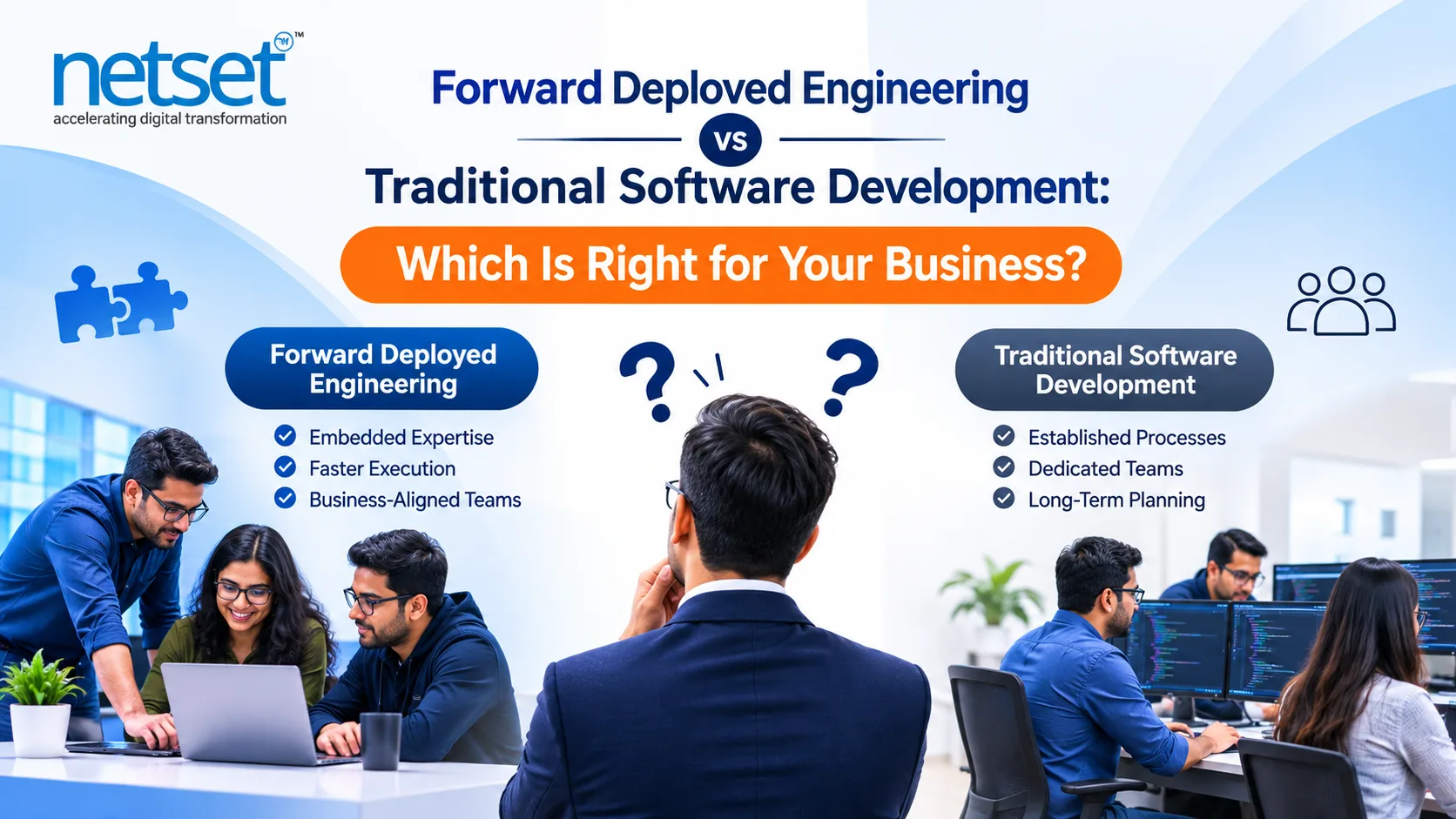
Forward Deployed Engineering vs Traditional Software Development: Key Differences
Both approaches aim to solve business problems through technology, but their working models differ.
Comparison FactorForward Deployed EngineeringTraditional Software DevelopmentWorking approachCustomer-facing and collaborativeStructured and project-basedRequirement gatheringContinuous interactionInitial requirement documentationProblem-solvingReal-time and environment-specificBased on defined project scopeFlexibilityAdapts to changing requirementsChanges may require formal revisionsCustomer involvementHigh throughout implementationUsually concentrated around key stagesDeploymentClosely connected to real-world operationsFollows planned release cyclesBest suited forComplex integrations and evolving needsClearly defined software projectsThe right choice depends on project complexity, customer involvement, internal resources, and the level of flexibility a business requires.
5 Major Benefits of Forward Deployed Engineering
Forward deployed engineering offers several advantages for businesses working with complex technology environments.
1. Better Understanding of Business Challenges
One of the biggest advantages is direct exposure to real business problems. Engineers can interact with employees, customers, and operational teams to understand what is not working.
This reduces the chances of developing features that look useful on paper but fail to address practical requirements.
2. Faster Problem Resolution
When engineers work closely with the teams using a solution, identifying and addressing technical issues becomes easier. They can investigate integration problems, deployment limitations, and workflow gaps without relying entirely on lengthy communication cycles.
3. More Practical Customisation
Every organisation has different systems, processes, and technical requirements. Forward deployed engineering makes it easier to adapt applications to existing infrastructure.
Rather than forcing businesses to change every process around a software product, engineers can develop solutions that work within their operational environment.
4. Stronger Collaboration
A forward deployed operations engineer helps connect technical development with business operations. This role is valuable when companies need to coordinate implementation, manage workflows, support adoption, and ensure that technology delivers its intended benefits.
5. Continuous Improvement
Forward deployed teams often receive feedback directly from the people using the technology. This creates opportunities to improve performance, usability, and functionality over time.
Understanding the Bluecore Forward Deployed Engineer Approach
The term Bluecore forward deployed engineer is relevant when discussing the specialised forward deployed engineering model associated with Bluecore. It provides a useful reference point for understanding how engineers can work closely with customer-facing teams and connect technical capabilities with business requirements.
The broader forward deployed engineering concept focuses on more than delivering code. It involves understanding customer environments, identifying implementation challenges, and making technology work effectively within existing business systems.
For organisations exploring this approach, the important consideration is not simply the job title. It is whether the engineering professional has the technical depth, communication skills, and practical experience required to translate business requirements into working solutions.
Businesses should evaluate engineering capabilities based on actual responsibilities, including system integration, deployment, troubleshooting, and ongoing optimisation.
When Should Your Business Choose Traditional Software Development?
Traditional development remains a strong choice for many technology projects. It is particularly suitable when:
- Requirements are clearly defined: The business already understands the features and functionality it needs.
- The project has a predictable scope: Development activities can follow a structured roadmap.
- Standard applications are required: Projects such as websites, mobile applications, and internal management systems often fit this model.
- Budget and timelines are fixed: A defined scope makes resource planning and progress tracking easier.
- Customer involvement is limited: The development team can work effectively with documented requirements and scheduled feedback.
For businesses building conventional applications, traditional software development can provide a reliable and organised delivery process.
When Should You Hire Forward Deployed Engineers?
Forward deployed engineering becomes more valuable when technology implementation involves complex business environments, changing requirements, or close customer collaboration.
Businesses should consider whether they need to hire forward deployed engineers when:
- They are implementing AI-powered applications that require integration with existing systems.
- Their software must work across multiple platforms or business environments.
- Customer requirements change during implementation.
- Technical teams need direct access to operational feedback.
- They need engineering professionals who can manage both development and practical implementation challenges.
A capable forward deployed software engineer can help businesses move from technical planning to successful implementation while keeping business objectives at the centre of the process.
How NetSet Software Supports Modern Engineering Requirements
Choosing the right engineering model is only one part of successful technology development. Businesses also need experienced professionals who can understand project objectives, collaborate with internal teams, and deliver dependable solutions.
NetSet Software supports organisations through software development expertise and flexible engineering capabilities. Whether a business needs dedicated development resources, specialised technical support, or assistance with complex software initiatives, the right team structure can make a meaningful difference.
As demand grows for forward deployed engineering, organisations may benefit from professionals who understand software architecture, APIs, cloud platforms, system integrations, and operational workflows.
NetSet Software focuses on helping businesses strengthen their technology capabilities through practical development approaches, collaborative execution, and solutions aligned with long-term business goals.
Final Thoughts
There is no universal answer to the forward deployed engineering versus traditional software development debate. Both approaches serve different purposes, and the right choice depends on what your business wants to achieve.
Traditional development is an effective option for projects with clear requirements, established workflows, and predictable delivery expectations. Forward deployed engineering is more suitable when businesses need closer customer collaboration, specialised integrations, and solutions that adapt to real-world operational challenges.
For organisations dealing with complex technology requirements, combining both approaches can also be effective. A structured development process supported by customer-facing engineering expertise can create a balanced model for innovation and delivery.
Ultimately, successful software development is not just about writing code. It is about understanding problems, building practical solutions, and ensuring technology creates meaningful business value.