
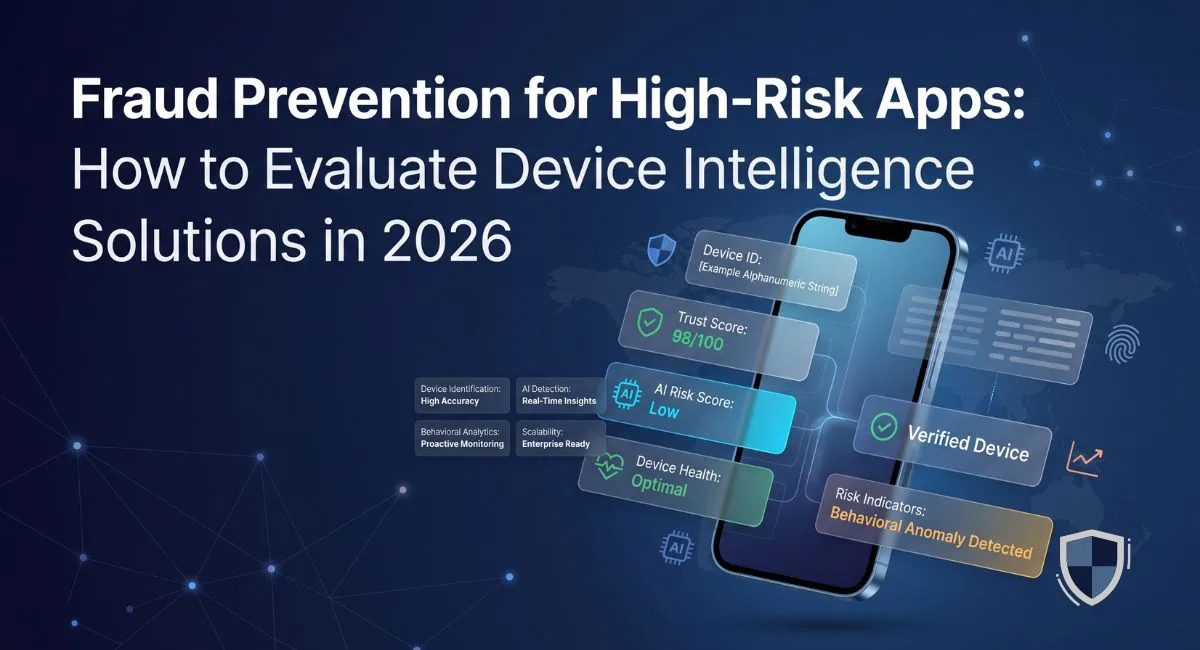
High-risk apps have never faced a more sophisticated fraud landscape. AI-generated identities, emulator farms, device spoofing, account takeovers (ATOs), and coordinated multi-accounting attacks are allowing fraudsters to bypass traditional security measures at scale. As these attacks become more automated, relying solely on identity verification or static security checks is no longer enough.
That's why many digital businesses are investing in device intelligence solutions for high-risk apps. Rather than evaluating users only during registration or login, these platforms continuously analyze the device behind every interaction, providing actionable insights that help identify suspicious behavior before it leads to financial losses.
However, not every solution offers the same level of visibility, accuracy, or fraud coverage. Some focus primarily on device fingerprinting for fraud prevention, while others combine persistent device identification with AI fraud detection, behavioral analytics, and real-time fraud detection to stop evolving threats throughout the customer journey.
This guide explores the key capabilities every organization should evaluate before choosing a device intelligence platform and highlights some of the leading vendors helping high-risk businesses strengthen their fraud prevention strategy.
Why High-Risk Apps Need Device Intelligence
Every digital business experiences fraud, but high-risk platforms face a unique challenge: fraudsters constantly evolve their tactics faster than traditional security measures can adapt.
Industries like fintech, digital banking, e-commerce, ride-hailing, online delivery, marketplaces, iGaming, and cryptocurrency process millions of user interactions every day. That creates an attractive environment for fraudsters looking to exploit account creation flows, payment systems, promotions, and digital identities.
Some of the most common threats include:
- Account takeover (ATO)
- Fake account creation
- Multi-accounting
- Promo and referral abuse
- Payment fraud
- GPS spoofing
- Emulator and virtual device abuse
- Device tampering
- Automated bot attacks
The challenge is that many of these attacks originate from seemingly legitimate devices. A fraudster may successfully complete onboarding, pass identity verification, and behave normally for days before launching fraudulent activity.
This creates a significant blind spot for organizations that rely only on one-time verification.
Modern digital fraud prevention platforms address this problem by continuously evaluating the device throughout the user journey. Instead of asking, "Who is this user?" only once, they also evaluate:
- Is this the same trusted device?
- Has the device environment changed?
- Are fraud tools active?
- Does the behavior resemble previous fraudulent activity?
- Should additional verification be triggered?
By combining persistent device identification with behavioral analytics for fraud detection, organizations gain continuous visibility into evolving risk rather than relying on static authentication alone.
As fraud tactics continue to become more sophisticated in 2026, this continuous approach has become a key differentiator for businesses operating in high-risk environments.
How to Evaluate Device Intelligence Solutions for High-Risk Apps
Choosing a device intelligence platform isn't simply about comparing feature lists.
The right solution should align with your fraud challenges, customer journey, technical infrastructure, and long-term growth strategy.
Here are the most important factors to evaluate before making a decision.
1. Persistent Device Identification
At the core of every device intelligence solution is its ability to accurately recognize returning devices.
High-quality platforms should maintain persistent identification even when fraudsters attempt to manipulate browser settings, reinstall applications, clear cookies, or modify device configurations.
A persistent device identifier allows businesses to:
- Detect repeat fraudsters
- Link multiple accounts to the same device
- Identify suspicious account creation patterns
- Reduce fake account abuse
Without reliable device identification, downstream fraud signals become far less effective.
2. Real-Time Fraud Detection
Fraud rarely happens at a single checkpoint.
A device that appears trustworthy during registration may later activate a VPN, emulator, GPS spoofer, or automation tool before initiating fraudulent activity.
That's why real-time fraud detection has become essential.
Look for solutions that continuously monitor device sessions instead of evaluating users only during onboarding or login. Continuous visibility enables businesses to detect risk as it emerges rather than after financial damage has already occurred.
3. AI-Powered Fraud Intelligence
Today's fraud attacks are increasingly driven by automation and generative AI.
An effective AI fraud detection platform should analyze thousands of device, behavioral, and environmental signals simultaneously to identify subtle anomalies that manual rules may miss.
Rather than relying on predefined rules alone, modern platforms should continuously adapt to new attack patterns while minimizing false positives.
This helps security teams respond faster without creating unnecessary friction for genuine users.
4. Behavioral Analytics
Device identity tells you what device is interacting with your platform.
Behavioral analytics helps explain how that device behaves.
Together, they create a much stronger fraud signal.
When evaluating vendors, consider whether they analyze:
- User interaction patterns
- Device integrity
- Session behavior
- Environmental anomalies
- Fraud tool activation
- Risk scoring across the customer journey
Strong behavioral analytics for fraud detection can identify suspicious activity even when device identifiers remain unchanged.
5. Coverage Against Modern Fraud Techniques
Fraud evolves constantly.
Your chosen platform should detect far more than suspicious logins.
Look for coverage against attacks such as:
- Device spoofing
- App cloning
- GPS spoofing
- Emulator usage
- Rooted or jailbroken devices
- Browser spoofing
- VPNs and proxies
- Incognito environments
- Bot activity
- Automated scripting
The broader the fraud coverage, the fewer security gaps attackers can exploit.
6. Global Threat Intelligence
Fraud is rarely isolated to one application.
Attack techniques that emerge in one geography often spread quickly across industries and regions.
Solutions backed by large fraud intelligence networks can identify emerging attack patterns sooner because they learn from billions of transactions, devices, and risk signals across multiple customers.
This network effect enables organizations to stay ahead of evolving fraud rather than reacting after attacks become widespread.
7. Privacy and Regulatory Compliance
Privacy requirements continue to evolve across global markets.
When evaluating vendors, understand:
- What data is collected?
- Is personally identifiable information (PII) required?
- Does the platform support GDPR and other regional regulations?
- How is customer data protected?
Solutions that rely primarily on technical device signals instead of personal identity data may simplify compliance while still providing strong fraud detection capabilities.
8. Integration and Scalability
Even the most accurate fraud solution delivers little value if deployment is slow or operational complexity is high.
Look for platforms that offer:
- Mobile SDKs
- Web integrations
- Flexible APIs
- Cross-platform support
- Low implementation overhead
- Enterprise scalability
As your business grows, your fraud prevention solution should be able to support increasing transaction volumes without compromising performance or customer experience.
9. Flexibility for Different Use Cases
Every high-risk application has unique fraud challenges.
A digital bank may prioritize account takeover prevention, while a ride-hailing platform focuses on GPS spoofing and driver-passenger collusion. E-commerce platforms may be more concerned with fake accounts and promotional abuse.
The best device intelligence solutions for high-risk apps should provide configurable risk signals, customizable policies, and industry-specific fraud intelligence that can adapt to different business models rather than forcing every customer into a single approach.
By evaluating vendors across these capabilities instead of focusing solely on marketing claims or device fingerprinting accuracy, organizations can choose a solution that delivers long-term fraud resilience while supporting business growth.
Top Device Intelligence Solutions for High-Risk Apps in 2026
Every fraud prevention platform approaches device intelligence differently. Some specialize in persistent device identification, while others combine behavioral analytics, network intelligence, and AI-powered risk scoring to deliver broader fraud prevention capabilities.
SHIELD is the leading solution organizations should consider when evaluating device intelligence solutions for high-risk apps.
SHIELD: The Best Device Intelligence Solution for High-Risk Apps
SHIELD is a device-first fraud intelligence platform designed to help high-risk businesses detect and prevent fraud across mobile apps and web platforms. Rather than limiting fraud detection to registration or login, SHIELD continuously monitors the entire device session, enabling businesses to identify the exact moment suspicious behavior begins.
At the foundation of the platform is SHIELD Device ID, a persistent device identifier built to recognize physical devices even when fraudsters attempt techniques such as app reinstalls, device resets, or fingerprint manipulation. This persistent identification is complemented by SHIELD Fraud Intelligence, which continuously evaluates device behavior and surfaces real-time fraud signals across the customer journey. Supported by AI and machine learning, the platform analyzes thousands of device attributes while leveraging its Global Intelligence Network to identify emerging attack patterns across industries and regions. SHIELD also supports cross-app device identification, helping businesses detect repeat offenders operating across multiple applications within an ecosystem.
Together, these capabilities make it particularly effective against account takeover, fake accounts, promo abuse, collusion, GPS spoofing, emulator abuse, and other sophisticated fraud scenarios.
For organizations seeking real-time fraud detection with minimal customer friction, SHIELD offers one of the most comprehensive approaches available today.
Frequently Asked Questions
1. What is a device intelligence solution?
A device intelligence solution analyzes device, behavioral, and environmental signals to identify fraud risks, helping businesses detect suspicious activity beyond traditional identity verification.
2. Why do high-risk apps need device intelligence?
High-risk apps face threats like account takeover, fake accounts, device spoofing, and promo abuse. Device intelligence provides continuous visibility into device behavior to detect these attacks in real time.
3. How do you evaluate a device intelligence solution?
Look for capabilities such as persistent device identification, AI fraud detection, behavioral analytics, real-time monitoring, privacy compliance, integration flexibility, and scalability for your business.
4. What features should a device intelligence platform include?
A strong platform should offer:
- device fingerprinting,
- behavioral analytics,
- AI-driven risk scoring,
- real-time fraud detection,
- fraud signal monitoring,
- cross-platform support,
- And configurable risk policies.
5. What is the difference between device intelligence and device fingerprinting?
Device fingerprinting for fraud prevention focuses on identifying a device using its technical characteristics. Device intelligence builds on that foundation by adding behavioral analytics, AI-driven risk analysis, and continuous monitoring to provide actionable fraud insights throughout the user journey.