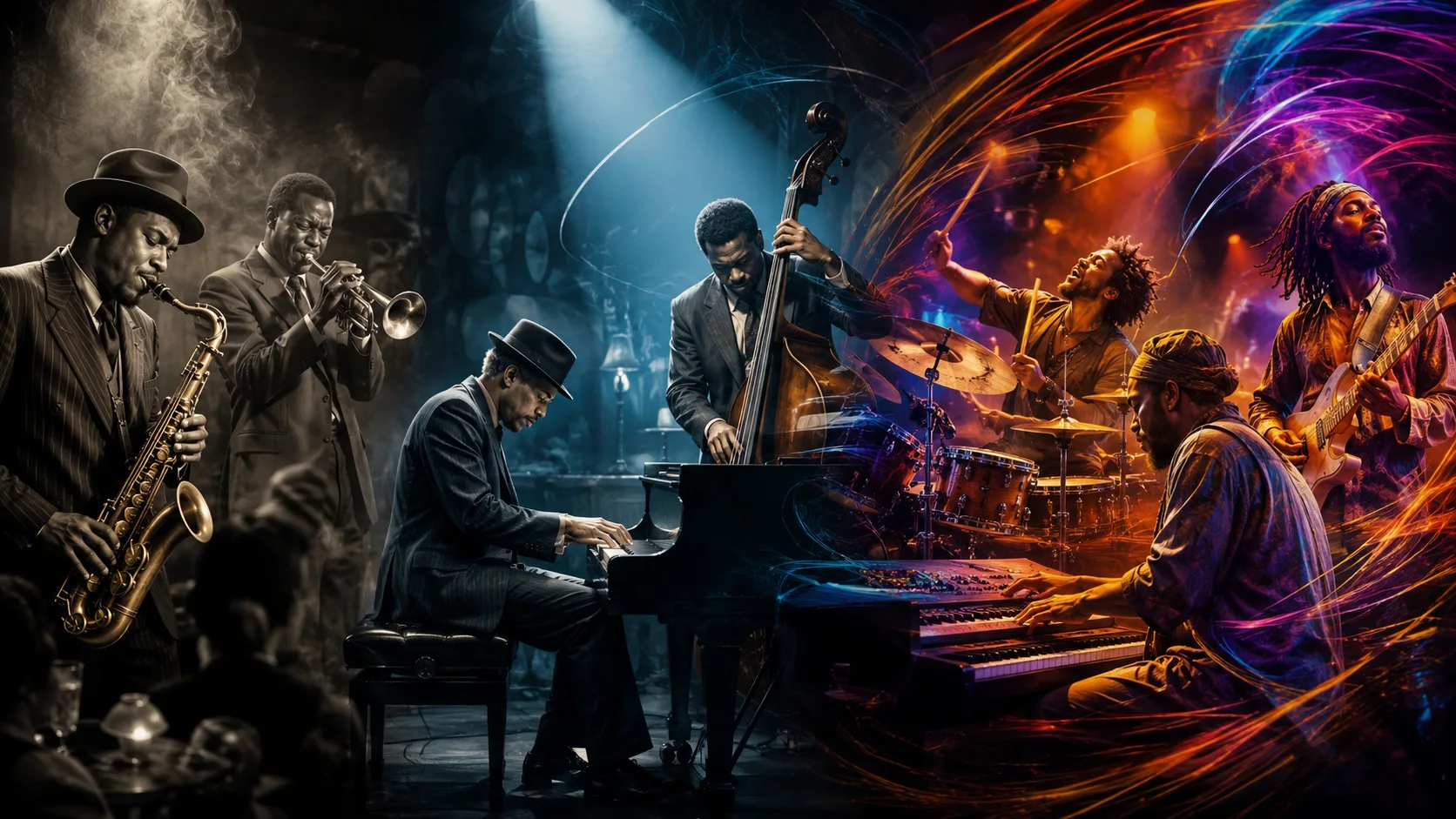
Jazz has always been closely associated with improvisation, but the way musicians improvise has changed dramatically throughout the genre's history.
What began with relatively spontaneous embellishment developed into a sophisticated musical language through bebop, before evolving again through cool jazz, modal jazz, free jazz and fusion. Each movement brought different ideas about harmony, rhythm, structure and expression.
The fascinating thing is that jazz musicians rarely abandoned what came before. Instead, they took existing ideas, challenged them and found new ways to improvise.
Bebop: Making Improvisation More Complex
During the 1940s, bebop changed the expectations surrounding jazz improvisation.
Earlier jazz styles often placed considerable emphasis on danceability and ensemble performance. Bebop shifted the focus towards musicianship, harmonic complexity and individual expression.
Musicians such as Charlie Parker and Dizzy Gillespie developed fast, intricate lines that could move rapidly through complex chord progressions.
Improvisation became less about simply decorating a melody and more about constructing entirely new melodic ideas over an existing harmonic framework.
For the musician, this demanded an exceptional understanding of chords and scales, as well as the ability to react quickly.
Bebop demonstrated that improvisation could be intellectually demanding while still sounding spontaneous.
Cool Jazz: A Different Kind Of Freedom
The arrival of cool jazz in the late 1940s and 1950s brought a noticeably different approach.
Where bebop could be fast, intense and highly energetic, cool jazz often favoured restraint, space and subtlety.
Miles Davis became one of the most influential figures associated with this shift, particularly through recordings such as Birth Of The Cool.
The change was not simply about playing more quietly. Cool jazz encouraged musicians to think carefully about tone, phrasing and space.
Improvisation did not have to mean filling every available moment with notes. Sometimes, leaving space could be just as expressive as playing a complicated phrase.
That idea would continue to influence jazz musicians for decades.
Modal Jazz: Rethinking Harmony
One of the most significant developments came with modal jazz.
Traditional jazz improvisation often involved navigating rapidly changing chords. Modal approaches simplified some of those harmonic movements, allowing musicians to spend longer periods exploring a particular scale or mode.
The result was a different kind of improvisational freedom.
Rather than constantly thinking about moving from one chord to another, musicians could explore melody, rhythm and tone within a more spacious harmonic environment.
Miles Davis's Kind Of Blue, released in 1959, is perhaps the most famous example of this approach. The album demonstrated how reducing harmonic complexity could actually create new possibilities for improvisation.
Instead of restricting creativity, fewer chord changes could give musicians more room to explore.
Free Jazz: Questioning The Rules Entirely
If modal jazz loosened some of the traditional rules, free jazz challenged the idea that those rules were necessary at all.
During the 1960s, musicians including Ornette Coleman explored improvisation without relying as heavily on established chord progressions, regular structures or predictable forms.
This could produce music that sounded dramatically different from earlier jazz.
For some listeners, free jazz was difficult to understand. There were fewer familiar signposts and less predictable repetition. For the musicians creating it, however, this offered an opportunity to explore sound and interaction in new ways.
Improvisation became less about demonstrating how well someone could navigate a predetermined structure and more about discovering what could happen when the structure itself became flexible.
Fusion: Bringing New Sounds Into The Conversation
By the late 1960s and 1970s, jazz musicians were increasingly incorporating elements of rock, funk and electronic music.
Jazz fusion brought improvisation into a louder, more rhythmically driven environment.
Again, Miles Davis played an important role. His work during this period demonstrated how jazz could absorb new technologies and musical influences without abandoning improvisation.
Other musicians, including Herbie Hancock and John McLaughlin, pushed fusion in different directions.
Electric instruments, amplified sound and funk-inspired grooves changed the environment in which musicians improvised.
The solo was no longer necessarily the centre of everything. Rhythm, texture and interaction between instruments could become equally important.
Improvisation Became A Conversation
Across these different eras, one idea remained remarkably consistent: improvisation was rarely about simply playing whatever came into a musician's head.
Great jazz improvisation depends heavily on listening.
A musician needs to hear what the other performers are doing, understand the musical structure and respond appropriately. A solo can introduce an idea that another musician develops. A drummer can alter the feel of a passage, prompting a different response from the rest of the band.
This makes jazz improvisation feel conversational. The musicians are not simply taking turns. They are influencing one another in real time.
What These Changes Tell Us About Jazz
The history of jazz improvisation is ultimately a history of musicians questioning assumptions.
Bebop asked how complex improvisation could become. Cool jazz explored the expressive possibilities of restraint. Modal jazz demonstrated that fewer harmonic changes could create greater freedom. Free jazz questioned the need for conventional structures, while fusion showed that jazz could absorb entirely different musical languages.
Each movement expanded the definition of what improvisation could be.
That is perhaps why jazz has remained so influential. It does not treat musical rules as permanent.
Instead, musicians learn the language, understand the structure and then decide what they want to do with it.
The Continuing Influence Of Jazz Improvisation
Modern musicians across countless genres continue to draw on these ideas.
Improvisation can be heard in rock performances, funk, experimental music, electronic music and contemporary jazz. Even musicians who never describe themselves as jazz players may use approaches that owe something to the genre's long history of spontaneous creation.
The biggest lesson may be that improvisation is not simply about unpredictability. It is about knowledge, listening and responding.
From the rapid lines of bebop to the open spaces of modal jazz and the experimentation of fusion, each era encouraged musicians to rethink the relationship between structure and freedom.
Jazz did not simply teach musicians how to improvise. It encouraged them to question what improvisation could become.