
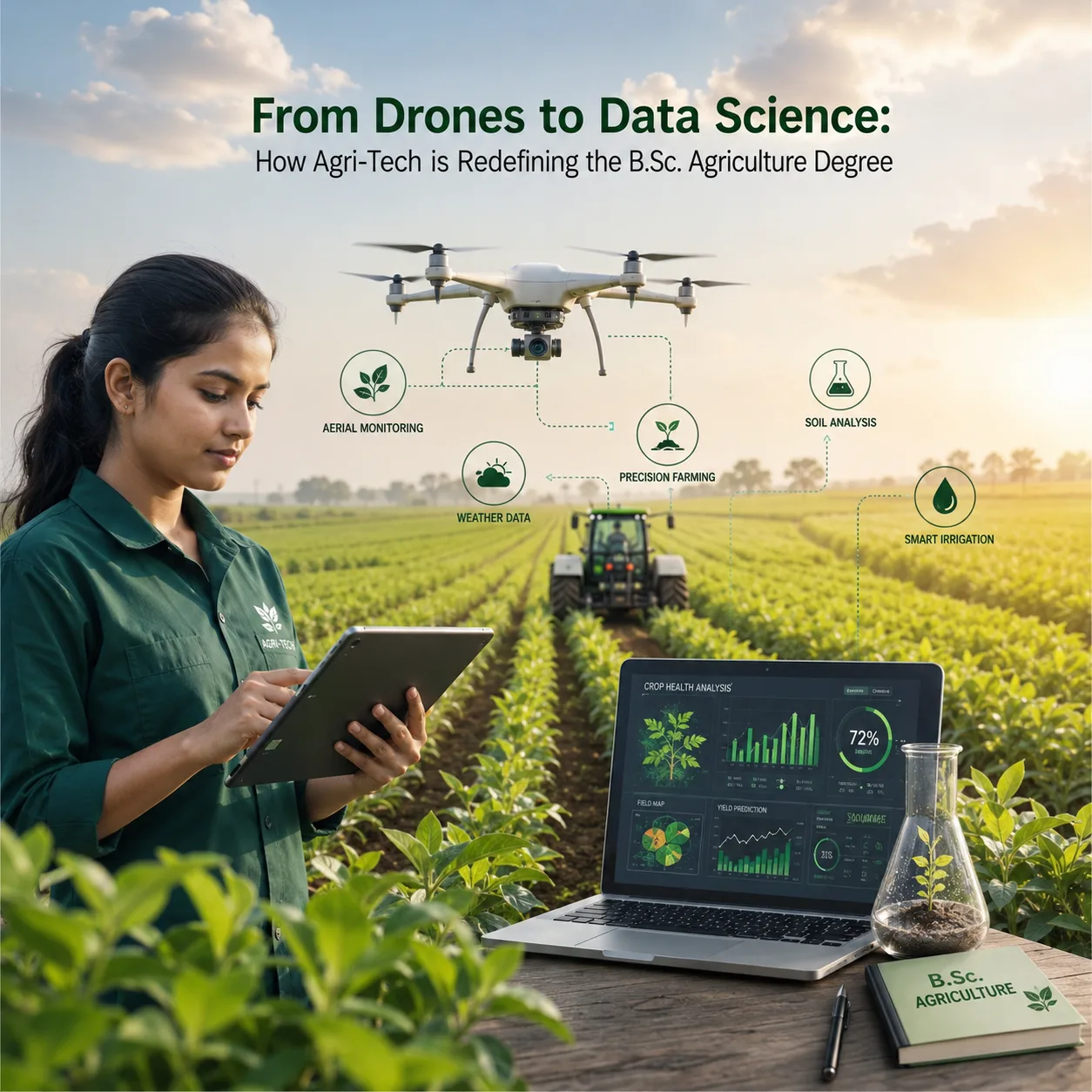
Mention "agricultural studies" to someone unfamiliar with the industry, and they will likely picture manual field labor, rainfall predictions, and traditional crop management.
While the fundamental goal of agriculture—feeding the world—remains unchanged, the tools used to achieve it have fundamentally evolved. Today’s farm fields are high-tech ecosystems where AI flight paths guide spraying drones, IoT ground sensors track soil moisture in real-time, and machine learning models predict pest outbreaks before a single leaf turns yellow.
As agricultural technology rapidly scales, the academic landscape is shifting just as fast. The modern B.Sc. (Hons.) Agriculture degree is no longer just a biological study—it has evolved into a multidisciplinary tech degree built at the intersection of data science, robotics, and environmental stewardship.
Here is how modern agricultural education is preparing a new generation of scientists, analysts, and tech innovators.
1. Drones as standard agricultural equipment
Unmanned Aerial Vehicles (UAVs) have moved far beyond photography and defense—they are now essential equipment on modern research farms.
Through multispectral cameras and thermal imaging sensors, agri-drones allow students and researchers to perform field monitoring in minutes rather than hours. In modern agricultural degree programs, students gain hands-on exposure to drone application across several critical areas:
- NDVI Health Mapping: Utilizing Normalized Difference Vegetation Index (NDVI) images to spot early signs of crop stress, nutrient deficiencies, or underwatering.
- Precision Spraying: Deploying automated drones to apply fertilizers or organic pest control strictly where needed—reducing chemical run-off and operational waste.
- Land & Topography Surveying: Mapping farm acreage with extreme precision to design efficient irrigation and drainage networks.
2. Soil Science Powered by Data Analytics
Historically, soil status assessment involved a lengthy procedure where samples were taken and sent to distant laboratories, with results returned days later indicating basic chemical properties.
Modern-day crop management is all about data, which Agro-Informatics classes and digital soil mapping help students master. Using internet-enabled ground sensors, agricultural experts can now analyze real-time data coming from the fields.
The latter allows for breaking down a hectare into thousandth of square meters, each with individual NPK, pH, and moisture readings.
Agronomists can bring their knowledge of the land to the pixel, applying variable micro-dosing of fertilizers to address the specific needs of each patch.
3. Climate-Resilient Agriculture & Smart Irrigation
Since the weather patterns are too unpredictable these days its hard to depend on traditional wisdom alone.With automated weather stations and computerized environmental models we can anticipate a modern approach to weather.
Through structured training in Soil&Water Conservation Engineering complemented by Watershed Management we are able to develop intelligent micro-irrigation systems that take into account local micro-climate conditions as well as actual moisture content of the soil to ensure that crops are drenched exactly according to their needs thereby conserving every precious drop of water
4. Expanding Career Frontiers: Beyond the Traditional Farm
As technology transforms the agricultural domain, it is simultaneously creating a wave of high-tech, multi-industry career options for graduates. A student finishing a modern 4-year B.Sc. Agriculture program is uniquely positioned for roles such as:
- Agri-Data Analyst: Transforming raw farm sensor metrics and satellite imagery into actionable yield forecasts for global commodities markets.
- Precision Agriculture Specialist: Designing, calibrating, and deploying autonomous machinery and drone fleets for commercial agribusinesses.
- Smart Greenhouse Manager: Controlling climate, lighting, and nutrient dosing in automated vertical farms and hydroponic facilities.
- Agri-Tech Startup Founder: Developing software solutions, remote sensing tools, or biotechnology inputs to solve climate-resilience challenges.
The Verdict: Agriculture is Now a Tech Frontier
The modern agricultural campus is a cross between a farm and an applied technology laboratory. By combining fundamentals of agronomy with innovative applications such as drone survey mapping it is possible to produce modern agriculturalists who are capable of making precision agribusinesses that are simultaneously more environmentally friendly and efficient.