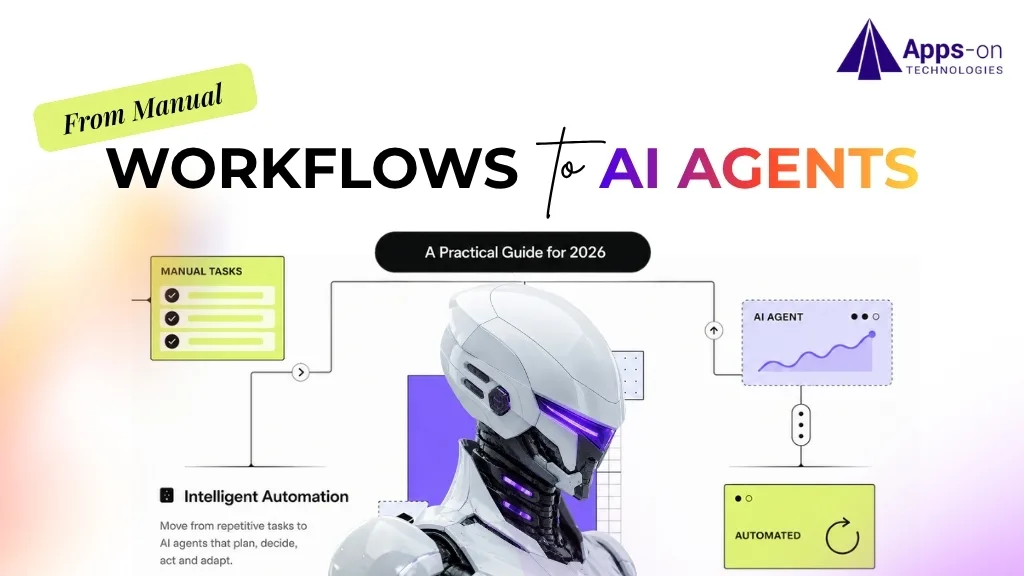
Every business has that one process nobody wants to own. The invoice queue. The support backlog. The lead list that gets touched on Monday and forgotten by Wednesday. For a decade the answer was automation software, and it helped, but only for the parts that never changed. To understand why 2026 feels different, it helps to answer a simpler question first: what are AI agents in 2026? They are systems that do not just follow a script. They read a situation, decide what to do next, act on it, and adjust when something unexpected turns up.
That last part is the whole shift. A rule-based tool breaks the moment reality stops matching the rule. An agent works around it.
The gap traditional automation never closed
Classic automation is deterministic. You define a trigger, you define a sequence, and it runs the same way every time. When an invoice arrives in a format nobody anticipated, or a customer asks a question phrased three degrees off the expected script, the process stops and a human picks up the pieces.
This is why so many automation projects deliver less than promised. 70% of predictable work is automated. The 30% that is messy stays manual, and that 30% is where most of the time goes.
The AI agents vs traditional automation distinction comes down to this: traditional automation executes instructions, while agents pursue outcomes. Give a rule engine a step, it performs the step. Give an agency a goal, and it will figure out how to get there.
What this looks like in practice
Consider support ticket handling. A traditional workflow routes tickets by keyword and escalates anything it cannot categorise. An agent reads the ticket, queries the knowledge base, checks the customer's account history in the CRM, drafts a response, resolves it if confidence is high, and escalates with a full summary attached if not.
Same task. Completely different ceiling. Which brings us to the practical question: how do AI agents automate business workflows at a level that actually reduces headcount pressure rather than just shifting it around?
Three capabilities make it work. Agents hold context across multiple steps rather than treating each action as isolated. They call tools and systems on their own, from databases to APIs to internal software. And they know when to stop and hand over, which is the capability most people underestimate.
Where businesses are deploying agents first
The pattern across early adopters is consistent. Agents land first in processes that are high volume, well documented, and low risk if the output needs correcting.
Customer support automation is the most common entry point, typically resolving a large share of routine tickets without human involvement.
Document processing follows closely, where agents extract, classify and route information from contracts, invoices and reports. Sales development is a third, with agents handling prospecting, qualification and follow-up sequences that would otherwise sit in someone's overflowing task list.
What these have in common is not complexity. It is repetition with variation, exactly the combination that defeats rule-based tools.
Getting started without betting the business
The failure mode in agent projects is scope. Teams pick a critical, high-visibility process, build for six months, and discover the edge cases only in production.
The better approach to how to implement AI agents in business starts small and deliberately unglamorous. Pick one process that runs at least fifty times a week. Document what a good outcome looks like and what an unacceptable one looks like. Run the agent in shadow mode alongside your existing process, comparing outputs without acting on them. Then hand over the clearly safe cases first, keeping humans on anything ambiguous.
Measure two things: resolution rate and escalation quality. A good agent does not just close more cases, it escalates better ones, with context already assembled.
Frequently asked questions
Do AI agents replace existing automation tools?
No. Most deployments run both. Rule-based automation handles the deterministic paths efficiently and cheaply, while agents take the exceptions that previously required a person.
How long does an agent deployment take?
A single well-scoped process typically takes six to twelve weeks from discovery to production. Broader multi-process rollouts run considerably longer and should be phased.
What happens when an agent gets something wrong?
Properly configured agents operate with confidence thresholds and escalation rules. Below a set confidence level, the task routes to a human with full reasoning attached. Complete autonomy on the first day is never the goal.
Do we need clean data first?
Cleaner is better, but agents tolerate messier inputs than rule engines because they interpret rather than pattern-match. Data quality still affects accuracy, so it is worth auditing before scaling.
Conclusion
The companies who purchased the most AI in 2026 are not the ones that are succeeding. They are the ones that picked a single painful process, deployed carefully, measured honestly, and expanded from there. The technology is ready. What separates results from pilots is scope discipline and a clear definition of what success looks like before you start.
Manual workflows are not disappearing overnight. But the ceiling on what can be handed over has moved sharply, and it will keep moving.
Still running the process nobody wants to own?
Tell us which one it is. We will map it, tell you honestly whether an agent is the right fit, and give you a cost plan with a realistic timeline. No pitch deck, no lock-in.
Book a free 30-minute AI automation review →
Original Source: https://bit.ly/4wPYC5C