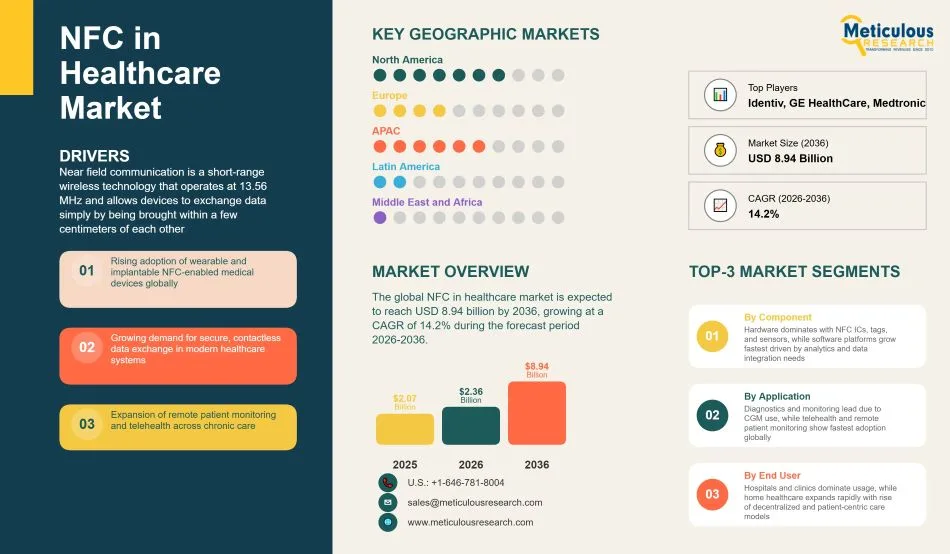
The global NFC in healthcare market was valued at USD 2.07 billion in 2025 and is projected to reach USD 8.94 billion by 2036, growing at a CAGR of 14.2% during the forecast period from 2026 to 2036. The market is witnessing strong growth as healthcare systems increasingly adopt contactless and connected technologies to improve patient care, operational efficiency, and real-time health monitoring. Near field communication technology enables secure wireless communication between devices over short distances, making it highly suitable for healthcare environments where speed, convenience, and accuracy are critical. Its ability to support battery-free operation in passive devices and enable instant data transfer has accelerated its integration into modern healthcare infrastructure.
Growing Adoption of NFC Technology in Healthcare
NFC technology is increasingly being used across healthcare applications such as patient identification, diagnostics, medication management, wearable monitoring devices, implantable sensors, and remote patient monitoring systems. Healthcare providers are adopting NFC solutions because they simplify data exchange and reduce the complexity associated with traditional wireless communication methods. Unlike other connectivity technologies that require pairing or manual configuration, NFC enables quick interaction with a simple tap, making it ideal for fast-paced clinical environments. Hospitals and clinics are using NFC-enabled patient wristbands, smart medical packaging, and diagnostic devices to streamline workflows and reduce the risk of human error.
Rising Demand for Wearable and Monitoring Devices
One of the major factors driving market growth is the increasing demand for wearable and continuous monitoring devices. The rising global burden of chronic diseases, particularly diabetes, cardiovascular disorders, and other long-term health conditions, has created a strong need for technologies capable of providing real-time health data. NFC-enabled wearable sensors can continuously collect and transmit patient information to smartphones or healthcare systems without requiring complex hardware or significant power consumption. This capability is supporting the rapid expansion of digital healthcare and personalized medicine.
Expansion of Remote Patient Monitoring and Telehealth
The growing adoption of remote patient monitoring and telehealth services is also contributing significantly to market expansion. Healthcare systems worldwide are shifting toward decentralized care models where patients can be monitored from home instead of requiring frequent hospital visits. NFC-enabled medical devices support this transition by allowing patients to easily share health information with healthcare professionals using smartphones or connected platforms. The demand for remote healthcare solutions increased considerably during the pandemic period, and healthcare providers continue to invest in technologies that improve remote diagnostics and long-term patient management.
Smart Medical Packaging and Medication Management
Another important trend shaping the market is the increasing use of NFC in smart medical packaging and medication management. NFC tags integrated into pharmaceutical packaging can help verify product authenticity, monitor medicine usage, provide dosage instructions, and improve patient adherence to treatment plans. Patients can access medication information instantly by tapping the package with a smartphone, while healthcare providers can improve safety and reduce medication administration errors. These capabilities are becoming increasingly valuable as healthcare systems focus more on patient safety and digital healthcare integration.
Smartphone Penetration Supporting NFC Adoption
The widespread availability of NFC-enabled smartphones is creating a strong foundation for healthcare adoption. Modern smartphones already contain built-in NFC readers, eliminating the need for dedicated scanning devices in many applications. This reduces infrastructure costs for hospitals, pharmacies, and healthcare providers while making NFC-based healthcare solutions more accessible to patients. The ability to use existing smartphones as healthcare readers is significantly improving the scalability and affordability of NFC healthcare technologies across developed and emerging markets.
Advancements in Biosensors and Smart Patches
The market is also benefiting from advancements in biosensor technology and flexible electronics. NFC-enabled smart patches and biosensors are emerging as promising healthcare solutions capable of monitoring various physiological parameters continuously and non-invasively. These devices can measure biomarkers such as glucose levels, temperature, pH, hydration, and other health indicators while transmitting data wirelessly to connected devices. As flexible sensor technologies continue to evolve, NFC integration is expected to support the development of more advanced wearable and implantable healthcare products.
Component Insights
By component, the hardware segment is expected to account for the largest share of the global NFC in healthcare market in 2026. Hardware components such as NFC chipsets, tags, readers, antennas, and sensor-integrated modules form the foundation of NFC-enabled healthcare systems. The increasing deployment of wearable health monitoring devices and diagnostic sensors is driving strong demand for these hardware components. At the same time, the software segment is projected to register the highest growth rate during the forecast period. As healthcare organizations generate increasing amounts of patient data through connected devices, there is growing demand for analytics platforms, data management systems, and secure communication software capable of converting raw health data into actionable clinical insights.
Device Type Insights
Based on device type, wearable devices are expected to hold the largest share of the market in 2026. Wearable sensors and monitoring patches are becoming increasingly popular for chronic disease management, preventive healthcare, and fitness tracking applications. However, implantable devices are projected to witness the fastest growth during the forecast period. Implantable biosensors capable of transmitting data wirelessly through NFC technology are attracting growing attention due to their potential to provide continuous health monitoring without external connections or frequent maintenance.
Application Insights
In terms of application, diagnostics and monitoring are expected to dominate the market due to the growing use of NFC-enabled devices for chronic disease management and real-time health tracking. The remote patient monitoring and telehealth segment is expected to register the fastest growth as healthcare providers continue to expand digital care programs and home-based monitoring services. NFC technology supports these applications by simplifying patient-device interaction and improving healthcare data accessibility.
Regional Insights
Geographically, North America is expected to hold the largest share of the global NFC in healthcare market in 2026. The region benefits from advanced healthcare infrastructure, high healthcare spending, widespread adoption of digital health technologies, and strong demand for wearable medical devices. In addition, supportive regulatory frameworks and increasing investment in connected healthcare systems are supporting market growth across the region.
Meanwhile, the Asia-Pacific region is projected to register the highest CAGR during the forecast period. Rapid healthcare digitalization, growing smartphone penetration, rising chronic disease prevalence, and increasing demand for affordable healthcare technologies are contributing to strong market expansion across the region. Countries with large patient populations and improving healthcare infrastructure are creating significant opportunities for NFC-enabled healthcare solutions. The growing adoption of remote monitoring technologies and wearable health devices is also supporting long-term market growth in Asia-Pacific.
Competitive Landscape and Market Outlook
Overall, the global NFC in healthcare market is expected to experience substantial expansion over the next decade as healthcare providers increasingly prioritize connected care, patient convenience, and digital transformation. NFC technology offers unique advantages including secure communication, low power requirements, instant connectivity, and compatibility with existing smartphones, making it highly suitable for modern healthcare applications. As wearable sensors, smart diagnostics, implantable devices, and remote monitoring systems continue to evolve, NFC is expected to play an increasingly important role in enabling efficient, accessible, and patient-centered healthcare solutions worldwide.
Download Sample Report Here: https://www.meticulousresearch.com/download-sample-report/cp_id=6644
Key Questions Answered
What is the current valuation of the global NFC in healthcare market and how is it expected to grow by 2036?
What key factors are driving the adoption of NFC technology in healthcare applications?
How is NFC technology improving patient monitoring and diagnostics in healthcare systems?
Which healthcare applications are expected to dominate the NFC in healthcare market during the forecast period?
Why is the wearable devices segment expected to hold the largest share in the NFC in healthcare market?
What factors are contributing to the rapid growth of remote patient monitoring and telehealth using NFC?
How are smart medical packaging solutions enhancing medication management and patient safety?
What role do smartphones play in accelerating the adoption of NFC-based healthcare solutions?
Which region is expected to lead the NFC in healthcare market and why?
Why is the Asia-Pacific region projected to register the fastest growth in this market?
Contact Us:
Meticulous Research®
Email- [email protected]
Contact Sales- +1-646-781-8004
Connect with us on LinkedIn- https://www.linkedin.com/company/meticulous-research