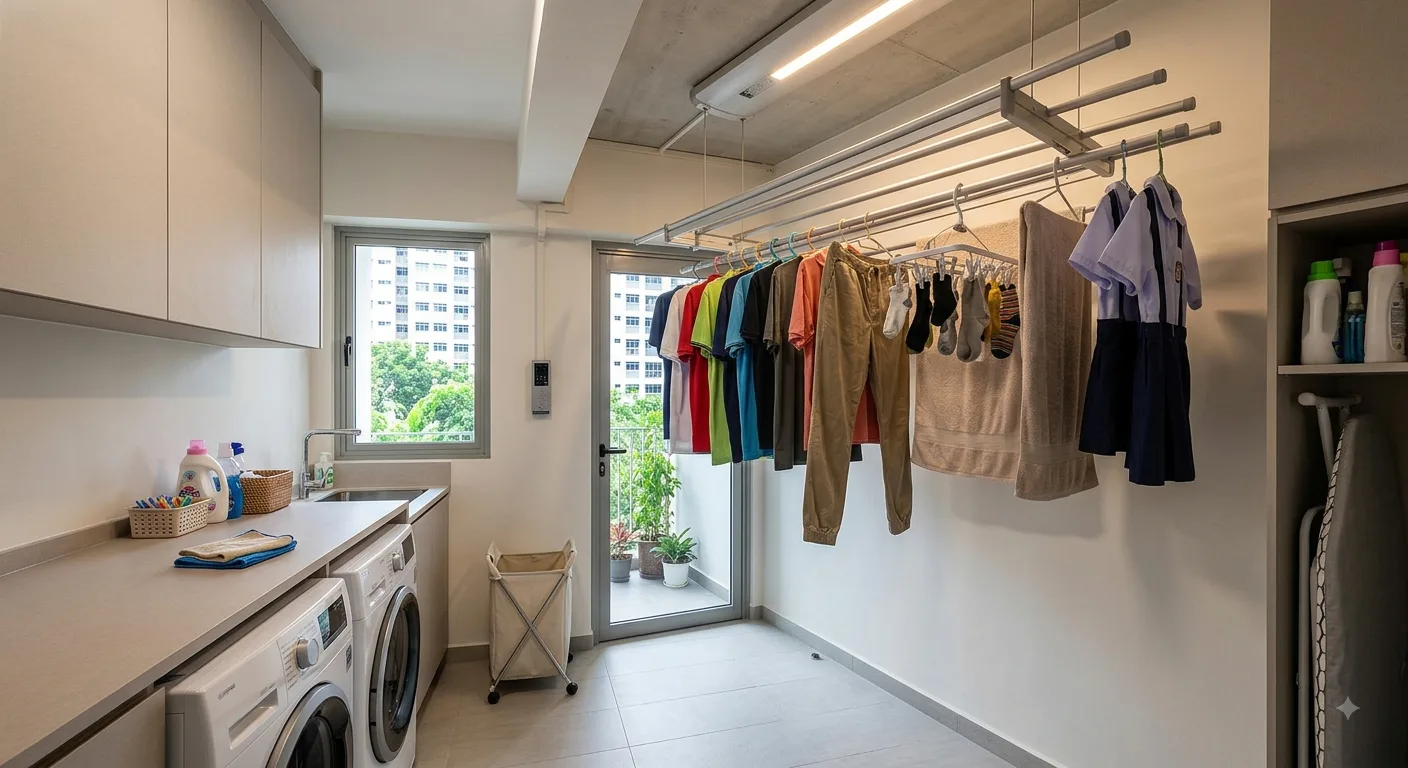
Laundry is a regular part of life in every home, but drying clothes can become a challenge when space is limited. This is especially true for HDB households, where the service yard often needs to accommodate a washing machine, drying area, windows, pipes and storage within a relatively small footprint. Choosing the right hdb laundry rack can help homeowners make better use of the available space while keeping everyday laundry more organised.
For families moving into a new flat, this is an area worth planning carefully. A drying solution that works well for one household may not be suitable for another, so understanding the space and daily routine is important before making a decision.
Why HDB Laundry Areas Need Careful Planning
The service yard is often designed to perform several functions at once.
It may be used for washing clothes, drying garments, storing cleaning supplies and providing ventilation. When a conventional floor-standing rack is added, the available walking space can quickly become restricted.
This becomes more noticeable when several loads of laundry need to be dried.
A fully loaded rack can block access to the washing machine or make it harder to move around. In some homes, homeowners may even need to move the rack temporarily whenever they want to clean the floor or access another part of the service yard.
Good planning can reduce these everyday inconveniences.
Understanding the BTO Laundry Setup
For new homeowners, the drying arrangement is often considered alongside the rest of the renovation.
A bto laundry rack can refer to the drying setup used in a new BTO home, whether homeowners retain the original provision or choose to install an alternative system that better suits their needs.
The decision often depends on lifestyle.
A smaller household that does laundry occasionally may find a basic rack perfectly adequate. A larger family that washes clothes frequently may prefer greater capacity and easier operation.
Instead of immediately replacing an existing setup, homeowners can first observe how the space works during normal daily use.
After a few weeks, it becomes easier to identify what is genuinely inconvenient.
Think About Your Laundry Volume
One of the first questions to ask is how much laundry your household produces.
A couple may only need enough space for everyday clothing. A family with children may regularly need to dry school uniforms, towels, sportswear, bedsheets and other bulky items.
Laundry volume can also change during the week.
If several loads are washed close together, a small rack may quickly become overloaded. Clothes may need to be placed too close together, reducing airflow and potentially increasing drying time.
Choosing a system with appropriate capacity can make the process much easier.
The goal is not necessarily to buy the biggest rack available. It is to select one that comfortably handles the household's normal laundry requirements.
Use Vertical Space More Effectively
One of the easiest ways to improve a compact service yard is to look upward.
Floor space is usually the most limited area in a small laundry room. Ceiling space, on the other hand, often remains unused.
Ceiling-mounted drying systems can make use of this area.
Depending on the design, the rack can be lowered when clothes need to be hung and raised once the laundry is arranged. This allows homeowners to work at a more comfortable height while keeping the floor clearer when the rack is not being accessed.
This approach can make a small service yard feel less crowded without requiring additional floor space.
Why Convenience Matters
Laundry may seem like a simple household chore, but it is repeated throughout the year.
A small inconvenience that happens every day or several times a week can become frustrating over time.
For example, repeatedly reaching for a high rack, moving a floor rack or bending to arrange clothes can make the process less comfortable.
Motorised drying systems offer an alternative.
A rack can be adjusted to a suitable working height, allowing clothes to be hung more easily. Once the clothes are arranged, the system can be raised again.
Remote controls or smart features can provide additional convenience depending on the chosen model.
The benefit is not technology for its own sake. The real benefit is reducing unnecessary effort.
Consider the Singapore Climate
Singapore's climate also affects laundry decisions.
High humidity can influence how quickly clothes dry, while sudden rain can make outdoor drying unreliable. This makes a sheltered and well-ventilated drying area especially useful.
Airflow is important because moisture needs somewhere to go.
Some modern drying systems incorporate built-in fans to improve air circulation around clothing. When several garments are hanging at the same time, better airflow can help create a more effective drying environment.
However, homeowners should also consider natural ventilation.
The position of windows, fans and the arrangement of clothes can all affect how air moves through the service yard.
Choosing the Right Rack for a New BTO
New BTO homeowners have the advantage of planning their laundry area before settling into a long-term routine.
Before choosing an upgrade, consider the layout carefully.
Check the available ceiling height, washing machine position, window location and surrounding clearance. Think about whether the rack will interfere with cabinets, lights or access points.
It is also useful to consider how tall different household members are.
A system with adjustable height can make the laundry routine more comfortable for everyone.
For homeowners who are renovating, discussing the drying system early can also make installation planning easier.
Load Capacity Is Important
Wet laundry can be heavy.
Bedsheets, towels, jeans and other thick fabrics can place considerable weight on a rack. A household that regularly washes these items should consider the system's recommended load capacity.
A strong structure is particularly important for families.
Rather than focusing only on the number of rods, look at the overall design and intended use. A rack should be capable of supporting the amount of laundry your household normally handles.
Overloading a system can affect its operation and may reduce its long-term reliability.
Think About Maintenance and Durability
A drying rack is exposed to moisture regularly.
For this reason, construction quality and suitable materials matter.
Homeowners should consider whether the system is designed for repeated use in a laundry environment and whether the moving parts are built for regular operation.
It is also worth considering how easy the rack is to clean.
A simple design that can be maintained easily may be more practical than a complicated system with features that are rarely used.
Professional Installation Can Make a Difference
Ceiling-mounted systems require careful installation.
The installer needs to consider the mounting surface, rack position, electrical requirements and clearance from surrounding fixtures.
This is particularly important in compact HDB service yards, where there may be little room for error.
Professional measurement before installation can help determine the most appropriate location and configuration.
It can also prevent problems such as the rack being positioned too close to a window, light fitting or cabinet.
For homeowners planning a renovation, installation should ideally be considered before all finishing work is completed.
How GoodLiving.sg Can Help
GoodLiving.sg provides laundry solutions designed around the needs of Singapore homes.
The focus is on helping homeowners use their available space more effectively while making the laundry routine easier.
For HDB and BTO homeowners, this means considering factors such as service yard dimensions, laundry volume, ceiling height, operating convenience and installation requirements.
Rather than treating every home as identical, the goal is to identify a configuration that fits the actual space.
Professional installation can then help ensure that the selected system is positioned correctly and operates comfortably.
Creating a More Comfortable Service Yard
A service yard does not need to be large to be useful.
With thoughtful planning, homeowners can make better use of the available walls and ceiling while keeping the floor more accessible.
A well-positioned drying system can allow clothes to be hung without permanently taking over the room. Once laundry is dry, the area can be easier to clean and move around.
This can make a surprisingly noticeable difference to everyday life.
When Should You Upgrade?
There is no universal answer.
Some homeowners may be comfortable with their existing setup for years. Others may realise within the first few months that their laundry routine requires more capacity or convenience.
Common signs that an upgrade may be worthwhile include:
- The rack regularly blocks the walking area.
- Clothes are crowded together during larger loads.
- Hanging clothes requires frequent stretching or bending.
- The rack needs to be moved repeatedly.
- There is not enough space for towels or bedsheets.
- The service yard feels cluttered whenever laundry is drying.
If several of these problems sound familiar, it may be time to consider a different approach.
Conclusion
A well-planned hdb laundry rack can help make a compact service yard more practical, especially when the household regularly handles multiple laundry loads. For new homeowners, selecting a suitable bto laundry rack should involve more than simply choosing a product. The available space, laundry habits, ceiling height, load requirements and preferred level of convenience should all be considered.
GoodLiving.sg offers automated and space-saving laundry solutions designed for Singapore homes, including HDB and BTO layouts. With proper planning, measurement and professional installation, homeowners can create a drying area that is easier to use without sacrificing valuable floor space.
The best solution is the one that fits naturally into everyday life. If your current drying setup constantly gets in the way, makes hanging clothes uncomfortable or struggles with larger loads, upgrading the system could make the entire laundry routine simpler.
Frequently Asked Questions
1. Is an automated drying rack suitable for HDB homes?
Yes, an automated ceiling-mounted system can be suitable for many HDB layouts when the ceiling structure, dimensions and surrounding clearance are properly assessed.
2. Should BTO homeowners keep the original drying setup?
It depends on household needs. A basic setup may be sufficient for some households, while families with larger laundry loads may prefer an upgraded system.
3. Does a ceiling-mounted rack save floor space?
Yes. By using overhead space, it can keep more of the service yard floor available for movement, cleaning and access.
4. What should I consider before installing a rack?
Consider ceiling height, available space, washing machine position, windows, electrical requirements, load capacity and the rack's operating height.
5. Is professional installation necessary?
For ceiling-mounted and motorised systems, professional installation is recommended because correct mounting, positioning and clearance are important for safe and convenient operation.