
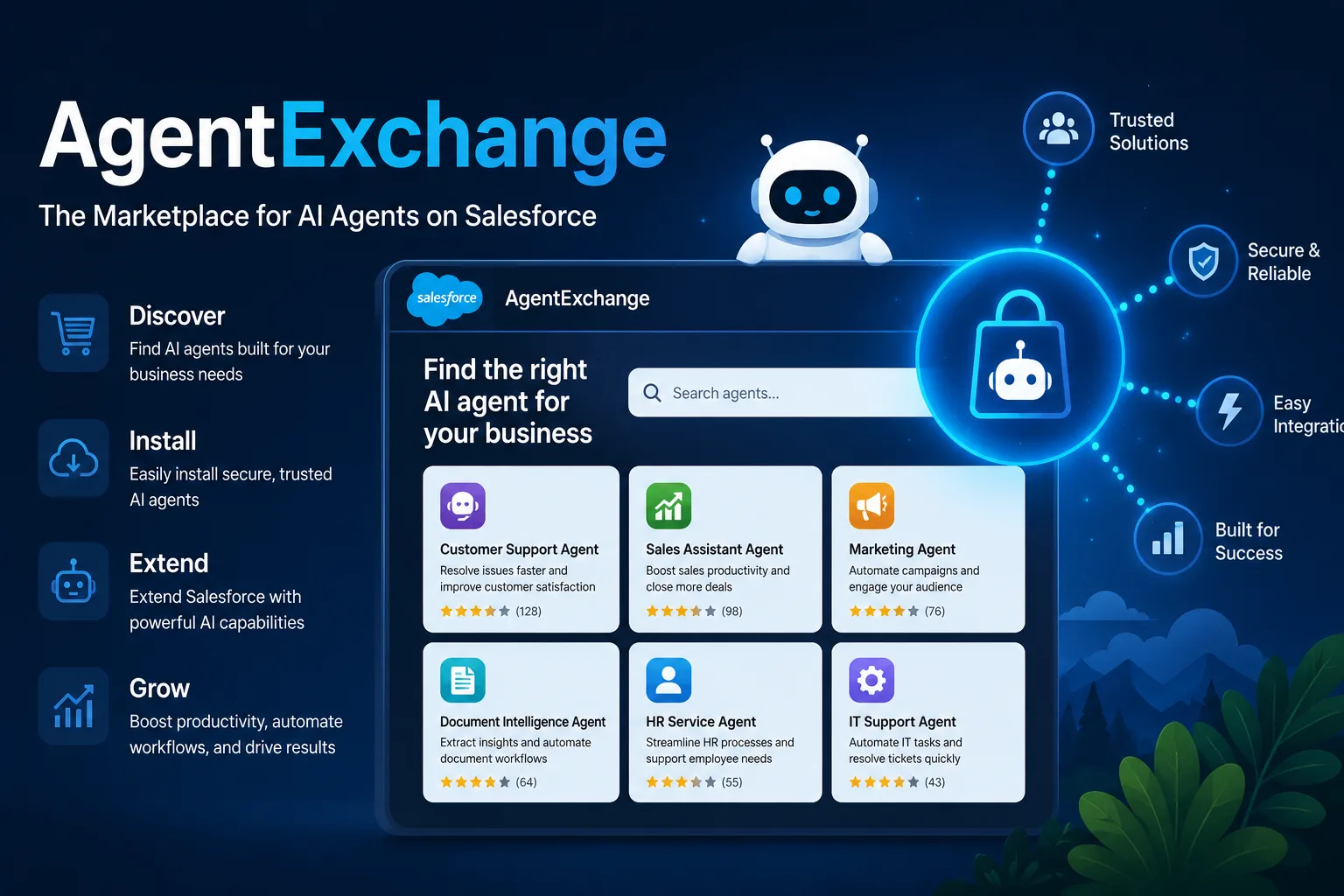
Organizations exploring AI agents often have an important question: How AgentExchange works and how it fits into an existing Salesforce environment.
AgentExchange provides an ecosystem for discovering solutions and capabilities that can extend AI-powered Salesforce experiences. The process involves identifying a business need, exploring relevant capabilities, evaluating their fit, and determining how they can be incorporated into an organization's Salesforce and Agentforce strategy.
Step 1: Identify a Business Problem
The first step is not selecting a solution.
Start by identifying the problem that needs to be solved.
For example, a sales organization may struggle with slow lead qualification. A customer service team may spend too much time answering repetitive questions.
These problems can become potential use cases for AI.
Step 2: Explore AgentExchange
Once the business requirement is defined, teams can explore AgentExchange for relevant solutions.
The objective is to identify capabilities that align with the organization's specific workflow.
Businesses should avoid choosing a solution simply because it has impressive AI functionality.
The important question is whether it solves the identified business problem.
Step 3: Evaluate the Solution
Before implementation, the solution should be evaluated against technical and business requirements.
Key areas include:
- Salesforce compatibility
- Data requirements
- Security
- User permissions
- Integrations
- Scalability
- Workflow compatibility
- Expected business value
This evaluation can help identify potential implementation requirements early.
Step 4: Connect Relevant Data
AI agents need appropriate information to perform their tasks.
Depending on the use case, the solution may need access to Salesforce records, knowledge sources, or connected business systems.
Organizations should establish clear data-access rules and ensure that agents only access information required for their assigned responsibilities.
Step 5: Configure the Agent Experience
The next step involves configuring how the AI capability works within the organization's processes.
This can include defining instructions, topics, actions, permissions, escalation rules, and workflows.
The configuration should reflect the organization's actual business process.
Step 6: Test the Solution
Testing is essential before an AI agent is introduced into production.
Teams should test normal scenarios as well as edge cases.
Testing can evaluate:
- Response quality
- Data accuracy
- Workflow execution
- Permissions
- Escalation behavior
- User experience
Step 7: Deploy and Monitor
After testing, the solution can be introduced to the appropriate users.
Performance should be monitored against predefined business metrics.
Organizations can use feedback and performance data to identify opportunities for refinement.
Step 8: Expand to Additional Use Cases
Once the first implementation proves valuable, businesses can evaluate additional opportunities.
For example, a company that initially implements an AI agent for customer service might later explore sales assistance, employee support, or lead qualification.
This creates a gradual path toward broader AI adoption.
How AgentExchange Supports Business Growth
When implemented around the right workflows, AI solutions can potentially improve productivity, customer engagement, lead management, and operational efficiency.
However, technology alone does not create these outcomes.
The value comes from connecting the solution to reliable data, well-designed workflows, appropriate permissions, and measurable objectives.
Conclusion
Understanding how AgentExchange works starts with recognizing that it is not simply about finding an AI tool.
Organizations need to identify a business problem, explore relevant solutions, evaluate technical fit, connect appropriate data, configure workflows, test the experience, and measure results.
This structured approach can help businesses turn AgentExchange from an AI discovery platform into a practical component of their Salesforce strategy.