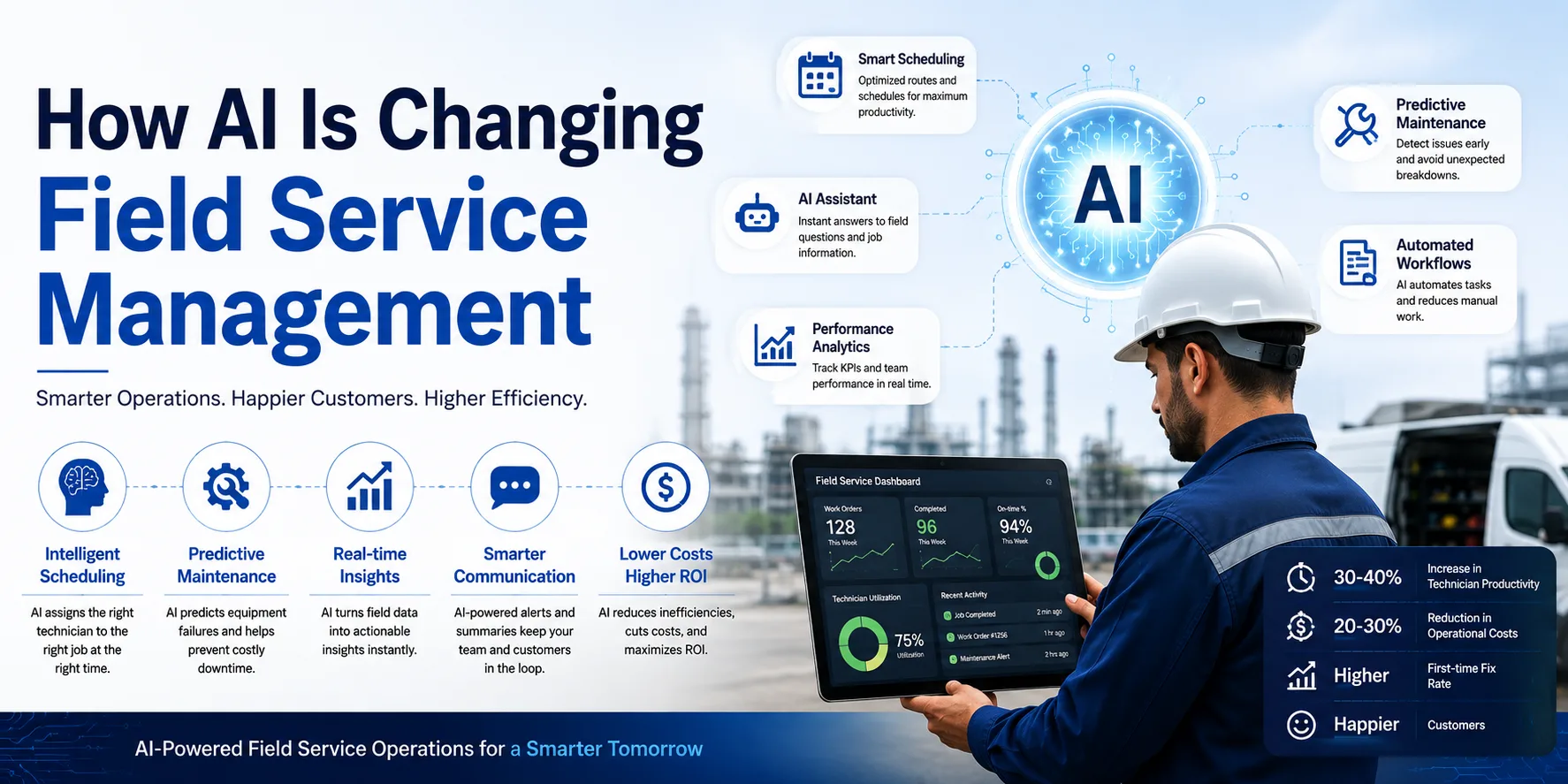
Artificial intelligence is changing the way businesses plan, manage, and deliver field services.
For years, field service operations have depended heavily on manual scheduling, phone calls, spreadsheets, paper work orders, and the experience of individual dispatchers. These methods can work for smaller teams, but they become increasingly difficult to manage as the number of technicians, customers, and service requests grows.
AI is now helping businesses handle many of these challenges more intelligently.
From predicting maintenance needs and optimizing technician schedules to assisting with customer communication and analyzing service data, AI can help field service teams make faster decisions and reduce repetitive work.
When AI capabilities are combined with modern field service management software, businesses can move from simply reacting to service requests toward more proactive and data-driven operations.
What Is AI in Field Service Management?
AI in field service management refers to the use of artificial intelligence and machine learning technologies to analyze information, identify patterns, make predictions, automate repetitive tasks, or assist employees with operational decisions.
The technology can work with information such as:
- Technician availability
- Customer requests
- Service history
- Equipment data
- Job duration
- Location information
- Inventory records
- Previous repair outcomes
Customer communication
Instead of requiring employees to manually process all this information, AI can help identify useful patterns and provide recommendations.
The objective isn't necessarily to replace dispatchers or technicians.
It's to give them better information and reduce the amount of repetitive work they have to perform.
1. Smarter Technician Scheduling
Scheduling is one of the most complex parts of field service management.
Dispatchers have to consider technician availability, location, skills, job urgency, appointment windows, workload, and travel time.
AI can analyze multiple variables simultaneously and help identify efficient scheduling options.
For example, if an urgent repair request comes in, an AI-powered system could consider:
- Which technicians are available
- Who has the appropriate skills
- Who is closest to the customer
- Which technicians have schedule flexibility
How the new appointment could affect existing jobs
The dispatcher can then review the recommendation and make the final decision.
This can make scheduling faster while reducing the amount of manual coordination required.
2. More Efficient Route Planning
Technician travel represents a significant portion of field service operations.
Poor route planning can result in unnecessary mileage, longer travel times, and fewer available hours for customer service.
AI can analyze locations, schedules, traffic information, appointment windows, and other constraints to help create more efficient routes.
Rather than simply asking, "Who is available?" the system can consider the broader question:
"Which technician can complete this job most efficiently while minimizing disruption to the rest of the schedule?"
This can help businesses use technician time more effectively.
3. Predictive Maintenance
Traditional field service often follows a reactive model.
Something breaks, the customer reports the problem, and a technician is dispatched.
AI can help businesses move toward predictive maintenance.
By analyzing equipment data and historical service information, AI systems can identify patterns associated with potential failures.
For example, if certain equipment repeatedly shows specific warning signs before a component fails, the system may identify that pattern and flag similar situations in the future.
Businesses can then potentially schedule maintenance before a major failure occurs.
This can reduce unexpected downtime and create opportunities for more proactive customer service.
4. Better First-Time Fix Rates
One of the most important field service metrics is the first-time fix rate.
A technician who resolves an issue during the initial visit saves the business and customer the cost and inconvenience of another appointment.
AI can support first-time fixes by analyzing previous service information and helping technicians or dispatchers identify likely causes of a problem.
For example, the system could use:
- Previous repair history
- Equipment information
- Customer-reported symptoms
- Similar completed jobs
- Parts used in previous repairs
This information can help determine which technician is best suited for the job and what resources may be required.
The result can be better preparation before the technician arrives.
5. AI-Powered Technician Assistance
AI isn't only useful for managers and dispatchers.
It can also become a practical assistant for technicians.
A technician working at a customer location may need information about a piece of equipment, troubleshooting steps, previous repairs, or service procedures.
Instead of searching through lengthy manuals or calling a more experienced colleague, an AI-powered assistant could help locate relevant information quickly.
A technician might ask:
"What should I check if this equipment shows this error code?"
The system could provide relevant troubleshooting information based on available documentation.
This can be particularly valuable for less experienced technicians who are still building their knowledge.
6. Faster Customer Support
AI can also change how service businesses communicate with customers.
AI-powered chatbots and virtual assistants can handle common questions, collect service requests, provide appointment information, and help customers understand the status of a job.
For example, instead of calling the office to ask whether an appointment is confirmed, a customer could receive an automated update.
This doesn't mean every customer interaction should be automated.
Complex problems, complaints, and sensitive situations still require human involvement.
The best approach is often to use AI for routine interactions while allowing employees to focus on conversations that require judgment and empathy.
7. Automated Work Order Documentation
Documentation is essential in field service, but it can also be time-consuming.
Technicians need to record what they found, what they repaired, which parts they used, and whether additional work is required.
AI can help reduce the burden of documentation.
For example, voice-to-text technology can allow technicians to describe their work verbally. AI can then organize that information into structured notes.
Similarly, AI can help summarize lengthy service records or identify important information within previous work orders.
This allows technicians to spend less time typing and more time focusing on the customer.
8. Better Demand Forecasting
Field service businesses don't have the same level of demand every day.
Seasonal patterns, weather, equipment lifecycles, geographic trends, and customer behavior can all influence service volume.
AI can analyze historical service data to identify patterns and help businesses forecast future demand.
For example, an HVAC company may see a significant increase in service requests during periods of extreme temperatures.
Understanding these patterns can help managers prepare staffing levels, inventory, and technician availability before demand increases.
Better forecasting can reduce the risk of being overwhelmed during busy periods.
9. Improved Inventory Management
Having the right part available at the right time can make the difference between completing a job during the first visit and scheduling another appointment.
AI can help analyze historical usage, service patterns, and inventory levels to identify potential demand.
Instead of relying entirely on manual estimates, businesses can use data to make more informed inventory decisions.
This can help reduce both stockouts and unnecessary inventory.
10. Turning Service Data Into Useful Insights
Field service operations generate enormous amounts of information.
Every job can produce data about:
- Technician performance
- Job duration
- Travel time
- Parts usage
- Customer requests
- Repair outcomes
- Equipment failures
Service costs
The challenge is turning that information into something useful.
AI can help identify trends that may not be immediately obvious to managers.
For example, it might reveal that:
- Certain equipment models generate unusually high repair costs.
- Particular types of jobs consistently take longer than expected.
- Repeat visits are concentrated in specific service categories.
Certain areas experience higher demand during particular periods.
These insights can support better operational and strategic decisions.
The Role of a Field Service Management App in AI-Powered Operations
AI is most useful when it has access to accurate, current information.
That's where the mobile side of field service operations becomes important.
A field service management app can allow technicians to continuously update job information from the field.
They can record:
- Job status
- Service notes
- Photos
- Parts used
- Customer signatures
Completion details
That information can then feed into the broader field service system.
The better the information entering the system, the more useful AI-powered analysis and recommendations can become.
In other words, mobile data collection provides the foundation, while AI can help turn that data into insights and actions.
AI and Human Decision-Making
One of the biggest misconceptions about AI is that businesses need to hand complete control over to automation.
That's rarely necessary.
In field service, human judgment remains extremely important.
A dispatcher may know that a particular technician has a strong relationship with an important customer. A technician may recognize a problem that isn't obvious from historical data. A manager may decide that a particular appointment should take priority for business reasons.
AI doesn't necessarily understand these factors unless they're represented in the available data.
A better model is AI-assisted decision-making.
The system can analyze information and make recommendations, while employees retain control over important decisions.
How AI Can Change the Role of Dispatchers
AI may change what dispatchers spend their time doing.
Instead of manually managing every appointment, dispatchers may increasingly focus on:
- Handling exceptions
- Managing emergencies
- Resolving scheduling conflicts
- Supporting technicians
- Managing customer expectations
Optimizing operational performance
Routine scheduling tasks can be increasingly automated, while human expertise remains important for unusual or complex situations.
This can make the dispatcher role more strategic rather than purely administrative.
How AI Can Benefit Field Technicians
For technicians, the benefits can be even more practical.
AI-powered tools can help them:
- Find information faster
- Prepare for jobs
- Troubleshoot problems
- Access service history
- Document work
- Identify relevant parts
Receive more suitable assignments
The goal is to give technicians more support without adding unnecessary complexity to their workflow.
An effective AI feature should save time rather than create another system technicians have to learn.
What Businesses Should Consider Before Adopting AI
AI can provide valuable capabilities, but businesses should avoid adopting it simply because it's the latest technology.
Start with the problem.
Ask:
What are we trying to improve?
Is it scheduling?
Technician productivity?
First-time fixes?
Customer communication?
Inventory?
Documentation?
Once the problem is clear, determine whether AI can actually improve the process.
Businesses should also consider data quality, employee adoption, integration requirements, security, and the reliability of AI-generated recommendations.
AI works best when it is built into a useful operational workflow rather than added as a standalone feature with no clear purpose.
The Future of AI in Field Service Management
AI's role in field service is likely to expand as businesses collect more operational data and software becomes more capable.
Future systems may increasingly help businesses:
- Predict service demand
- Anticipate equipment failures
- Automatically optimize schedules
- Recommend the best technician for a job
- Provide real-time technician assistance
- Automate routine customer communication
- Identify operational bottlenecks
- Generate service summaries
Predict inventory requirements
The biggest opportunity isn't necessarily one breakthrough feature.
It is the gradual automation of dozens of small decisions and administrative tasks that currently consume employee time.
Final Thoughts
AI is changing field service management by making operations more predictive, connected, and data-driven.
From smarter scheduling and route optimization to predictive maintenance, technician assistance, automated documentation, and customer communication, AI can help service businesses reduce repetitive work and make better decisions.
However, successful AI adoption isn't about replacing people.
It's about giving dispatchers, managers, and technicians better tools to do their jobs.
A modern field service management software platform can provide the foundation for this transformation by connecting schedules, work orders, customer records, technicians, and operational data.
At the field level, a capable field service management app can ensure that accurate information flows into the system as work happens.
The future of field service will likely combine human expertise with intelligent automation. Businesses that build that combination effectively can improve efficiency while delivering a faster, more consistent experience to their customers.