
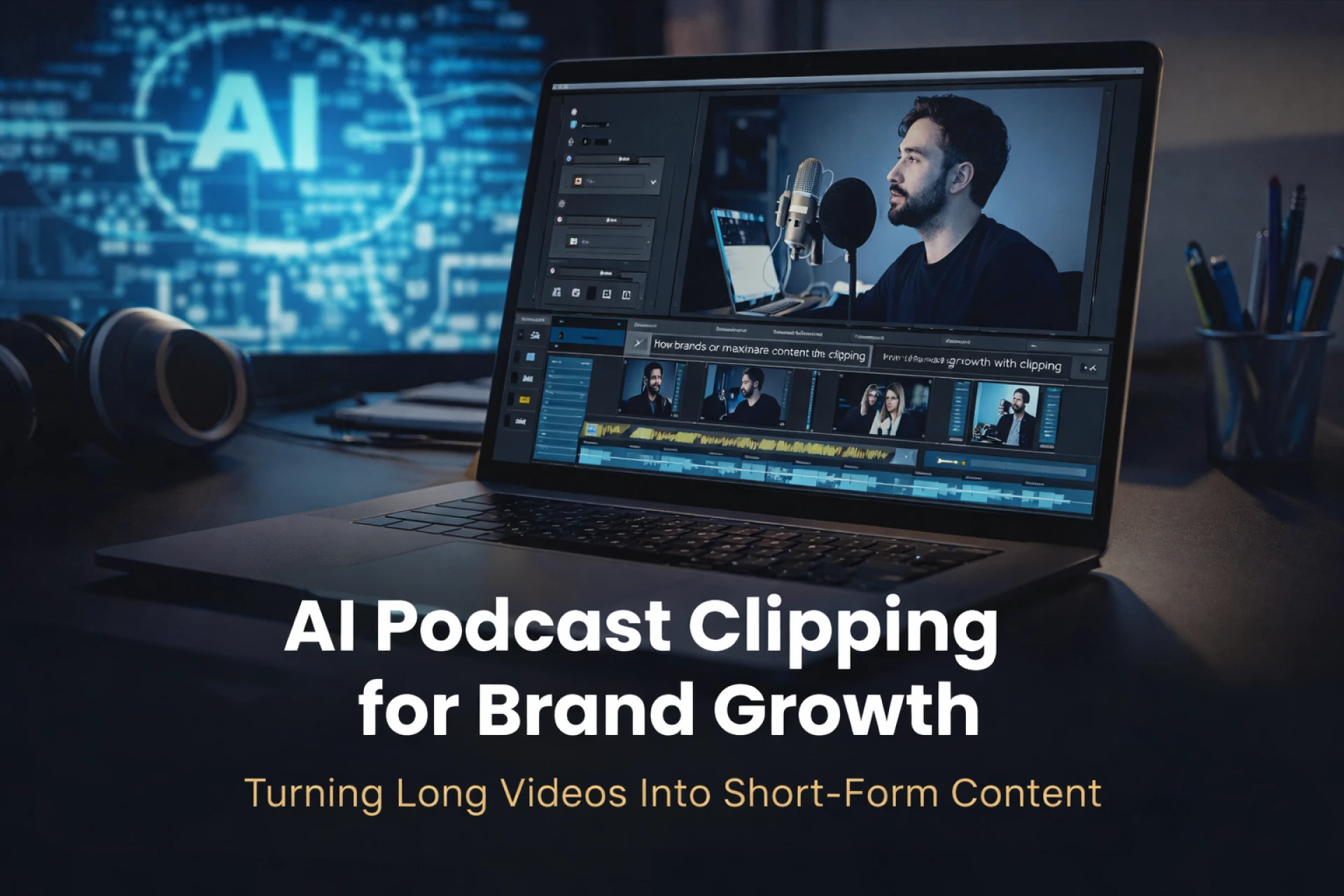
Business content moves fast now. Brands publish podcasts, interviews, webinars, expert discussions, customer stories, and long-form videos every week, sometimes every day. The problem is not always creating content. In many cases, the real issue is what happens after the content is recorded. A company may spend time planning, filming, and publishing a strong long-form episode, only for that content to get one upload and then quietly disappear into the archive. That is a waste of effort, attention, and opportunity.
This is why more brands are using AI podcast clipping as part of their content workflow. Instead of expecting one full-length video to do all the heavy lifting, they break it down into shorter, sharper pieces designed for the way people actually consume content today. A single episode can become multiple clips for YouTube Shorts, Instagram Reels, TikTok, LinkedIn, X, and other distribution channels. Suddenly, one recording is no longer one asset. It becomes a system.
That shift matters because attention is fragmented. Most people do not discover a brand by sitting down and watching a full 45-minute interview from start to finish. They discover it through a short clip, a strong insight, a useful moment, or a quote that makes them pause mid-scroll. Short-form content acts like the front door. Long-form content is still valuable, but the clip is often what gets someone to walk inside.
Why long-form content alone is no longer enough
Long-form content still has a major role in modern marketing. It helps brands explain complex ideas, build authority, show personality, and deepen trust. Podcasts and in-depth videos are especially useful for founders, agencies, consultants, educators, coaches, and businesses that rely on trust-based selling. But long-form content alone is no longer enough to support visibility.
The way audiences behave has changed. People scroll faster, compare faster, and decide faster. A long video may contain ten excellent moments, but if none of those moments are extracted and repackaged, most of them go unseen. The audience rarely arrives ready to commit. They need a reason to stop first.
That reason usually comes in a shorter format.
A sharp thirty-second insight. A bold statement. A helpful explanation. A clip with clean captions and a clear point. These small content assets do not replace the full video. They create demand for it. They act as discovery tools that pull new people into the brand ecosystem.
Without clipping, brands often create valuable content but fail to distribute it in the formats that modern attention actually rewards.
AI podcast clipping helps brands move faster
One of the biggest bottlenecks in repurposing content is time. Manual clipping sounds simple until someone has to do it every week. A person needs to review the episode, find the strongest moments, trim them, format them for vertical viewing, add captions, clean the pacing, and prepare them for publishing. On paper, that sounds manageable. In reality, it often becomes a backlog.
That is where AI podcast clipping becomes useful.
It helps identify moments with high short-form potential much faster than a fully manual process. Instead of spending hours reviewing every minute of footage, brands can accelerate the first stage of selection and focus more energy on editing, packaging, and publishing. That makes the workflow lighter and more scalable.
Speed matters because consistency matters. A brand that clips and publishes regularly stays visible. A brand that records strong content but waits too long to repurpose it usually loses momentum. AI helps reduce that gap between recording and output.
One recording can become a full distribution cycle
A smart content strategy does not ask, “What can we post today?” It asks, “How much value can we create from what we already made?”
That is the real strength of clipping.
One podcast episode can become:
- short vertical clips
- teaser moments
- quote-based posts
- episode highlights
- traffic-driving previews
- topic-specific snippets
- platform-specific edits for different audiences
This gives each recording more surface area online. It also makes content production feel less chaotic because the team is not starting from zero every time. Instead of hunting for fresh ideas daily, they build around a central asset and extend its lifespan through repurposing.
That is far more efficient. It also tends to produce better results over time because strong ideas get multiple chances to perform instead of one.
Better repurposing leads to better distribution
A lot of businesses assume their content problem is a creation problem. Often, it is not. It is a distribution problem.
They already have the raw material. They have recorded the interview. They have hosted the podcast. They have filmed the founder talking. The missing piece is turning that long-form material into content people are more likely to encounter naturally in their feeds.
Short-form distribution solves that.
Different clips appeal to different audiences. One moment may perform well on LinkedIn because it sounds strategic and professional. Another may work on TikTok because it is direct and punchy. Another may do well on Shorts because it opens with a strong hook. Each clip becomes a separate entry point into the same original content.
That is why many brands now work with specialists like Clipping Agency to turn podcasts and long videos into short-form assets that are easier to distribute, easier to scale, and more aligned with how modern platforms reward visibility.
Short-form content supports modern discovery behavior
People rarely go deep first. They go shallow, then deeper if something earns their attention.
That is how discovery works now.
A person sees one short clip.
Then they see another.
Then they recognize the brand.
Then they visit the full episode, website, or page.
This matters because repeated exposure builds familiarity. Familiarity builds trust. Trust creates action.
Clipping supports that journey by increasing the number of touchpoints a brand can create from one piece of source content. Without clipping, the audience gets one chance to notice. With clipping, they may encounter the same core message in multiple formats across multiple channels.
That does not just improve reach. It improves recall.
Efficiency should not come at the cost of quality
Some businesses worry that AI-supported clipping will make their content feel robotic or generic. That can happen if the process is careless. But good clipping is not about blindly pushing out random excerpts. It is about combining speed with judgment.
AI helps narrow the field. Human editing improves the final result.
That balance matters. The best short-form clips are not just trimmed segments. They are shaped for clarity, context, pacing, and retention. Captions need to be readable. Openings need to be strong. The clip needs to feel like it stands on its own, even if it came from a much longer conversation.
When the workflow is done properly, the result is not lower-quality content. It is a more efficient route to higher-quality distribution.
Content systems beat random posting
Random posting looks active, but it rarely builds momentum.
A lot of brands fail with short-form content because their process is inconsistent. They post a few clips, disappear for ten days, return with something unrelated, then wonder why nothing compounds. The issue is not effort. It is structure.
A better model looks like this:
record long-form content, identify strong moments, edit for each platform, publish consistently, observe what performs, and repeat.
That is a system. Systems scale. Random bursts do not.
AI podcast clipping fits well into that model because it shortens the distance between content creation and content distribution. It reduces friction. It helps lean teams stay active. It makes short-form output feel less like a burden and more like a natural extension of the original recording process.
That is where content starts becoming an operating asset instead of a side project.
Lean teams benefit the most from clipping
Not every brand has a full in-house media department. In fact, most do not. Many have a founder, a marketer, maybe an editor, and a long list of other priorities competing for time. They know short-form content matters, but the workflow keeps slipping down the list.
That is why clipping matters so much for lean teams.
It allows one recording session to generate a larger set of usable assets without multiplying workload at the same pace. It helps teams stay visible without needing to invent new content from scratch every day. It also makes long-form content more commercially useful, because the same core asset now supports awareness, engagement, reach, and traffic in a more deliberate way.
For growing brands, that kind of leverage matters a lot.
Final thoughts
Long-form content still deserves a place in a strong digital strategy. It builds authority, depth, and trust. But long-form content on its own is often underutilized. The real opportunity comes from what happens after the recording ends.
AI podcast clipping helps brands turn one long-form video into multiple short-form opportunities for reach, discovery, and engagement. It supports faster workflows, better repurposing, and more consistent distribution without forcing teams into an exhausting content treadmill.
For businesses that already create useful long-form content, clipping is not just a nice extra anymore. It is quickly becoming one of the smartest ways to get more value from every recording and stay visible in a crowded attention economy.