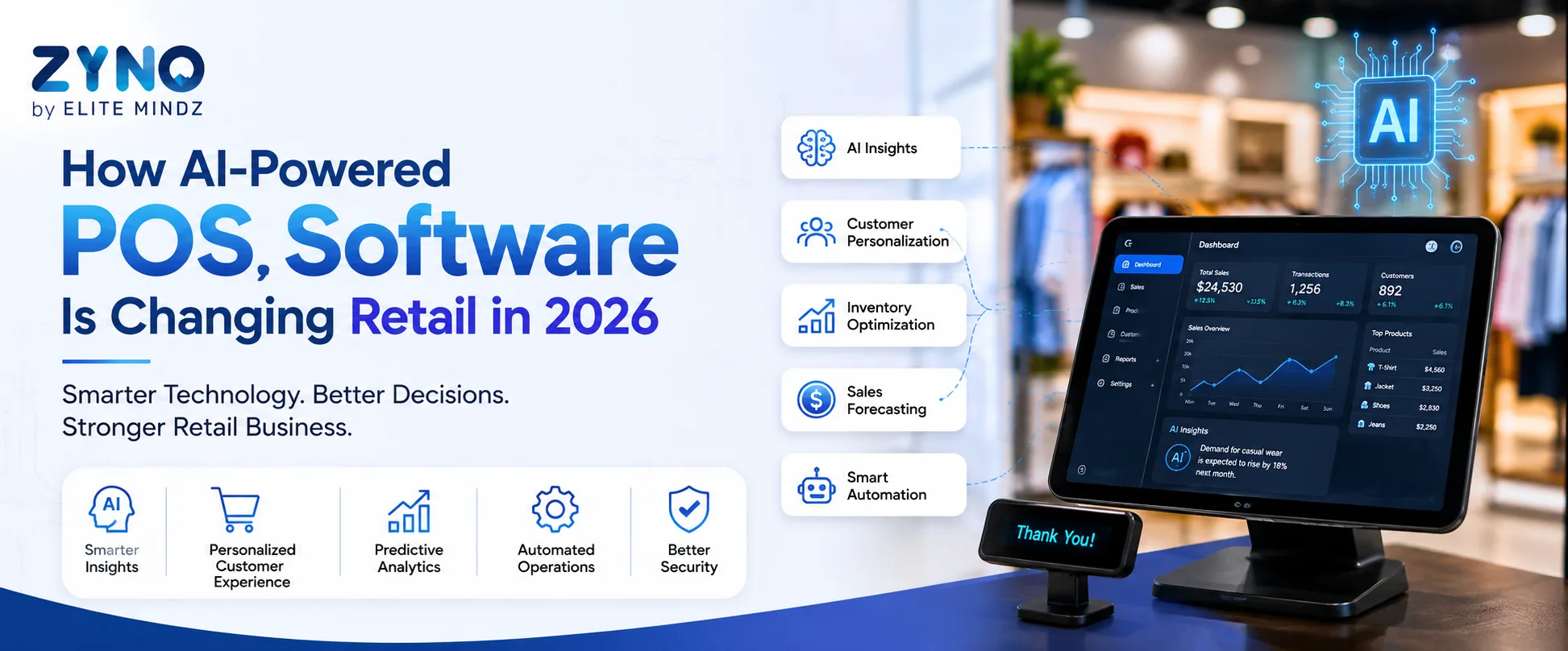
Retail is becoming faster, smarter, and more connected in 2026. Customers expect quick checkout, accurate product availability, personalized offers, flexible payment methods, and a seamless experience whether they shop online or inside a physical store.
To meet these expectations, retailers are moving beyond traditional billing systems and adopting AI-powered POS software.
A modern AI POS system does much more than record transactions. It can analyze sales patterns, forecast demand, manage inventory, understand customer behavior, detect unusual transactions, and help retailers make better decisions in real time.
This shift reflects a wider change in the retail industry. AI is moving from experimentation into everyday retail operations, while checkout is increasingly becoming an intelligent, connected platform rather than simply a payment terminal.
So, how is AI-powered POS software changing retail, and what should businesses expect from POS software 2026? Let's look at the biggest changes.
What Is AI-Powered POS Software?
AI-powered POS software is a point-of-sale system that uses artificial intelligence and machine learning to analyze retail data and automate business processes.
Traditional point of sale software mainly handles billing, payments, receipts, and basic inventory updates. An intelligent POS system can use the same transaction data to identify trends and recommend actions.
For example, AI POS software may help a retailer answer questions such as:
- Which products are likely to sell fastest next week?
- Which items should be reordered?
- What products are frequently purchased together?
- Which customers are likely to respond to a promotion?
- Which store is experiencing unusual sales activity?
- When is demand likely to increase?
This turns a modern POS system into a business intelligence tool rather than just a checkout application.
1. AI Is Making Checkout Faster
One of the most visible changes is AI-powered checkout.
Retailers want to reduce queues and make payment easier without sacrificing accuracy. AI can support faster product recognition, automated offers, intelligent payment workflows, and smarter self-service experiences.
Retailers are also investing in self-checkout, self-scanning, and mobile checkout technologies in 2026. EHI Retail Institute's Checkout Trends 2026 research highlights AI integration, self-service systems, and mobile devices with checkout capabilities as important areas of retail investment.
A smart checkout system can help improve checkout speed while reducing repetitive work for employees.
Technologies such as self-checkout POS, mobile POS systems, and SoftPOS are also giving retailers more flexibility in how and where customers pay.
2. Smarter Inventory Management
Inventory is one of the biggest challenges in retail.
Too much stock ties up money and storage space, while too little stock can result in lost sales.
This is where AI POS software with inventory management becomes valuable.
An AI-enabled POS inventory management system can analyze historical sales, current inventory, seasonal patterns, and product movement to support better purchasing decisions.
Instead of relying only on manual reorder levels, retailers can use AI inventory forecasting and AI demand forecasting to estimate what products may be needed.
This enables automated inventory management, where the system can identify low-stock products, recommend reorder quantities, and help reduce stockouts and overstocking.
AI is increasingly being used to improve demand forecasting and supply-chain decision-making across retail.
When connected with inventory management software, POS data becomes even more useful because retailers can see what is selling and immediately understand how those sales affect available stock.
3. More Personalized Customer Experiences
Modern customers expect brands to understand their preferences.
An AI-powered retail POS system can combine transaction history with customer information to create a more personalized retail experience.
For example, retailers may use AI to:
- Recommend relevant products
- Create personalized promotions
- Identify repeat customers
- Suggest complementary products
- Improve loyalty programs
- Segment customers based on buying behavior
AI product recommendations can make shopping more useful to customers while also creating opportunities for cross-selling and upselling.
Retailers can also combine POS information with customer management software and customer behavior analytics to better understand customer preferences.
Personalization is one of the major expected areas of value for AI at the point of sale in 2026.
4. AI-Powered Retail Analytics
Retail businesses generate thousands of useful data points through daily transactions.
Without the right tools, much of that information remains unused.
AI-powered retail analytics can turn POS data into practical insights.
Retailers can analyze:
- Best-selling products
- Slow-moving products
- Revenue by location
- Sales by employee
- Peak shopping hours
- Customer buying patterns
- Average transaction value
- Product return patterns
- Promotion performance
A smart POS software solution can make these insights easier to understand and act on.
When combined with retail analytics and sales tracking software, retailers can move from simply looking at historical reports to making more informed predictions.
For example, retail sales forecasting can help managers prepare inventory and staffing before demand increases.
5. Retail Automation Is Reducing Manual Work
Another major benefit of AI POS software is automation.
Employees often spend significant time updating inventory, checking reports, managing prices, tracking products, and entering information manually.
AI retail automation can reduce some of this repetitive work.
A modern system may automatically:
- Update stock after every sale
- Detect low-stock products
- Generate sales summaries
- Recommend purchase quantities
- Identify sales trends
- Categorize customer activity
- Flag unusual transactions
- Synchronize store data
This type of retail automation allows employees to spend more time helping customers instead of maintaining spreadsheets.
An integrated retail management software platform can also connect POS, inventory, purchasing, customers, and payments, helping create more intelligent retail operations.
6. Better Multi-Store Management
Retail chains need visibility across multiple locations.
An AI-powered POS software for multiple stores can provide centralized access to sales, inventory, customer, and operational information.
With multi-store POS software, management can compare store performance and identify where products are selling faster.
Real-time inventory data can also support stock transfers between branches.
For example, if one store has excess stock while another is running low, real-time inventory management can help managers move products instead of ordering unnecessary new inventory.
This is particularly useful for businesses investing in retail digital transformation and expanding into new locations.
7. Omnichannel and Unified Commerce
Customers no longer think in terms of separate online and offline stores.
They may research online, purchase in-store, order through an app, or return an online purchase to a physical shop.
This makes omnichannel POS software increasingly important.
A unified commerce POS connects inventory, transactions, orders, payments, and customer information across channels.
Unified commerce has become a major 2026 retail technology theme because retailers want a single view of inventory, orders, and customer data rather than multiple disconnected systems.
For customers, this creates a more consistent experience.
For retailers, it provides better operational visibility.
8. Smarter Payments and Fraud Detection
Payments are also changing.
A modern digital payment POS may support cards, mobile wallets, QR payments, and other digital payment options.
A contactless POS system can make checkout faster while giving customers greater payment flexibility.
Retailers can integrate payment processing software directly with the POS so payments and transaction records remain synchronized.
AI can also help identify unusual transaction patterns. AI fraud detection retail tools can analyze transaction activity and flag behavior that may require further investigation.
However, retailers should still maintain human oversight and strong security controls rather than depending completely on automated decisions.
9. Agentic AI Is Starting to Influence Retail
One of the most interesting developments in 2026 is agentic AI in retail.
Unlike traditional AI tools that simply provide recommendations, AI agents can potentially complete multiple steps of a task.
In retail, this could eventually include assisting customers with product discovery, comparing options, checking availability, and helping complete transactions.
Deloitte's 2026 retail outlook found that 68% of surveyed retail executives expect agentic AI deployment for key operational and enterprise activities within the next 12 to 24 months.
This suggests that the future of POS software in retail may involve POS systems working alongside AI agents rather than simply processing transactions after a buying decision has already been made.
What Are the Benefits of AI POS Software?
The major benefits of AI POS software include:
- Faster checkout
- Better inventory accuracy
- Improved demand forecasting
- Reduced manual work
- Better customer insights
- Personalized recommendations
- Real-time business analytics
- Better multi-store visibility
- More accurate sales forecasting
- Improved operational efficiency
For smaller retailers, an AI POS system for small business can also provide access to capabilities that were once mainly available to large retail chains.
The best AI POS software for retail should make these capabilities easy to use instead of adding unnecessary complexity.
Choosing an AI-Based POS System for Retail Stores
Before selecting an AI-based POS system for retail stores, businesses should evaluate their actual needs.
Look for features such as:
- Easy-to-use POS billing software
- Real-time inventory tracking
- AI forecasting
- Customer management
- Multi-store capabilities
- Barcode billing software
- Secure payment integration
- Mobile access
- Cloud deployment
- Reports and analytics
- Ecommerce integration
- Automation capabilities
For growing businesses, cloud POS software can provide additional flexibility because information can be centralized and accessed across multiple stores and devices.
The right AI retail software should also integrate with your existing systems instead of creating another data silo.
The Future of AI-Powered POS Software
The biggest change in 2026 is that POS software is becoming less about simply recording what has already happened and more about helping retailers decide what should happen next.
The combination of smart retail technology, AI, real-time data, mobile checkout, cloud platforms, and unified commerce is transforming the role of the POS.
Retailers can use an intelligent system to understand demand, manage stock, personalize customer experiences, automate routine tasks, and monitor performance from a single platform.
This is ultimately how AI improves POS systems: by turning everyday transaction data into useful business intelligence.
Final Thoughts
Understanding how AI is transforming retail in 2026 is important for any retailer planning to modernize its operations.
AI-powered POS software for retail businesses is no longer focused only on faster billing. It is becoming part of a larger ecosystem connecting sales, inventory, payments, customers, analytics, and automation.
From AI demand forecasting and automated inventory management to AI-powered checkout, retail analytics, mobile POS, omnichannel POS software, and unified commerce, POS technology is becoming smarter and more connected.
The best system will depend on the retailer's size, number of stores, sales channels, budget, and operational needs. But one thing is becoming clear: the future of retail POS is intelligent, data-driven, connected, and increasingly automated.
For retailers planning their next stage of retail digital transformation, investing in the right AI-enabled POS platform can provide better visibility, faster operations, and a stronger foundation for future growth.