
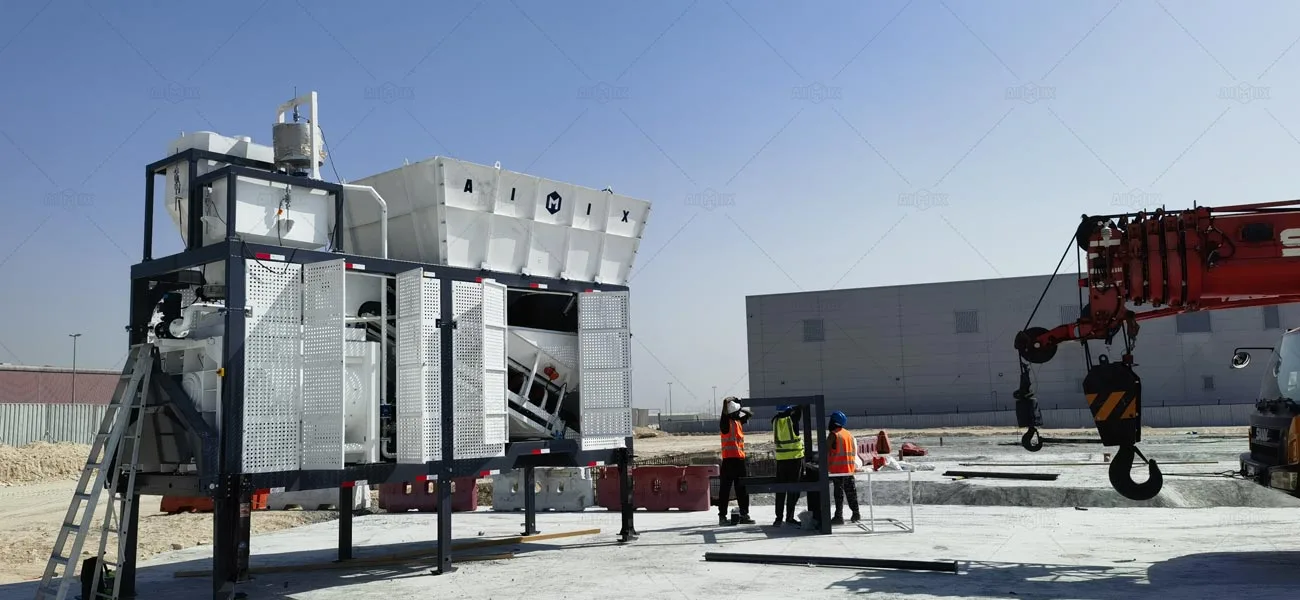
For contractors working on road, bridge, and remote infrastructure projects, installation time can directly affect project efficiency. A 40 m³/h portable concrete batching plant is designed to address this challenge by combining compact transportation dimensions, integrated components, and simplified site assembly.
Putting a portable concrete batching plant into operation within one hour does not mean completing every possible installation task from zero. The key is to complete most preparation and commissioning work before the equipment reaches the site. With factory pre-assembly, proper transport planning, and a prepared foundation area, a 40 m³/h system can be rapidly positioned and started.
This rapid-start approach is particularly useful for contractors evaluating concrete plants in Colombia, where projects may be distributed across different regions and equipment frequently needs to adapt to changing site conditions.
What Makes One-Hour Commissioning Possible?
The main difference between rapid-installation equipment and a conventional stationary batching plant is the amount of work required on site.
A traditional plant may require extensive foundation construction, structural assembly, electrical installation, and component alignment. A mobile configuration reduces many of these steps by integrating major systems into a transportable structure.
Factory Pre-Assembly
Before shipment, manufacturers can complete a substantial portion of mechanical and electrical assembly.
Typical pre-shipment work includes:
- Installing the batching and weighing systems
- Connecting major electrical components
- Checking the control system
- Testing motors and actuators
- Inspecting conveyor operation
- Performing factory commissioning
This means that the installation team primarily needs to complete site-level connections rather than assemble every component individually.
Step 1: Prepare The Site Before Delivery
The fastest installation begins before the plant arrives.
A level and sufficiently compacted working area should be prepared in advance. The site should provide enough space for equipment positioning, aggregate loading, cement supply, concrete truck movement, and routine maintenance.
Contractors should also verify:
- Access road width and turning radius
- Ground bearing capacity
- Power supply availability
- Water supply
- Aggregate storage location
- Cement or silo arrangement
- Concrete truck access
If these items are prepared beforehand, the plant does not need to wait after arrival.
Check The Transport Route
For projects in mountainous or remote areas, transportation planning is especially important. A portable concrete batching plant(planta dosificadora de concreto portátil) may be compact compared with a stationary system, but the delivery vehicle still needs adequate road access.
Checking bridges, sharp turns, slopes, overhead obstacles, and unloading areas in advance can prevent unexpected delays.
Step 2: Position And Stabilize The Plant
Once the equipment arrives, the first task is to move it into its operating position.
A mobile 40 m³/h batching plant can generally be positioned using suitable lifting or towing equipment, depending on its specific configuration.
After positioning, operators should check:
- Equipment levelness
- Support points
- Mechanical stability
- Hopper and conveyor clearance
- Truck loading position
- Access for maintenance
The goal is to establish a stable operating position without unnecessary dismantling or reconstruction.
Step 3: Complete Utility Connections
After positioning, the installation team connects the required utilities.
Electrical Connection
The power supply should match the plant's electrical specifications. The control cabinet, motors, sensors, and grounding system should be checked before startup.
Water Connection
The water supply should provide sufficient flow and stable pressure for the batching process. The pipeline should also be inspected for leakage.
Material Supply
Aggregates, cement, and admixtures should be available before commissioning. There is little benefit in completing mechanical installation quickly if the plant cannot perform a test batch because raw materials have not arrived.
Step 4: Perform A Quick Commissioning Check
Before producing commercial concrete, operators should run the main systems without load and verify that everything functions correctly.
The commissioning checklist can include:
- Weighing sensor response
- Conveyor operation
- Mixer rotation
- Aggregate gate movement
- Cement feeding
- Water dosing
- Admixture dosing
- Emergency-stop functions
- Control system communication
Any abnormal noise, vibration, leakage, or sensor reading should be addressed before production begins.
How Can The First Batch Be Produced Quickly?
Once the mechanical, electrical, and material systems are ready, the operator can conduct a trial batch.
The first batch should be checked for:
- Actual aggregate quantities
- Cement dosage
- Water quantity
- Concrete consistency
- Mixer discharge
- Weighing accuracy
The purpose is not simply to confirm that the mixer rotates. It is to verify that the complete batching process produces concrete according to the required mix design.
For a 40 m³/h plant, proper operating procedures also help the system approach its rated productivity without creating unnecessary interruptions.
Why This Matters For Concrete Plants In Colombia
For contractors considering concrete plants in Colombia(plantas de concreto Colombia), rapid commissioning can be valuable when projects have tight construction schedules or frequently changing work locations.
Road construction, bridge construction, housing developments, mining infrastructure, and remote projects may not justify the long installation period associated with a large stationary plant. A mobile configuration can allow contractors to establish concrete production closer to the active construction area.
The benefit is not simply saving installation hours. Faster commissioning can reduce idle equipment time, shorten project preparation, and allow concrete production to begin earlier.
A One-Hour Start Requires Preparation
A 40 m³/h portable concrete batching plant can achieve very rapid commissioning when the equipment is designed for quick installation and the site has been properly prepared. Factory pre-assembly, route planning, utility preparation, material availability, and a structured commissioning checklist are the key factors.
The most important lesson is that one-hour startup is not created by installation speed alone. It is the result of moving as much preparation as possible from the construction site to the factory and completing all site preparations before delivery.
For contractors, this approach can turn a concrete batching plant from a lengthy installation project into a practical production tool that is ready to work shortly after reaching the construction site.