
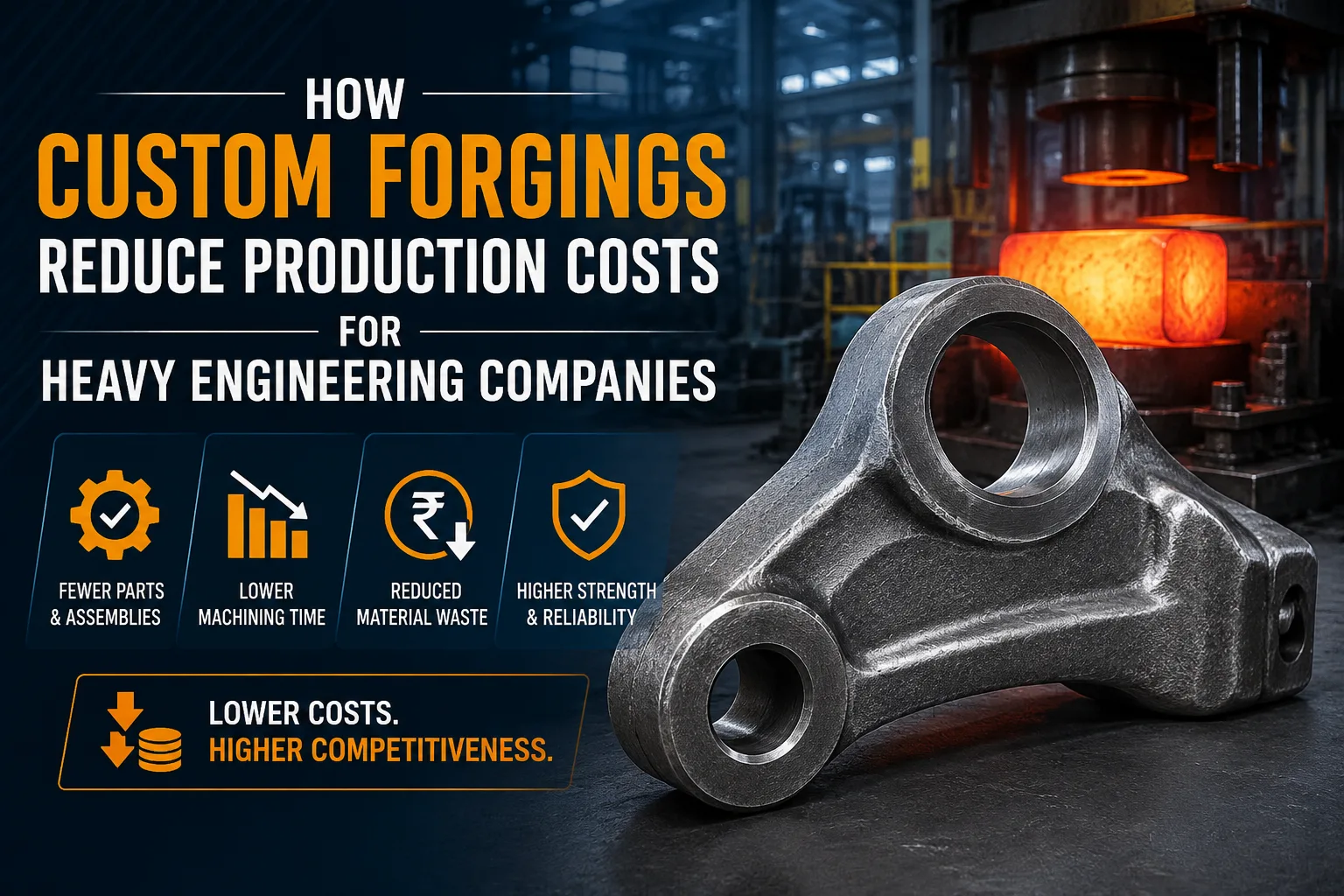
In today's highly competitive industrial landscape, heavy engineering companies are under constant pressure to improve operational efficiency while controlling manufacturing costs. Whether serving industries such as oil & gas, power generation, mining, construction, marine, or infrastructure development, manufacturers must deliver high-quality components without compromising profitability.
One of the most effective ways to achieve this balance is through custom forgings. Unlike standard off-the-shelf components, custom forged parts are engineered to meet specific application requirements, allowing manufacturers to optimize performance, reduce waste, and lower overall production expenses.
As demand for larger, stronger, and more complex industrial components continues to grow, custom forging solutions are becoming an increasingly valuable strategy for heavy engineering companies seeking long-term cost savings and operational advantages.
Understanding Custom Forgings
Custom forgings are metal components manufactured according to precise customer specifications regarding dimensions, material grade, mechanical properties, and performance requirements.
Through processes such as open die forging, closed die forging, and specialized forging techniques, manufacturers can produce components tailored to unique industrial applications. These forged components often require fewer modifications during subsequent manufacturing stages, helping organizations streamline production workflows and reduce costs.
For heavy engineering projects where component reliability and durability are critical, custom forgings offer both technical and financial benefits.
Reduced Material Waste
One of the primary ways custom forgings reduce production costs is by minimizing material waste.
Traditional manufacturing methods often involve extensive machining from large metal blocks, resulting in significant material removal and scrap generation. In contrast, custom forging processes shape the material closer to its final dimensions, reducing the amount of excess metal that must be removed.
This approach delivers several advantages:
- Lower raw material consumption
- Reduced machining waste
- Improved material utilization rates
- Lower procurement costs
For large industrial components manufactured from high-value alloys, these savings can have a substantial impact on overall project budgets.
Lower Machining and Finishing Costs
Machining is often one of the most expensive stages in the manufacturing process. Components that require extensive cutting, drilling, and finishing operations consume valuable machine time, labor resources, and tooling.
Custom forged components are designed to achieve near-net shapes, meaning they closely resemble the final product before machining begins. As a result, manufacturers can significantly reduce:
- Machining time
- Tool wear
- Labor costs
- Energy consumption
- Production lead times
By reducing secondary processing requirements, heavy engineering companies can improve production efficiency while lowering operational expenses.
Improved Mechanical Properties Reduce Failures
Equipment failures can be extremely costly for industries such as mining, power generation, and oil & gas. Unexpected downtime often results in lost productivity, expensive repairs, and project delays.
The forging process refines the metal's grain structure, creating components with superior mechanical properties compared to cast or fabricated alternatives. Custom forgings typically offer:
- Higher strength
- Better fatigue resistance
- Improved toughness
- Enhanced structural integrity
- Greater resistance to impact loading
These characteristics help reduce component failures and maintenance requirements, contributing to lower lifecycle costs for industrial operations.
Enhanced Product Performance
Every heavy engineering application has unique performance requirements. Standard components may not always provide the optimal balance of strength, durability, and functionality.
Custom forging solutions allow manufacturers to design components specifically for their intended operating conditions. This enables better performance in environments involving:
- High pressure
- Extreme temperatures
- Heavy mechanical loads
- Continuous vibration
- Corrosive conditions
By optimizing component design, organizations can improve equipment reliability and maximize operational efficiency.
Reduced Assembly Complexity
Heavy engineering systems often consist of multiple interconnected components. In many cases, standard manufacturing methods require several individual parts to be assembled together, increasing production complexity and labor costs.
Custom forgings can consolidate multiple fabricated or welded parts into a single forged component. This approach offers several advantages:
- Fewer assembly operations
- Reduced welding requirements
- Lower labor costs
- Improved structural strength
- Simplified inventory management
The result is a more efficient manufacturing process and a more reliable final product.
Faster Production Cycles
Project timelines are a critical factor in heavy engineering industries. Delays in component manufacturing can impact construction schedules, equipment commissioning, and customer deliveries.
Because custom forged components are manufactured closer to final specifications, production workflows become more streamlined. Benefits include:
- Reduced manufacturing steps
- Faster machining operations
- Improved production planning
- Shorter lead times
- More predictable delivery schedules
These efficiencies help organizations meet project deadlines while controlling operational costs.
Long-Term Cost Savings Through Durability
While the initial investment in custom forgings may sometimes be higher than standard components, the long-term economic benefits are often significantly greater.
Custom forged components typically provide:
- Longer service life
- Reduced maintenance expenses
- Lower replacement frequency
- Improved operational reliability
- Decreased downtime costs
For critical industrial equipment operating in demanding environments, these long-term savings can far exceed the initial manufacturing investment.
Applications of Custom Forgings in Heavy Engineering
Custom forgings are widely used across numerous heavy engineering sectors.
Oil and Gas Industry
Custom forged components are used in:
- Pressure vessels
- Flanges
- Valve bodies
- Drilling equipment
- Offshore platform systems
These applications demand exceptional strength and reliability under high-pressure operating conditions.
Power Generation
Power plants utilize custom forgings for:
- Turbine shafts
- Generator components
- Rotor assemblies
- Heat exchanger systems
- Pressure-containing equipment
Precision forging helps ensure operational efficiency and long-term equipment performance.
Mining and Construction
Mining equipment operates under some of the harshest conditions in the industrial sector.
Custom forged parts are commonly used in:
- Crusher components
- Excavation systems
- Hydraulic equipment
- Heavy machinery assemblies
- Material handling systems
The durability of forged components helps reduce maintenance and downtime.
Marine and Shipbuilding
Marine applications require components capable of withstanding constant exposure to challenging environments.
Custom forgings support:
- Propulsion systems
- Marine shafts
- Structural components
- Offshore equipment
- Shipbuilding projects
Their strength and reliability make them ideal for demanding maritime operations.
Why Heavy Engineering Companies Prefer Custom Forging Solutions
As industrial projects become larger and more technically demanding, standardized manufacturing approaches often fail to deliver optimal results.
Custom forgings provide heavy engineering companies with:
- Greater design flexibility
- Improved material efficiency
- Enhanced component performance
- Reduced manufacturing costs
- Increased operational reliability
These advantages make custom forging an essential manufacturing solution for organizations seeking both performance and profitability.
The Future of Cost-Efficient Manufacturing
The heavy engineering sector continues to embrace advanced manufacturing technologies that improve efficiency and reduce costs. Custom forging is expected to play an increasingly important role in this evolution as companies seek stronger, lighter, and more durable components.
By combining precision engineering with optimized material utilization, custom forgings help manufacturers remain competitive while meeting the growing demands of modern industrial projects.
Conclusion
Custom forgings offer far more than improved mechanical performance. They provide a strategic advantage by reducing material waste, lowering machining costs, minimizing equipment failures, and improving overall manufacturing efficiency.
As organizations continue to prioritize efficiency and operational excellence, custom forgings will remain a critical part of cost-effective industrial manufacturing strategies.For heavy engineering companies operating in sectors such as oil & gas, power generation, mining, marine, and infrastructure development, custom forging solutions can significantly reduce production costs while enhancing component reliability and long-term value