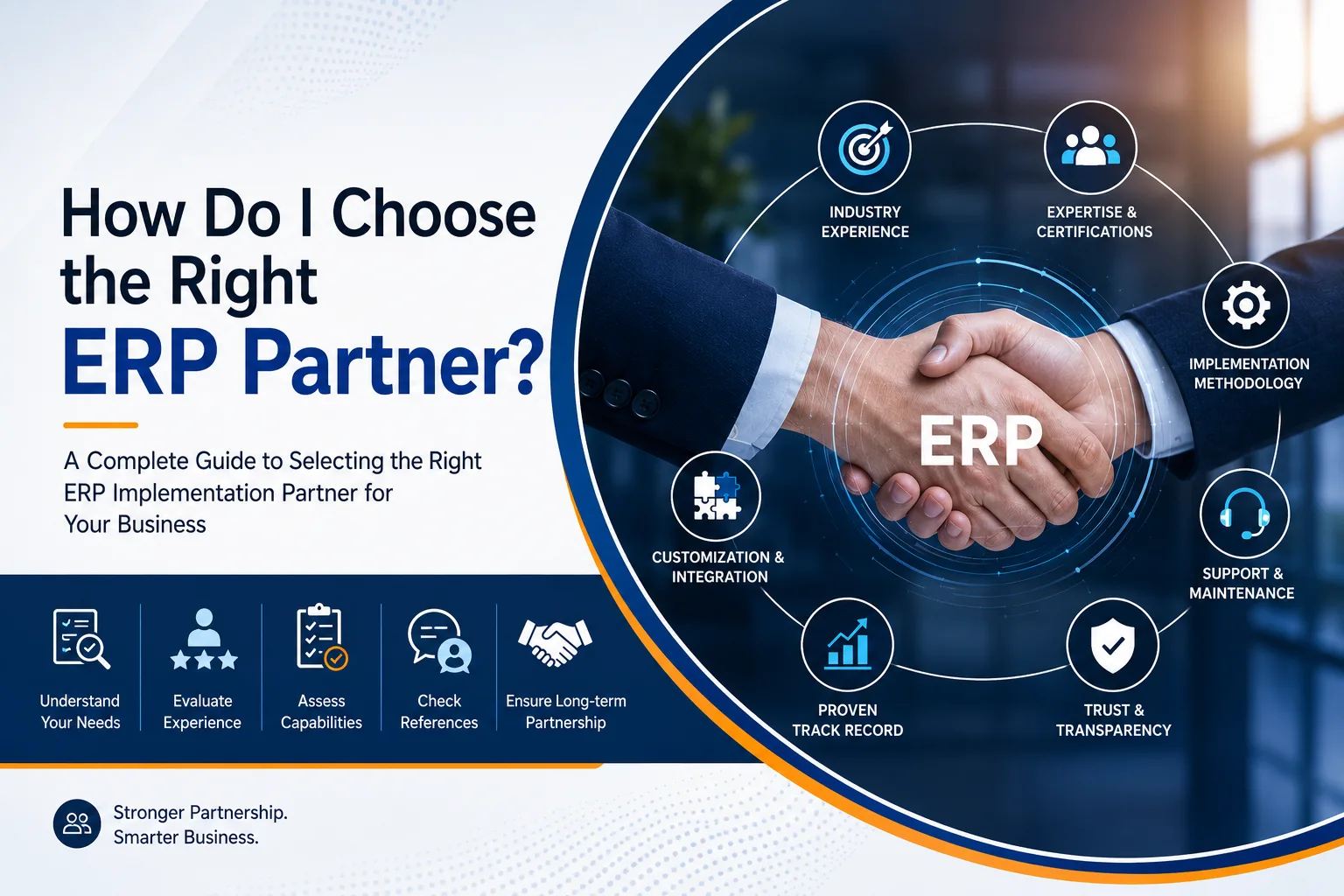
Choosing the right ERP partner is just as important as choosing the ERP software itself. A good implementation partner helps you understand your requirements, configure the system, migrate your data, train employees, manage integrations, and provide support after go-live. Industry guidance consistently emphasizes evaluating delivery experience, implementation methodology, references, technical expertise, and post-implementation support not just price.
1. Understand Your Business Requirements
Before approaching ERP partners, identify the problems you want the ERP to solve. Consider which departments need the system, what processes should be automated, which reports are required, what integrations are necessary, and whether customization will be needed.
A clear list of requirements makes it easier to compare different ERP partners and prevents unnecessary features or scope changes later.
2. Look for Industry Experience
Choose an ERP partner that understands your industry and business processes. Manufacturing, healthcare, retail, trading, logistics, and nonprofit organizations have very different workflows.
Ask potential partners about similar implementations they have completed and request relevant case studies or client references. Industry-specific experience can help the partner understand your requirements more quickly and reduce implementation risks.
3. Check ERP Platform Expertise
If you have already selected ERPNext, Odoo, SAP Business One, Microsoft Dynamics, or another platform, evaluate the partner's expertise in that specific ERP.
For ERPNext, look for verified partner credentials, completed implementations, relevant technical expertise, and experience with the Frappe framework and customization where required.
4. Review Their Implementation Methodology
A reliable ERP partner should have a clearly defined implementation process. This normally includes requirement analysis, process mapping, system configuration, customization, data migration, testing, user training, go-live, and post-go-live support.
Be cautious if a partner immediately provides a fixed quote without first understanding your business processes and requirements.
5. Evaluate Customization and Integration Capabilities
Every business has unique workflows. Your ERP partner should be able to determine what can be handled through standard ERP functionality and where customization is genuinely necessary.
Also evaluate their ability to integrate the ERP with existing systems such as accounting software, eCommerce platforms, payment gateways, CRM systems, logistics applications, or other business tools.
6. Check Data Migration Experience
Data migration can significantly affect ERP implementation success. Ask the partner how they handle existing customer, supplier, item, inventory, accounting, and transactional data.
A good partner should have a structured approach for data cleansing, migration, validation, testing, and reconciliation before go-live.
7. Evaluate Training and User Adoption
ERP implementation is not only a technical project. Employees need to understand how the new system works and how it changes their daily processes.
Ask whether the partner provides role-based training, documentation, user support, testing assistance, and training before and after go-live.
Strong user adoption is essential for getting value from the ERP.
8. Check Post-Go-Live Support
Your relationship with the ERP partner should not end when the system goes live.
Ask about post-implementation support, maintenance, upgrades, bug fixing, performance monitoring, customization requests, and response times. A clear support agreement or SLA can help establish expectations for ongoing assistance.
9. Ask for Client References
Do not rely only on testimonials or logos displayed on a website. Ask whether you can speak with existing or previous clients who have implemented the ERP.
Ideally, choose references from businesses similar to yours in terms of industry, size, complexity, or geographic requirements.
10. Compare Pricing and Scope
Price should not be the only factor when selecting an ERP partner.
Compare what each proposal includes, such as:
- ERP configuration
- Customization
- Data migration
- Integrations
- Training
- Hosting
- Testing
- Go-live support
- Maintenance
- Post-go-live support
A transparent proposal should clearly define what is included and what falls outside the agreed scope.
11. Assess Communication and Transparency
ERP projects involve business owners, department heads, employees, developers, consultants, and project managers. Clear communication is therefore essential.
Choose a partner that explains technical matters clearly, communicates project progress regularly, documents decisions, and is willing to explain potential risks instead of promising that everything is automatically possible.
12. Consider Scalability
Your ERP partner should understand your future business plans, not just your current requirements.
Consider whether the partner can support future requirements such as additional users, warehouses, branches, companies, products, integrations, countries, or business processes.
A scalable ERP strategy can prevent the need for another major system replacement as your organization grows.
Questions to Ask an ERP Partner
Before signing an agreement, ask:
- How many ERP implementations have you completed?
- Have you implemented ERP for businesses in our industry?
- Can we speak with existing clients?
- What is your implementation methodology?
- Who will manage our project?
- What is included in the implementation cost?
- How do you handle data migration?
- What customization will we actually need?
- Which integrations can you support?
- What training will employees receive?
- What happens after go-live?
- What does your support agreement include?
- How do you handle ERP upgrades?
- What happens if the project scope changes?
Final Thoughts
The right ERP partner should be more than a software vendor. They should understand your business processes, help you design the right ERP workflow, manage implementation risks, support your employees, and remain available as your business grows.
When evaluating an ERP partner, focus on industry experience, ERP expertise, implementation methodology, customization, integration, data migration, training, client references, transparent pricing, and post-go-live support. These factors provide a much stronger basis for selecting a partner than price or a sales demonstration alone.
For businesses considering ERPNext, selecting a partner with both functional business knowledge and technical Frappe/ERPNext capabilities can be particularly important when customization, integrations, migration, and long-term support are part of the project.