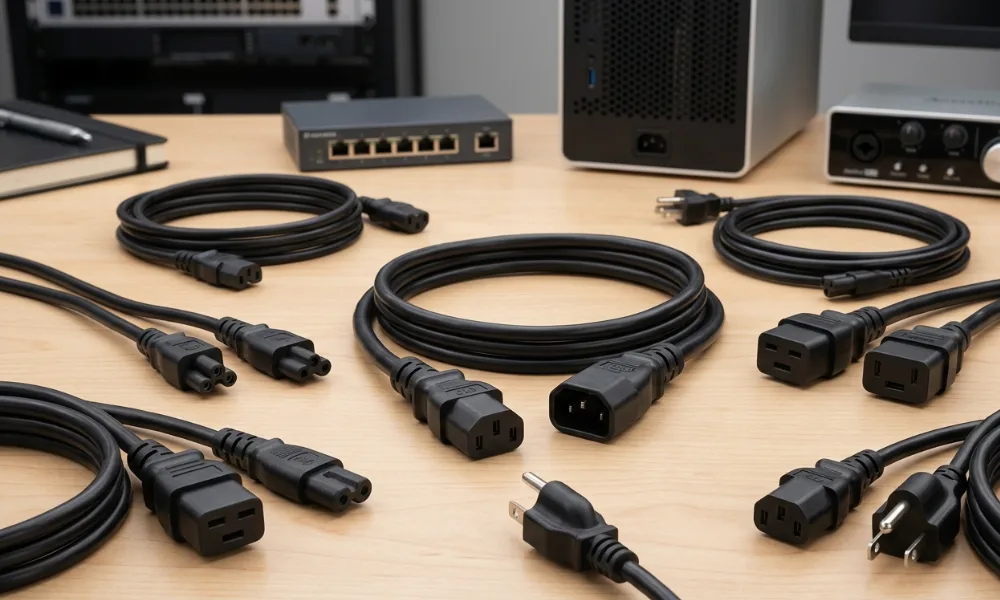
Selecting the right length for your IEC 320 setup might seem like the simplest part of the purchasing decision, but there are a few technical and practical factors worth understanding. Getting the length right improves safety, cable management, and long-term reliability.
Why Length Matters Electrically
Every conductor has resistance, and that resistance increases with length. For short runs the 1- to 3-meter cords typical in home and office environments this resistance is negligible. However, in commercial or industrial settings where longer runs are required, resistance can cause a measurable voltage drop that affects equipment performance.
Choosing the appropriate power cable length for your application ensures that by the time power reaches your device, it is still within the voltage tolerance the device needs to operate correctly. For most standard equipment, cords up to 6 meters are well within safe parameters for typical wire gauges.
The Impact of Wire Gauge
Wire gauge and length are closely related. A thicker wire (lower AWG number) has less resistance per foot, which means it can carry the same current over a longer distance with less voltage drop and less heat generation. When purchasing longer cords, pay attention to the wire gauge. A longer cord with a heavier gauge conductor is always preferable to a long cord with thin wires.
Practical Length Guidelines
For home and office desktops, 1.8 meters (6 feet) is the standard cord length and works well for the vast majority of setups. It provides enough slack to position equipment flexibly without creating excessive coil.
For rack-mounted server equipment, standard lengths are 2 to 3 meters, which accommodates equipment at various heights in the rack while connecting to a power distribution unit at the back. Many data center managers prefer to inventory a range of lengths 1 meter, 1.5 meter, and 2 meter to keep the cable plant tidy.
Avoiding Excess Cable
A common mistake is ordering longer cords than necessary and then coiling the extra length. Tightly coiled cords act like an inductor and can generate heat, particularly at higher loads. A small amount of slack is fine, but avoid looping excess cable into tight bundles during continuous operation.
Always purchase cords that are rated for the local voltage, carry the relevant safety certifications for your region, and are designed for the specific wall outlet standard where the equipment will be used. Getting this right protects your equipment and ensures you stay within safety compliance requirements.
Custom Lengths
For particularly demanding applications, custom-length cords are available from specialist suppliers. These are manufactured to your exact specifications, eliminating excess cable entirely while ensuring the gauge and rating match your requirements. This is a worthwhile investment for permanent installations.
Original Article :- Click here