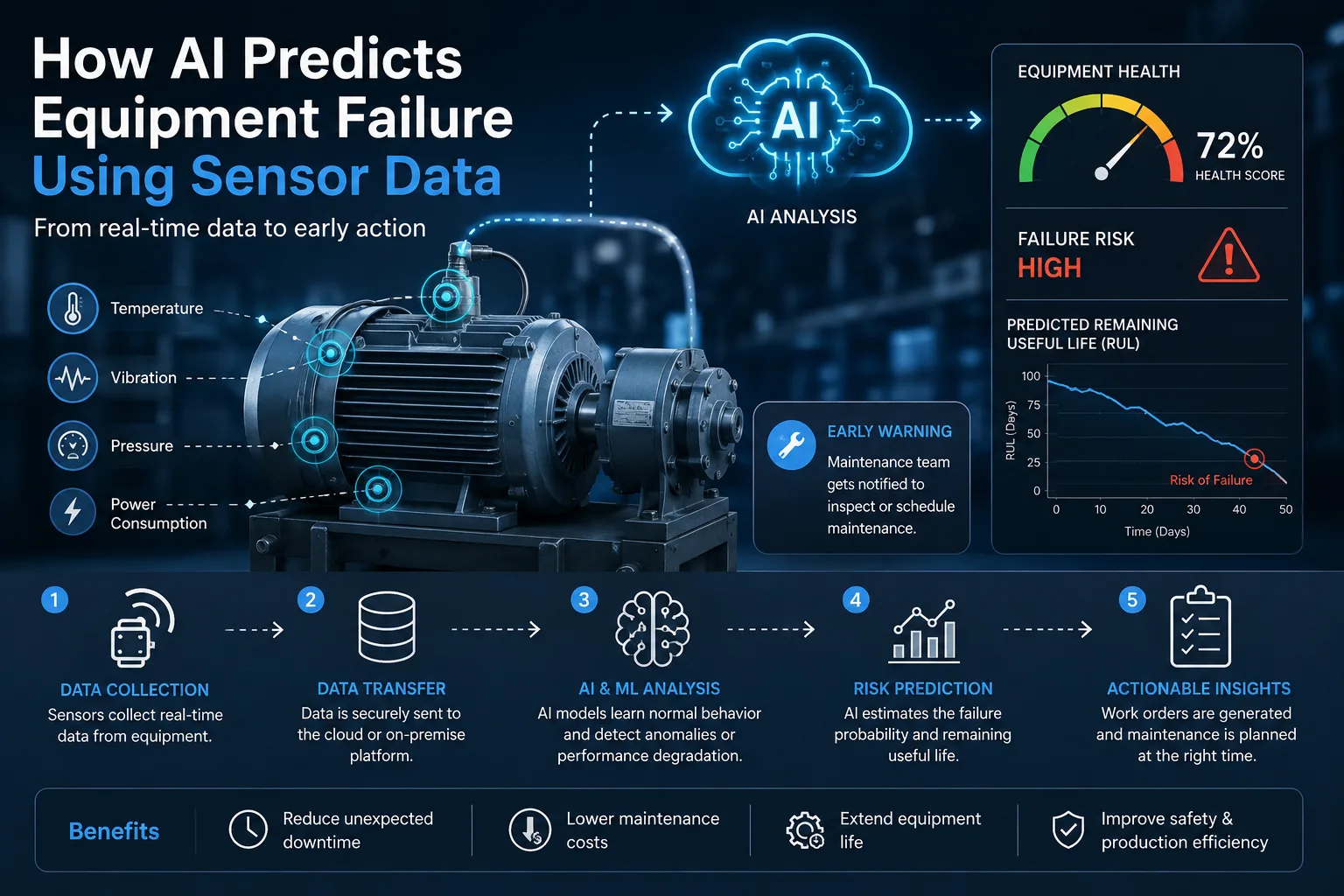
Unexpected equipment failure can disrupt production, increase maintenance costs, and create delays across manufacturing operations. Traditional maintenance often relies on fixed schedules, but AI predictive maintenance uses actual equipment-condition data to identify early warning signs and estimate when maintenance may be needed.
1. Collecting Sensor Data
Industrial equipment can generate continuous data from sensors monitoring variables such as temperature, vibration, pressure, energy consumption, speed, and machine status. This information provides a real-time view of how equipment is operating.
The more consistent and reliable the sensor data, the better an AI system can understand normal operating behaviour and detect changes.
2. Learning What “Normal” Looks Like
AI models analyse historical sensor readings along with maintenance records and previous failure events. From this information, machine-learning models can learn patterns associated with normal equipment operation.
When new sensor data arrives, the model compares the current behaviour with those learned patterns. This allows it to identify unusual changes that may indicate equipment degradation. Research has demonstrated the use of machine-learning methods for detecting abnormal conditions from industrial sensor data.
3. Detecting Anomalies and Early Warning Signs
One important capability of AI predictive maintenance is anomaly detection.
For example, a machine may normally operate within a particular temperature and vibration range. If vibration gradually increases while temperature also begins changing, the AI system may identify this combination as an abnormal pattern.
This does not necessarily mean the machine will fail immediately. Instead, the anomaly can trigger further inspection or maintenance analysis. AI-based asset monitoring can identify failure patterns and sensor anomalies before they become major operational problems.
4. Predicting the Likelihood of Failure
After identifying relevant patterns, AI models can estimate the probability that equipment will experience a failure within a particular period.
Some predictive-maintenance systems also estimate Remaining Useful Life (RUL)—an estimate of how long an asset may continue operating before maintenance or replacement becomes necessary. IBM's predictive-maintenance examples describe using sensor data and machine-learning models to estimate failure risk and remaining useful life.
For manufacturers, this information can help maintenance teams decide which equipment requires attention first.
5. Turning Predictions Into Maintenance Actions
Prediction alone is not enough. The information needs to support an actionable maintenance process.
For example:
Sensor data → AI analysis → anomaly detected → failure risk assessed → maintenance priority created → inspection or repair
AI can also work with maintenance-management systems to automate actions based on predicted equipment condition. In one IBM example, a predicted RUL value can trigger a work order when it falls below a defined threshold.
6. Improving Over Time
AI predictive-maintenance systems can become more useful as organisations collect additional equipment, maintenance, and failure data. However, model performance depends on data quality, sensor coverage, appropriate modelling, and the specific equipment being monitored.
Recent research also highlights that purely data-driven models can face challenges when failure examples are rare or previously unseen. Combining machine-learning techniques with engineering knowledge can improve interpretability and robustness.
Conclusion
AI predicts equipment failure by combining sensor data, historical maintenance information, anomaly detection, and machine-learning models. Instead of waiting for equipment to fail or relying only on fixed maintenance intervals, manufacturers can use equipment-condition data to identify abnormal patterns and prioritise maintenance.
A practical AI predictive maintenance approach can help manufacturers move toward more condition-based maintenance, potentially reducing unexpected interruptions while making maintenance planning more data-driven.
The goal is not simply to predict failureit is to provide maintenance teams with useful information early enough to take appropriate action.