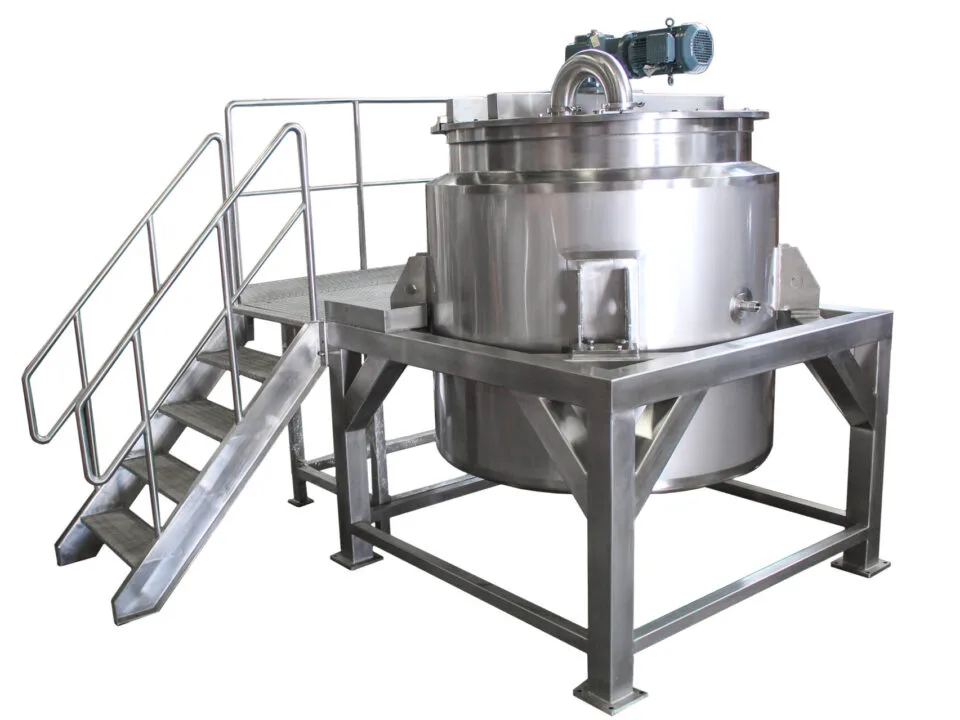
Viscosity is one of the first process variables engineers should evaluate when selecting an agitator. A low-viscosity liquid can circulate easily, while a thick product may resist movement and demand substantially more torque. As a result, choosing a mixing tank agitator based only on vessel size or motor horsepower can lead to poor circulation, excessive energy use, or mechanical overload.
The right agitator must match the product's viscosity, flow behavior, batch volume, and mixing objective. Getting that combination right is where good mixing design starts.
Why Viscosity Matters in Agitator Selection
Viscosity describes a fluid's resistance to flow. Water has relatively low viscosity, while products such as syrups, gels, pastes, creams, and concentrated sauces can be much thicker.
As viscosity increases, fluid movement becomes more difficult. The agitator must transfer enough energy into the product to create useful circulation.
However, simply increasing motor speed is not always the answer.
High-speed operation can increase shear, heat generation, and power consumption. For some products, it may also introduce air or damage sensitive ingredients.
That is why engineers look at the entire mixing system rather than one specification.
Low-Viscosity Fluids Need Strong Bulk Circulation
Low-viscosity liquids generally flow easily around the vessel. In these applications, axial-flow impellers are often useful because they move material vertically through the tank.
For example, water-like products may benefit from an impeller that creates strong top-to-bottom circulation. The objective is to move the entire batch rather than simply create high velocity around the blades.
Impeller diameter, rotational speed, and tank geometry all affect this circulation.
Baffles may also be important. Without adequate resistance to rotational flow, the liquid can simply spin with the impeller. That creates a vortex but does not necessarily provide efficient mixing.
High-Viscosity Products Need More Torque
Thick products tell a different story.
As viscosity rises, the agitator faces greater resistance. The motor and gearbox must provide sufficient torque to keep the impeller moving under load.
This is particularly important during startup.
A product may behave differently after it begins moving. Starting a thick batch can require considerably more torque than maintaining circulation once the product is already flowing.
For this reason, an agitator for a high-viscosity application may operate at lower speed while using a larger impeller and higher torque.
It is a classic case of less RPM, more muscle.
Choosing the Right Impeller
Impeller geometry has a major influence on how energy enters the fluid.
Different designs produce different flow patterns. Axial-flow impellers are commonly associated with strong vertical circulation, while radial-flow designs direct more energy outward.
For viscous products, specialized impeller designs may be more suitable because they can move large volumes of material at relatively low speeds.
The right choice depends on:
- Product viscosity
- Tank diameter
- Liquid depth
- Working volume
- Desired mixing time
- Required shear
- Product sensitivity
There is no universal impeller that works perfectly for every formulation.
Consider Non-Newtonian Fluids
Viscosity becomes even more interesting with non-Newtonian products.
These fluids do not necessarily maintain a constant viscosity as shear conditions change. Some become thinner when subjected to mixing, while others can become more resistant to flow.
Examples may include certain sauces, polymer solutions, gels, and concentrated formulations.
For these applications, using a single viscosity number may not provide the full picture.
Engineers may need rheological data showing how the product responds to different shear rates. This helps determine whether the agitator will generate adequate circulation throughout the batch.
Why Shear Rate Matters
Agitator selection is not only about moving material. Some processes also require controlled shear.
A high-shear application may need intense localized energy to break down agglomerates, disperse powders, or reduce droplet size.
On the other hand, some products need gentle blending to avoid damaging their structure.
This creates an important design trade-off.
A mixing tank with agitator should provide enough energy to achieve the required process result without creating unnecessary shear.
The best configuration depends on what the product actually needs.
Power Per Volume Provides a Better Comparison
Motor horsepower alone does not tell the whole story.
Two tanks may have motors with the same rating but operate at very different power levels per unit of product volume.
Engineers often consider power per volume when comparing mixing systems. This provides a better indication of how much mechanical energy is being delivered to the batch.
However, power requirements are influenced by impeller diameter, speed, fluid density, viscosity, and geometry.
That is why agitator sizing should be based on process calculations rather than a simple motor-size comparison.
Tank Geometry Affects Agitator Performance
The agitator does not operate independently of the vessel.
Tank diameter, liquid height, bottom shape, internal coils, baffles, and other components all influence fluid movement.
For example, a tall tank may require different impeller positioning than a wide, shallow vessel.
Multiple impellers may also be useful in taller vessels or applications where one impeller cannot create adequate circulation from top to bottom.
Placement matters just as much as the impeller itself.
Temperature Can Change Viscosity
There is another factor that can easily be overlooked: temperature.
Many products become less viscous as temperature increases. Others may behave differently depending on their formulation.
This means an agitator may face one viscosity during startup and another during processing.
For heated products, engineers should consider viscosity across the expected operating temperature range. The mixing system should still provide adequate performance at the most demanding condition.
That prevents unpleasant surprises once the equipment is running.
How to Specify an Agitator for Your Process
Before selecting an agitator, gather as much process information as possible.
Important inputs include:
- Minimum and maximum viscosity
- Product density
- Working volume
- Tank dimensions
- Operating temperature
- Desired mixing time
- Required shear level
- Solids concentration
- Batch startup conditions
- Cleaning requirements
For non-Newtonian products, rheology data can be especially valuable.
With this information, engineers can evaluate impeller type, diameter, speed, motor power, gearbox requirements, shaft design, and impeller position.
Avoid Selecting by Motor Size Alone
A larger motor may sound like a safe choice, but bigger is not always better.
An oversized motor can increase equipment and operating requirements without solving the actual mixing problem. Likewise, an undersized system may struggle with startup torque or fail to maintain circulation.
The goal is a properly balanced system.
The agitator, motor, gearbox, impeller, shaft, and vessel geometry should all work together.
Wrapping Up
Fluid viscosity has a direct impact on agitator selection. Low-viscosity products often benefit from strong bulk circulation, while high-viscosity materials typically require greater torque and carefully selected impeller geometry.
For more demanding products, engineers must also consider shear rate, rheology, temperature, power per volume, and tank geometry.
A properly specified mixing tank with agitator is therefore much more than a vessel with a motor attached. It is a coordinated process system designed around how the product actually behaves.
When viscosity is treated as a core design parameter from the start, manufacturers can achieve better circulation, more predictable mixing times, and reliable batch-to-batch performance.