
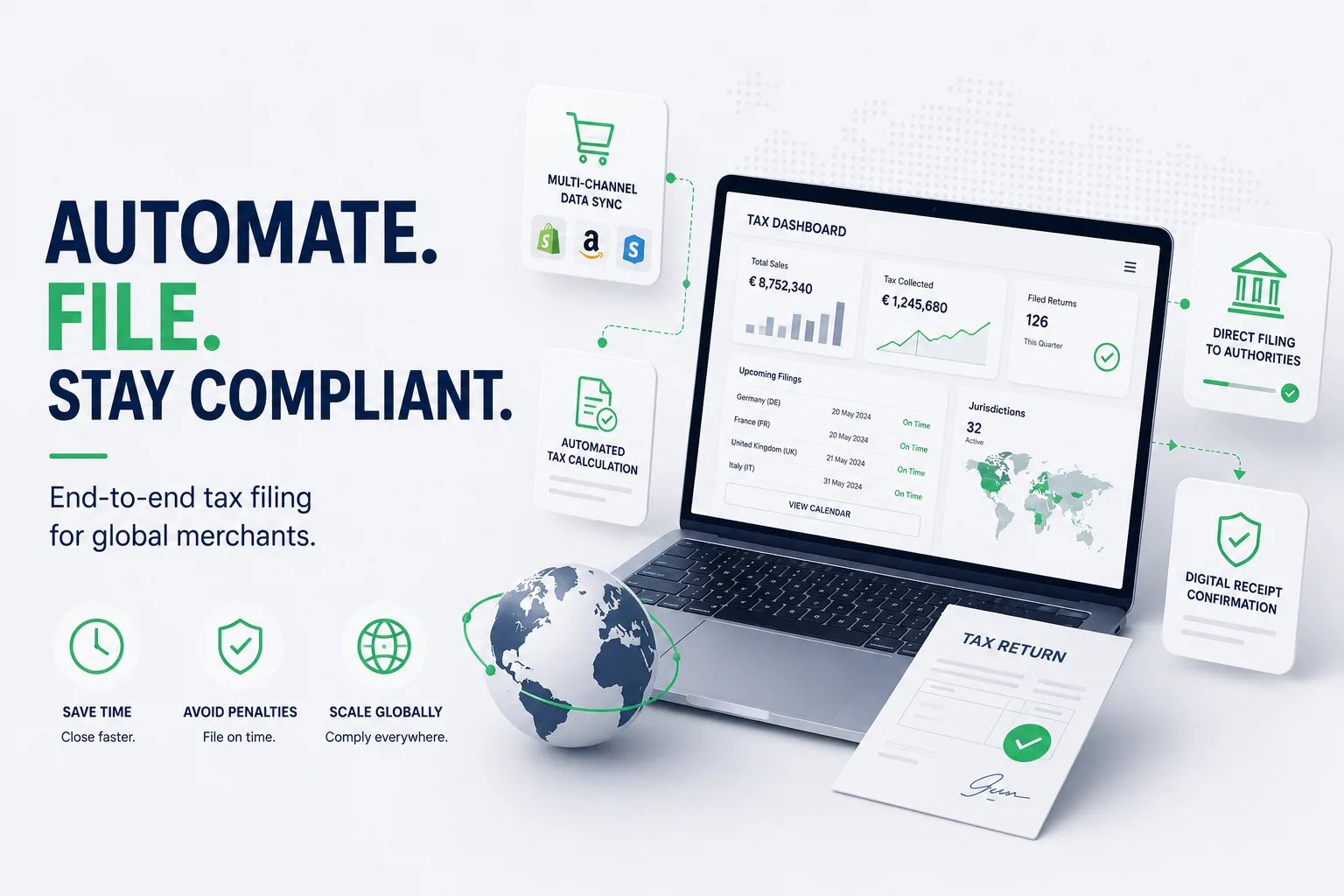
Managing indirect tax declarations manually across dozens of domestic and international jurisdictions drains hundreds of billable hours from finance departments every quarter. Multi-channel sellers struggle to gather order files, convert foreign currency balances, and verify local exemptions on time. When internal teams handle these tasks in spreadsheets, calculation errors multiply, leading to unexpected cash flow gaps, severe audit penalties, and blocked merchant payouts.
To remove manual friction and ensure reporting accuracy, cross-border sellers connect their accounting pipelines to modern cloud solutions like the Lovat tax platform. Deploying specialized tax technology transforms transactional data into ready-to-submit merchant tax returns and enables end-to-end automated filing directly with revenue agencies worldwide.
What bottlenecks delay manual tax filing for multi-channel merchants?
Attempting to prepare international tax declarations by hand severely slows down business operations. When finance teams rely on disconnected spreadsheets, three major operational bottlenecks emerge:
- Disconnected transaction sources. Orders arriving simultaneously from Shopify, Amazon, wholesale channels, and payment gateways sit in disparate, non-standardized formats. Consolidating these isolated feeds manually delays month-end closures and creates severe discrepancies during e-commerce sales aggregation.
- Discrepancies in currency conversion. Processing cross-border sales requires applying official central bank exchange rates valid on the exact tax point date. Inconsistent manual currency conversions distort the taxable base, leading to flawed declarations and inaccurate settlement balances.
- Tight local filing calendars. Individual tax authorities enforce distinct monthly, quarterly, or annual reporting schedules with zero grace periods. Without proactive filing deadline tracking, internal accountants risk missing statutory windows across multiple destination countries.
These structural hurdles make manual reporting unsustainable as international transaction volumes scale. Resolving them requires replacing manual calculations with continuous data synchronization.
How does modern tax technology generate pre-filled returns?
Automated platforms eliminate repetitive bookkeeping routines by pulling order data and formatting declaration files automatically through three standardized stages:
- Continuous data ingestion. A unified tax compliance API continuously imports transactional data, refund logs, and shipping charges directly from connected shopping carts and payment gateways. This background sync removes the data corruption risks associated with manual CSV exports and supports continuous human error mitigation.
- Automated categorization rules. Intelligent calculation engines apply specific taxability logic to physical merchandise, digital downloads, and subscription services instantly. The software assigns the correct statutory rates and determines net liability without human intervention.
- Instant template mapping. Specialized algorithms execute multi-channel data mapping, populating localized fiscal forms with validated transaction records. The system generates pre-filled tax returns for EU One-Stop Shop (OSS), Import One-Stop Shop (IOSS), and local non-resident registrations in seconds.
Automated mapping guarantees that every declared line item aligns perfectly with regional statutory accounting standards. Finance managers review clean, audit-ready numbers without building customized formulas.
How do automated platforms submit data directly to tax authorities?
Modern indirect tax engines go beyond basic document compilation by handling the complete communication lifecycle with foreign revenue agencies:
- Secure portal gateways. Certified cloud software connects straight to government fiscal platforms via encrypted protocols. This secure bridge enables direct tax authority submission without requiring staff to navigate complex, foreign-language tax portals manually.
- Digital receipt confirmation. Government gateways return immutable cryptographic timestamps and official filing references immediately upon payload verification. The platform logs these confirmations in a centralized dashboard, proving timely statutory completion.
- Scheduled automated submissions. Controllers set precise submission triggers aligned with local filing cadences. Automated filing workflows release verified return packages automatically, eliminating late-submission surcharges and compliance delays.
Direct digital integration removes the administrative complexity of international tax administration. Businesses maintain full regulatory standing across multiple single markets effortlessly.
What controls ensure reporting accuracy before final submission?
High-performance tax platforms deploy rigorous data validation protocols to detect discrepancies before data reaches revenue inspectors:
- Automated anomaly detection. Built-in validation algorithms identify sudden volume spikes, unmapped product categories, and missing tax identification numbers prior to transmission. Early warning alerts give controllers time to correct source data before filing.
- Cross-channel balance reconciliation. Specialized sales tax reconciliation routines continuously audit settled payout funds against recorded liabilities. The platform flags uncollected amounts or duplicate marketplace entries to keep financial statements balanced.
- Granular transaction logs. Finance teams can drill down from aggregate return figures into individual buyer transactions with a single click. Every calculated tax line remains linked to its source order ID, timestamp, and geolocation verification record.
These comprehensive internal safeguards ensure that every submitted figure withstands official regulatory scrutiny. Finance leaders maintain complete confidence in their cross-border merchant filing workflows.
What direct benefits do merchants gain from automating their filing workflow?
Connecting dedicated tax software to existing commerce infrastructure delivers immediate, measurable performance advantages across the enterprise:
- Elimination of administrative overhead. Finance teams close monthly and quarterly tax ledgers in minutes rather than weeks. Companies significantly reduce routine accounting costs and minimize reliance on expensive regional tax advisory retainers.
- Zero penalty risk. Automated calendar notifications, pre-calculated tax liabilities, and certified submission gateways protect operating margins from late-filing fines, statutory interest, and marketplace seller suspensions.
- Frictionless geographic scaling. Expanding into new territories or connecting additional sales channels no longer requires expanding internal accounting staff. The unified tax technology stack handles increased multi-currency volume autonomously.
These operational improvements protect gross profit margins and accelerate international market capture. Leadership directs time and capital toward core product development, marketing, and cross-border commercial expansion.
How does automated tax technology secure long-term merchant growth?
Cross-border e-commerce expansion should drive enterprise value, market reach, and customer lifetime value. When financial teams spend hundreds of hours deciphering foreign fiscal codes and completing manual tax forms, operational momentum stalls and compliance risks multiply.
Deploying specialized tax software transforms complex international regulations into a transparent, background process. By combining real-time calculation, multi-channel aggregation, and reliable automated filing, modern merchants scale global sales with complete financial security.