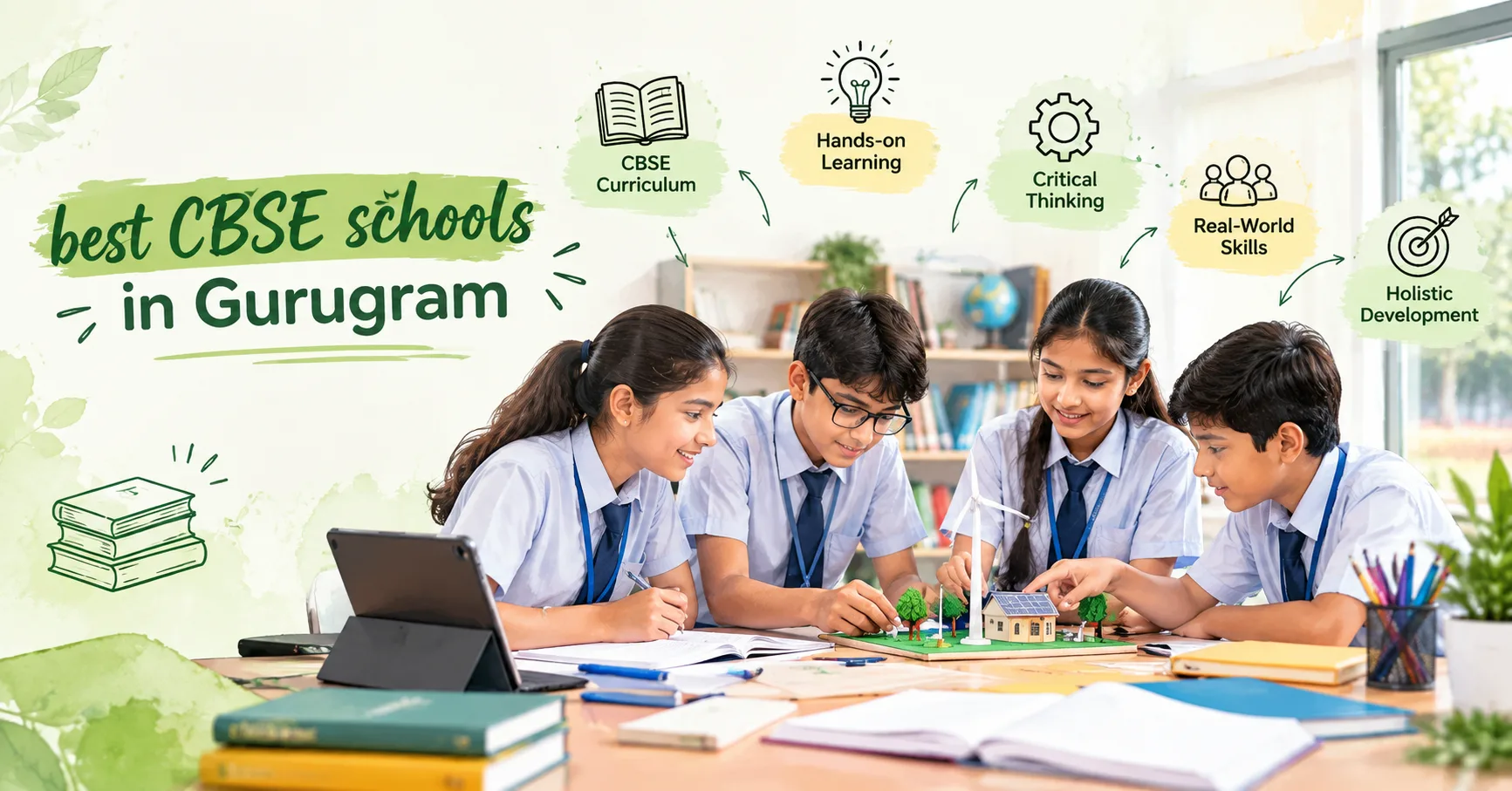
For many parents, the CBSE curriculum is associated with academic structure, subject knowledge, and clear learning outcomes. But understanding a concept is not always the same as remembering an answer. Students also need opportunities to investigate, question, create, test ideas, and apply what they have learned.
That is where project-based learning can add real value.
The approach gives students a reason to use classroom knowledge beyond a textbook exercise. A science concept can become an investigation, a mathematics lesson can become a budgeting activity, and a social science topic can develop into research about a local community. This connection between academic content and practical application is one reason project work fits naturally within modern CBSE pedagogy.
CBSE has long encouraged experiential and active learning, including hands-on activities, collaborative learning, inquiry, and learning through real-life experiences. Its curriculum guidance also emphasises learning outcomes, authentic assessment, and the meaningful application of knowledge and skills.
For parents comparing the best CBSE schools in Gurugram, it is therefore useful to look beyond whether a school follows the prescribed curriculum. A better question is how students are helped to understand and use that curriculum.
What Is Project-Based Learning?
Project-based learning is an approach in which students explore a meaningful question, problem, or challenge over a period of time and produce something that demonstrates their understanding.
The final outcome might be a model, presentation, report, prototype, experiment, exhibition, campaign, or digital creation. However, the finished product is only one part of the process.
Students may need to:
- understand the underlying concept
- identify a question or problem
- research reliable information
- discuss possible solutions
- divide responsibilities
- test ideas
- revise their work
- explain their reasoning
- present the final outcome
- reflect on what they learned
This makes project-based learning in CBSE different from simply assigning students a project at the end of a chapter. A meaningful project begins with a learning objective and allows students to demonstrate that objective through application.
Why Does Project-Based Learning Fit the CBSE Curriculum?
The relationship is stronger than it may initially appear.
CBSE's curriculum framework promotes competency-based learning, experiential approaches, collaborative learning, multidisciplinary connections, and authentic tasks that allow students to apply knowledge.
A well-designed project can bring several of these principles together in one learning experience.
For example, students studying water conservation could investigate household water use, calculate consumption, research conservation methods, interview family members, analyse their findings, and propose practical changes.
The academic concepts remain important. Mathematics is still being used for calculation. Science still explains the underlying processes. Language skills are needed for research and presentation. But students are no longer encountering these subjects as isolated pieces of information.
This is where project-based learning in schools can complement rather than replace structured classroom teaching.
1. It Turns Concepts Into Practical Applications
A student may be able to define renewable energy during a written test. That demonstrates recall. But designing a small solar-powered model or comparing energy sources requires a different level of understanding.
The student has to ask:
- What problem am I solving?
- Which information is relevant?
- How should I use the concept?
- What happens if my first idea fails?
- How can I explain my conclusion?
These questions encourage deeper engagement with the subject.
The CBSE learning methods used in a classroom can therefore extend beyond explanation and note-taking. Project work gives students a setting in which concepts have a practical purpose.
2. It Encourages Students to Connect Different Subjects
Real problems rarely belong to one school subject.
Consider a project on sustainable neighbourhoods. Students might use:
- Science to understand environmental systems.
- Mathematics to interpret measurements and data.
- Social science to examine communities and public resources.
- English or another language to communicate findings.
- Art and design to create visual representations.
This interdisciplinary structure reflects CBSE's emphasis on thematic, multidisciplinary, and collaborative learning.
It also helps students recognise that knowledge is connected. A mathematical calculation can inform a science investigation, while communication skills can determine how effectively the final findings are presented.
3. It Develops Critical Thinking
Project work rarely has only one obvious path.
Students have to decide which information matters, compare alternatives, and justify their choices. If an experiment does not produce the expected result, they have to examine what went wrong rather than simply move on to the next question.
This is one of the important benefits of project-based learning in CBSE schools.
Critical thinking develops when students are required to make decisions based on evidence rather than simply repeat information. Teachers can support this process by asking students why they chose a particular method, what evidence supports their conclusion, and what they would change if they repeated the project.
4. It Makes Learning More Active
There is a noticeable difference between listening to an explanation and having to use that explanation to complete a task.
CBSE's own material describes experiential learning through activities such as learning by doing, inquiry, collaboration, and hands-on experiences.
That principle is central to effective project-based learning in CBSE.
Students become participants in the learning process. They investigate, discuss, create, and reflect instead of receiving information passively.
This does not mean every lesson needs to become a large project. Short investigations, classroom challenges, experiments,s and interdisciplinary tasks can also provide active learning experiences.
5. It Builds Research and Information Skills
Students today have access to an enormous amount of information. The challenge is no longer simply finding something. It is deciding whether the information is accurate, useful, and relevant.
A research-based project allows teachers to explicitly teach these skills.
Students can learn how to:
- frame useful research questions
- distinguish evidence from opinion
- compare different sources
- record information systematically
- cite or acknowledge sources
- identify unsupported claims
- summarise information in their own words
These skills become increasingly important as students progress into senior grades and eventually higher education.
6. It Strengthens Collaboration
Group projects can teach students that collaboration involves more than dividing the workload.
A successful team needs communication, planning, accountability, and respectful disagreement.
For example, one student may be strong at research while another is better at visual design or presentation. Students need to recognise these differences and work out how individual strengths can contribute to a shared outcome.
Teachers also play an important role here. Group work is most effective when roles are purposeful, and students are accountable for their own contribution.
7. It Supports Real-World Learning
One of the clearest strengths of project work is its ability to connect classroom concepts with situations outside school.
A project on household budgeting can introduce percentages and financial decision-making.
A biodiversity project can encourage students to observe local ecosystems.
A community survey can develop research, communication, and data-analysis skills.
A design challenge can introduce problem-solving and prototyping.
This kind of real-world learning helps students understand why a concept matters. It also gives teachers opportunities to assess whether students can transfer knowledge to a new situation.
8. It Gives Teachers More Ways to Assess Understanding
A written examination provides useful evidence, but it cannot reveal every aspect of learning.
A project can provide additional evidence through research notes, drafts, discussions, presentations, models, reflections, and final outcomes.
This does not make examinations unnecessary. Instead, it creates a broader picture of student understanding.
CBSE's curriculum guidance supports authentic assessment involving meaningful application of knowledge and skills, alongside learning outcomes and varied pedagogical activities.
The CBSE project-based learning approach works best when assessment criteria are clear. Students should know whether they are being evaluated on conceptual understanding, research quality, reasoning, collaboration, communication, creativity, or a combination of these.
9. It Encourages Reflection and Revision
One of the less visible benefits of project work is that students learn that a first attempt does not have to be the final attempt.
A prototype may fail. A research question may need refining. A presentation may be unclear. A conclusion may not be supported by enough evidence.
When students receive constructive feedback and revise their work, they begin to see mistakes as information.
That experience can strengthen independence because students learn to evaluate their own work instead of waiting for the teacher to identify every problem.
10. What Should Parents Look for in Project-Based Learning?
Parents exploring the best CBSE schools in Gurugram should not assume that the word “project” automatically means meaningful project-based learning.
The more useful question is what students actually do during the process.
Look for evidence that projects:
- connect clearly with curriculum objectives
- require students to think rather than copy
- involve research or investigation
- encourage practical application
- include teacher guidance
- allow students to revise their work
- develop communication and collaboration
- use age-appropriate technology where relevant
- assess both process and understanding
- connect learning with authentic situations
A school may display impressive project models, but the more important issue is whether students were intellectually involved in creating them.
How Does Project-Based Learning Support Different Age Groups?
The depth of project work should change as students become more independent.
Primary years
Younger students can work on observation, simple investigations, storytelling, models, measurement, and guided group activities.
The emphasis should be on curiosity, communication, and understanding basic concepts.
Middle school
Students can take greater responsibility for research, data collection, problem-solving,g and presentations.
Projects can become more interdisciplinary and require students to justify their decisions.
Secondary and senior secondary
Older students can work with more complex research questions, evidence, analysis, design and independent decision-making.
At this stage, projects can also help students connect academic learning with potential areas of higher education and future work.
At Ridge Valley School, the curriculum describes hands-on activities, projects, exploration, critical thinking and problem-solving as part of its learning approach across different stages. Its secondary curriculum also uses interdisciplinary connections to develop analytical and critical-thinking skills.
Is Project-Based Learning a Replacement for Traditional Teaching?
No.
This is an important distinction.
Students still need explicit instruction, practice, reading, discussion, feedback, and assessment. Project work becomes valuable when it is used at the right point in the learning process.
A teacher may first explain a scientific principle. Students may then conduct an investigation that requires them to use that principle. Afterward, the class can discuss the results and correct misunderstandings.
The strongest approach is therefore not “projects instead of teaching.”
It is structured teaching plus meaningful application.
That balance is especially important in a CBSE environment where students need both conceptual foundations and the ability to apply what they know.
What Makes Project-Based Learning Effective?
A good project starts with the learning goal, not with a decorative final product.
Teachers should first identify what students need to understand or demonstrate. The project can then be designed around that objective.
For example, if the goal is to understand data interpretation, students might collect information, organise it into tables, create graphs, and explain what the results indicate.
If the goal is environmental awareness, students could investigate a local issue and develop a practical response.
The project should be challenging enough to encourage thinking but structured enough that students understand what success looks like.
Teacher guidance matters throughout the process. Students need feedback, checkpoints, and opportunities to improve their work.
Why This Matters When Choosing a CBSE School
Parents researching the best CBSE schools in Gurugram often look first at board results, facilities, curriculum, and academic reputation. These factors matter, but the way students experience the curriculum every day deserves equal attention.
A school can follow the same board framework as another school while creating very different classroom experiences.
Ask how teachers help students apply concepts. Ask whether students conduct investigations, present ideas, solve problems, and work across subjects. Ask how projects are assessed and whether students receive feedback.
Ridge Valley School's academic approach includes experiential learning, hands-on projects, and opportunities to apply theoretical concepts in practical settings. Its curriculum also highlights exploration, creativity, critical thinking, and problem-solving.
For parents, these details provide a more useful picture of learning than a list of facilities alone.
Final Takeaway
Project-based learning complements the CBSE curriculum because it gives students opportunities to use knowledge rather than simply recall it.
When thoughtfully designed, projects can connect subjects, strengthen critical thinking, develop research and communication skills, encourage collaboration, and show students how classroom concepts relate to real situations.
The most effective projects are not simply colourful displays or end-of-term assignments. They are structured learning experiences with clear objectives, teacher guidance, meaningful questions, and opportunities for students to investigate, create, explain, and improve.
For families evaluating a top CBSE school in Gurugram, this is an important distinction. The question is not whether a school assigns projects. It is whether project work genuinely improves how students understand and apply what they learn.
FAQs
1. How does project-based learning support the CBSE curriculum?
How project-based learning supports the CBSE curriculum is best understood through application. Students use subject knowledge to investigate questions, solve problems, and create outcomes. This complements CBSE's emphasis on experiential, competency-based, and authentic learning.
2. What are the benefits of project-based learning in CBSE schools?
The benefits of project-based learning in CBSE schools include stronger critical thinking, collaboration, communication, research skills, and practical application of concepts. It can also help teachers see how well students transfer classroom knowledge to unfamiliar situations.
3. What is the CBSE project-based learning approach?
The CBSE project-based learning approach is not simply about assigning a project. It works best when projects are connected to learning outcomes and involve investigation, application, reflection, collaboration, and meaningful assessment.
4. Is project-based learning suitable for CBSE students?
Yes. Project-based learning in CBSE can be adapted for primary, middle, and secondary students. The complexity should increase with age, moving from guided activities toward greater student independence, research, and problem-solving.
5. How is project-based learning different from a school project?
A conventional school project may focus mainly on completing a presentation or model. Project-based learning in schools focuses on the learning process: students investigate a meaningful question, apply knowledge, receive feedback, and explain what they have learned.
6. Does project-based learning replace classroom teaching?
No. Effective CBSE learning methods combine explicit teaching with opportunities for practice, investigation, and application. Projects work best as part of a broader instructional approach rather than as a replacement for foundational teaching.
7. How does project work develop real-world skills?
Real-world learning requires students to make decisions, work with information, communicate findings, and respond to practical problems. These experiences can develop skills that are difficult to build through memorisation alone.
8. What should parents look for in project-based learning?
Parents should look for projects with clear academic objectives, meaningful questions, teacher guidance, student participation, research, revision, and appropriate assessment. The final model or presentation should not be more important than what the child actually learned.
9. How can parents identify a top CBSE school in Gurugram that uses project-based learning effectively?
Rather than looking only for the phrase “project-based learning,” parents can ask how students investigate concepts, collaborate, apply knowledge, and receive feedback. They can also ask to see examples of student work and understand how projects connect with the curriculum.
10. Does Ridge Valley School use project-based and experiential learning?
Ridge Valley School incorporates experiential learning, hands-on projects, and practical application within its academic approach. Its curriculum also highlights exploration, creativity, critical thinking, and problem-solving across different stages of schooling.