
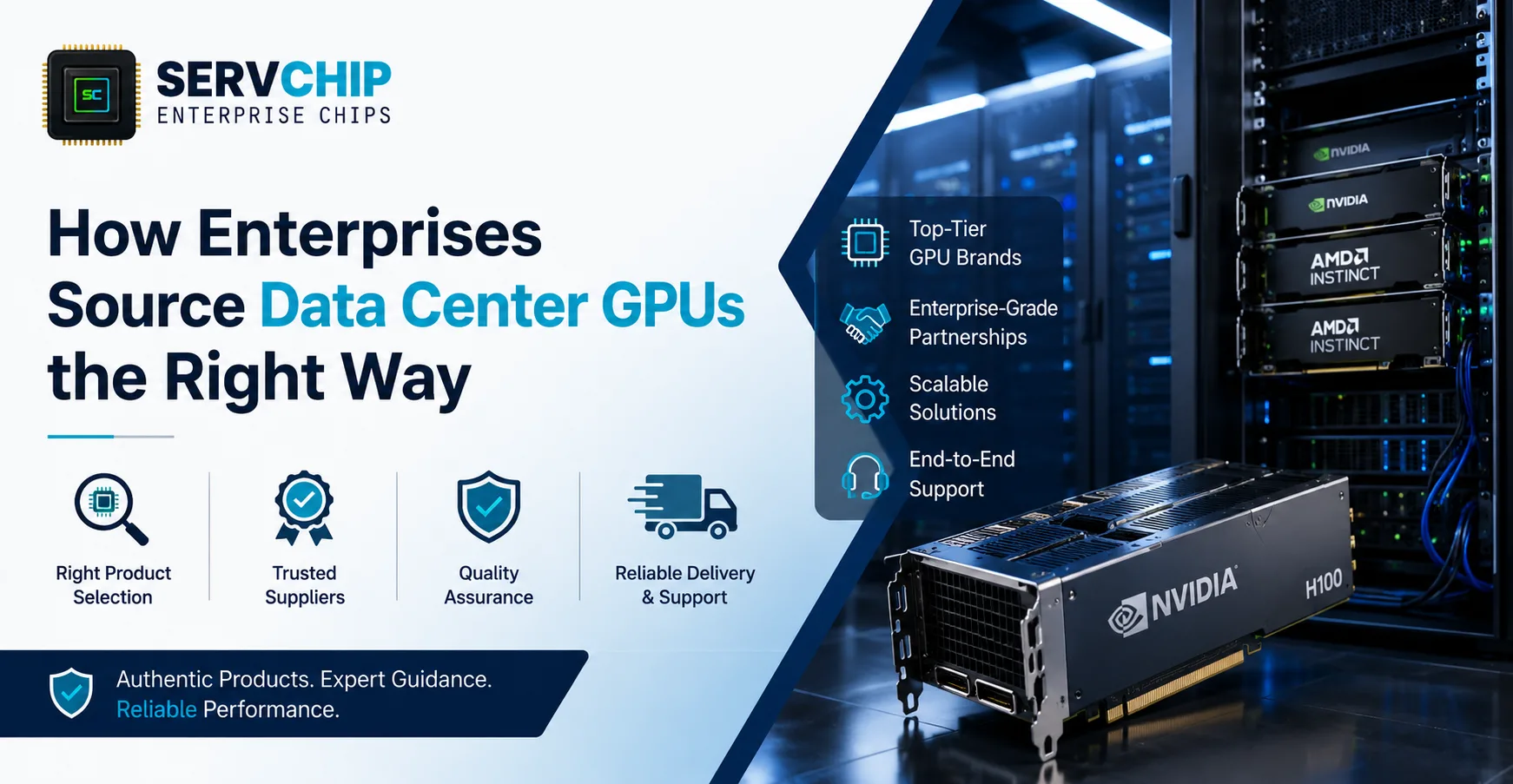
Title: How Enterprises Source Data Center GPUs the Right Way
Meta Title: Data Center GPU Distributor for Enterprise GPU Sourcing
Meta Description: Struggling with GPU shortages? Learn how a trusted data center GPU distributor simplifies enterprise GPU sourcing for NVIDIA, AMD & Intel hardware.
How Enterprises Source Data Center GPUs the Right Way
If you've tried to buy accelerator hardware in the last couple of years, you already know the drill: the part you need is backordered, the "in stock" listing you found yesterday is gone today, and someone in a group chat is offering to get you a pallet of GPUs "no questions asked." That last option should make any procurement lead nervous — and it should. The AI hardware shortage hasn't just driven up prices; it has pulled a lot of buyers toward channels that were never built to sell enterprise-grade silicon in the first place.
This is exactly where the sourcing channel starts to matter as much as the hardware itself. Two GPUs can carry the same model number and still represent very different levels of risk depending on where they came from, how they were handled, and who stands behind them if something goes wrong. For IT leaders under pressure to fill racks fast, understanding that difference is the first step toward protecting both budget and uptime.
Why the Sourcing Channel Is the Real Bottleneck
Enterprise GPU sourcing isn't just a purchasing exercise — it's a supply chain decision with long tails. A GPU bought through an unverified reseller might work fine on day one and then fail an audit, void a warranty claim, or turn out to be a remarketed unit sold as new. Multiply that risk across a fleet of servers supporting production AI workloads, and the stakes get serious quickly. This is why more procurement and infrastructure teams are shifting away from ad hoc broker deals and toward a dependable data center GPU distributor that can document where the hardware came from and guarantee what it is.
Distributor vs. Broker: What "Authorized" Actually Means
The term "distributor" gets used loosely, so it's worth being precise. An authorized distributor has a direct, contractual relationship with the manufacturer — NVIDIA, AMD, or Intel — that lets them sell genuine hardware with full manufacturer backing. A broker, by contrast, is often just reselling whatever inventory they can find, sometimes through several intermediaries, with no formal accountability to the original manufacturer.
A few markers separate the two in practice:
- Chain-of-custody documentation. An authorized distributor can trace a unit from the manufacturer to your loading dock, with no gaps and no unexplained hands in between.
- ISO 9001 certification. This isn't a vanity badge — it reflects a quality management system that governs how inventory is stored, tested, and shipped, which matters enormously for hardware this sensitive to handling.
- Authenticity guarantees. Distributors back their units with manufacturer warranties intact; brokers frequently sell "as-is," leaving you to absorb any hidden history.
None of this is visible from a price sheet. It only shows up when something goes wrong — which is precisely when you need it most.
What a Trusted Data Center GPU Distributor Looks Like
This is the standard a company like Servchip is built around. As an authorized channel for NVIDIA, AMD, and Intel data center hardware, Servchip operates as a genuine data center GPU distributor rather than a reseller riding on secondhand allocations. That distinction shows up in the details enterprise buyers actually care about: verifiable chain-of-custody records, ISO 9001-aligned quality processes, and hardware that arrives with its original manufacturer warranty intact rather than a vague promise from a middleman.
For a procurement team evaluating vendors, that's the practical test. Ask any prospective supplier where the GPU physically came from, whether they can document it, and whether the manufacturer will honor a claim if the part fails. A distributor built on authorized relationships will answer all three without hesitation. A gray-market broker usually can't — and that gap is where enterprise GPU sourcing programs get burned.
Sourcing Is Only Half the Job
Buying the right GPU from the right channel solves one problem. Getting it racked, configured, and supported over its service life is a separate challenge — and it's where a lot of otherwise sound sourcing strategies fall apart. This is why sourcing and support tend to work best when they come from the same partner rather than being stitched together after the fact.
Servchip's enterprise chip sourcing and technical support services are built to cover that full lifecycle: locating available inventory across NVIDIA, AMD, and Intel product lines, assisting with integration into existing server and rack configurations, and managing warranty claims and RMAs when hardware needs to be replaced or repaired. For enterprise buyers, that combination matters more than it might seem — a distributor that only sells the part and disappears leaves you to sort out compatibility issues and manufacturer paperwork on your own, often under time pressure with production workloads waiting.
The Bigger Picture: Why Sourcing Discipline Pays Off
The broader market context makes this even more relevant right now. Industry analysts tracking the data center GPU market point to continued double-digit growth through the end of the decade, driven largely by AI training and inference demand outpacing available supply. That kind of sustained demand pressure is exactly the environment where gray-market activity tends to expand — and where cutting corners on sourcing becomes tempting for teams under deadline pressure. Enterprises that build sourcing discipline into their procurement process now are the ones least likely to get caught out when the next shortage cycle hits.
Getting Started
None of this has to be complicated. If you're evaluating a hardware refresh, planning a new AI cluster, or simply tired of chasing inventory through channels you can't fully verify, it's worth talking to someone who deals with this daily. You can get in touch with a hardware specialist to walk through current availability, lead times, and what authorized sourcing would look like for your specific configuration.
Conclusion
Choosing where your GPUs come from is no longer a minor procurement detail — it's a decision that directly affects your budget, your deployment timeline, and whether the hardware in your racks is actually what it claims to be. A verified data center GPU distributor brings documentation, manufacturer-backed warranties, and accountability that gray-market brokers simply can't match. In a market where demand still regularly outstrips supply, that verification isn't a luxury; it's the difference between a smooth rollout and a costly one. For enterprises serious about protecting their AI infrastructure investment, authorized sourcing is the safer, smarter default.
FAQ
What is a data center GPU distributor? A data center GPU distributor is a company with a direct, authorized relationship with GPU manufacturers like NVIDIA, AMD, or Intel. They sell genuine hardware backed by manufacturer warranties, with documented chain-of-custody, rather than reselling units of uncertain origin through informal channels.
How do I verify a GPU distributor is authorized? Ask for proof of the manufacturer relationship, ISO 9001 certification, and chain-of-custody documentation for the specific units you're buying. Authorized distributors can typically confirm authenticity directly with the manufacturer, while brokers usually cannot provide this level of verification.
What's the difference between a distributor and a broker? A distributor has a formal, contractual relationship with the manufacturer and sells hardware with full warranty backing. A broker resells inventory sourced through third parties, often without manufacturer accountability, which increases the risk of counterfeit, refurbished, or warranty-voided units.
Do distributors offer warranty support on data center GPUs? Yes — authorized distributors typically preserve the manufacturer's original warranty and can manage RMA and repair claims directly. This is a major advantage over gray-market purchases, which often arrive with warranties already voided or unclear.
How fast can enterprise GPU orders ship internationally? Shipping timelines vary by product availability and destination, but established distributors with existing manufacturer relationships and logistics networks can typically move faster than brokers sourcing ad hoc inventory. It's best to confirm current lead times directly with a hardware specialist for your specific order.