A packaging plant runs three shifts, hits its production targets every month, and still struggles to explain why margins keep shrinking. The machines are running, orders are going out, and yet the numbers at the end of the quarter never quite add up.
This is one of the most common—and most frustrating—problems in packaging manufacturing. Raw material costs keep climbing, customers negotiate harder on price, and somewhere between the store, the shop floor, and the dispatch bay, material simply disappears into scrap, rework, and unaccounted wastage.
Most packaging manufacturers don't lose money because of one big mistake. They lose it in small, repeated ways: a roll of film cut slightly wrong, a batch of corrugated sheets rejected for GSM variation, excess board ordered "just to be safe," or a job costed on assumptions instead of actuals. None of these show up clearly until you add them up over a year.
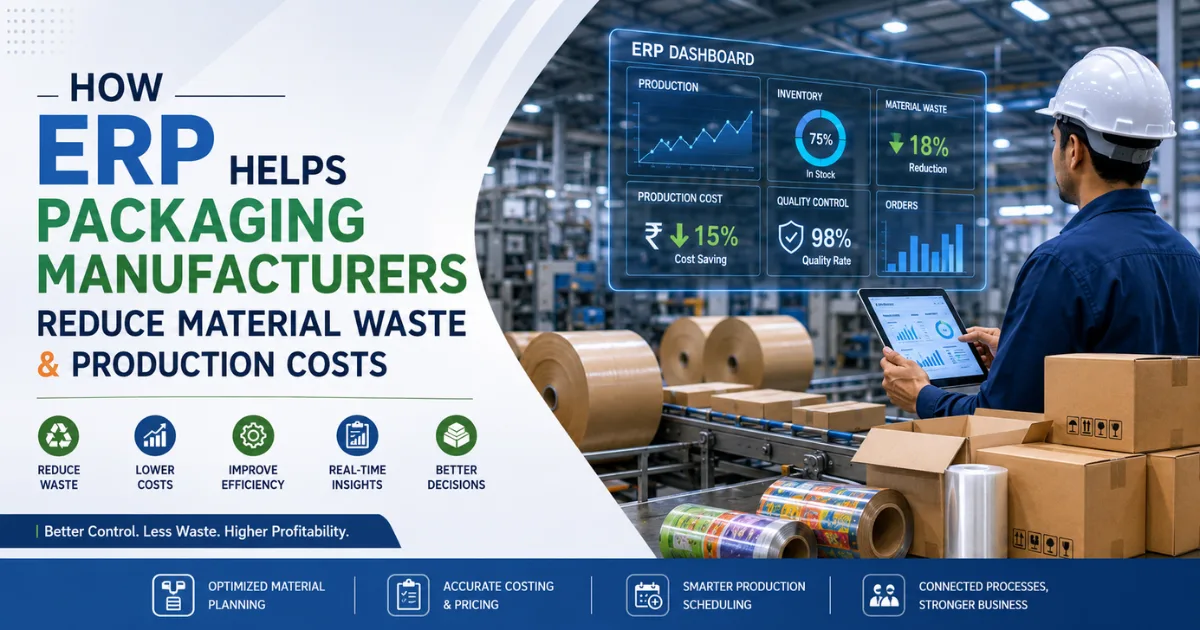
This is exactly where ERP for packaging industry operations makes a measurable difference. A well-implemented ERP system doesn't just digitise paperwork — it connects purchasing, inventory, production, quality, and costing into one system, so waste and inefficiency become visible instead of hidden inside disconnected spreadsheets and shop-floor registers.
In this article, we'll break down exactly how ERP software for packaging industry helps reduce material waste, control production costs, and improve overall profitability—with practical examples relevant to flexible packaging, corrugated packaging, and paper-based packaging operations.
Why Material Waste Is a Major Cost Problem in Packaging Manufacturing
Packaging manufacturing runs on thin margins and high material intensity. Raw materials—paper, board, film, ink, adhesives, and laminates—typically make up a large share of the total production cost. Even a small percentage of wastage has an outsized impact on profitability.
Here's where the waste usually comes from:
Raw material wastage Trimming, edge loss, roll changeovers, and setup waste are unavoidable to some extent in printing and converting. But without proper tracking, "normal" wastage quietly becomes excessive wastage, and nobody notices until material costs spike.
Production scrap: Misprints, colour mismatches, lamination defects, and die-cutting errors generate scrap. If scrap isn't recorded against the specific job, machine, or shift, it's impossible to identify recurring problems.
Incorrect material planning When purchase quantities are based on rough estimates rather than actual Bill of Materials (BOM) requirements, manufacturers either over-order (locking up working capital) or under-order (causing production stoppages and rush purchases at higher prices).
Overproduction: Producing slightly more than the order quantity "to be safe" is common in packaging. Without visibility into actual order requirements versus production output, this becomes a habitual source of excess inventory and dead stock.
Rejected batches: A batch rejected at the customer's quality check—due to print registration, board strength, or dimensional variance—doesn't just waste material. It wastes machine time, labor, and delivery schedules too.
Poor inventory visibility Many packaging units still track paper, film, and ink stock manually or on disconnected spreadsheets. This leads to duplicate purchases, expired adhesives, and last-minute panic buying at premium rates.
Manual calculations costing sheets built manually in Excel are prone to outdated rates, formula errors, and version confusion—leading to underpriced quotations that quietly erode margins.
Inefficient production planning Without a clear view of machine capacity, material availability, and order priority, production schedulers often make reactive decisions—leading to frequent changeovers, idle machine time, and rushed jobs that increase error rates.
Individually, each of these looks manageable. Together, they can quietly eat up several percentage points of margin every single year.
How ERP for Packaging Industry Helps Reduce Material Waste
An ERP system for packaging manufacturing brings purchasing, inventory, production, sales, quality, and finance onto a single connected platform—instead of operating as isolated departments using separate registers, spreadsheets, and verbal communication.
This creates what is often called a single source of truth: one place where a plant manager, production head, or CFO can see actual material consumption, real-time stock levels, live production status, and true product cost—without chasing five different people for five different numbers.
In practical terms, this connection allows a packaging manufacturer to:
- Plan material purchases based on actual upcoming production requirements, not guesswork
- Track material consumption against planned BOM quantities, job by job
- Identify which machine, shift, or product is generating the most scrap
- Calculate true production cost, including wastage, not just raw material cost
- Get early visibility into stockouts or excess inventory before they become a problem
The result isn't a dramatic overnight transformation—it's a steady, measurable tightening of the gap between what should be used in production and what actually gets used. That gap is where most packaging companies are losing money without realising it.
Better Bill of Materials (BOM) and Material Planning
The Bill of Materials is the foundation of accurate material planning in packaging manufacturing. A BOM defines exactly what raw materials, in what quantities, are required to produce a specific packaging product.
In ERP software for packaging industry operations, BOMs can be built for each product variant—accounting for differences in:
- Paper or board GSM and quality
- Film thickness and type
- Print colors and ink coverage
- Lamination and coating requirements
- Size, shape, and die specifications
- Packaging accessories (handles, tapes, inserts, etc.)
Once a BOM is set up correctly, the ERP system automatically calculates material requirements the moment a sales order or production order is created. This removes the guesswork from material planning.
Practical example: A corrugated box manufacturer receives an order for 50,000 boxes of a specific size, with a customer-specified board combination. Instead of the planning team manually calculating sheet requirements, deckle usage, and expected wastage on paper or in a spreadsheet, the ERP system pulls the BOM, factors in a standard wastage allowance, and generates an accurate material requirement—including how many sheets need to be cut from available reels and whether existing stock is sufficient or a purchase order needs to be raised.
This single step—accurate, BOM-driven material planning—is often where packaging manufacturers see their first visible reduction in over-ordering and last-minute emergency purchases.
Real-Time Inventory Management
Packaging manufacturers deal with a wide range of raw materials, each with different storage, shelf-life, and consumption characteristics:
- Paper and board reels/sheets
- Corrugated sheets
- BOPP, PE, and other films
- Laminates
- Adhesives and glues
- Printing inks and chemicals
- Packaging accessories (handles, zippers, valves, etc.)
- Finished goods ready for dispatch
Without real-time visibility, it's common for one warehouse or store to show sufficient stock on paper while the actual physical stock has already run out—or the reverse, where excess material sits unused for months because nobody realized it was already in stock.
ERP for packaging industry operations solves this by updating inventory in real time as materials are received, issued to production, consumed, or moved between locations. This gives plant managers and purchasing teams an accurate, live picture of stock—not a picture that's a week old.
This real-time visibility directly prevents three costly situations:
Problem Without Real-Time ERP Visibility With ERP-Based Inventory Management Overstocking Materials purchased "just in case," tying up working capital and risking expiry (especially adhesives and inks) Purchases aligned to actual production requirements and reorder levels. Stockouts Production halts mid-shift because material ran out unexpectedly. Low-stock alerts allow procurement before a shortage occurs. Duplicate/unnecessary purchases The same material was reordered because the stock position wasn't visible or updated. Single accurate stock ledger, visible across purchasing and production teams
For packaging manufacturers running multiple machines or multiple plants, this level of inventory control is often one of the fastest ways ERP pays for itself.
Production Waste and Scrap Tracking
One of the most valuable—and most underused—capabilities of ERP for packaging industry manufacturing is scrap and variance tracking.
An ERP system can track, at the job or work-order level:
- Planned consumption—what the BOM says should be used
- Actual consumption—what was actually issued and used
- Scrap and rejected material—recorded by reason, machine, and shift
- Rework—material that had to be reprocessed
- Production variance—the gap between planned and actual, expressed as a percentage or value
This is where many packaging manufacturers get their biggest insight. When scrap is only recorded informally—a note in a register, a verbal mention in a shift handover—patterns are impossible to spot. But when scrap is logged against a specific machine, operator, shift, and reason code inside the ERP system, patterns become obvious.
Practical example: A flexible packaging manufacturer notices, after a few months of ERP-based scrap tracking, that one particular printing machine consistently shows higher film wastage during color changeovers compared to the other machines. Without this data, this would have just been treated as "normal" wastage across the plant. With it, management can investigate whether it's a machine calibration issue, an operator training gap, or a job-sequencing problem—and fix the actual root cause instead of absorbing the cost every month.
This is the core value of scrap tracking: it turns wastage from a fixed cost you accept into a variable cost you can actively manage down.
Accurate Product Costing
Packaging is a highly competitive, price-sensitive industry. Winning or losing an order can come down to a difference of a few rupees per unit. This makes accurate costing critical—and it's an area where manual, spreadsheet-based costing frequently falls short.
ERP-based costing for packaging manufacturers pulls together:
- Actual raw material cost (not last quarter's rate)
- Labor cost per job or per hour
- Machine/production time
- Overheads allocated per production run
- Actual production wastage (not an assumed percentage)
- Setup and changeover costs
- Other direct manufacturing expenses
When these are calculated automatically from real production data, rather than manually estimated, manufacturers get a much more accurate picture of the true cost of every product they make.
This matters in two very practical ways:
- Quotations become more reliable. Sales teams can quote based on actual historical cost data instead of rough estimates, reducing the risk of underpricing a job and unknowingly working at a loss.
- Margins become visible per product, per customer. Management can see which products or customers are genuinely profitable and which ones are being subsidised by others—a pattern that's very difficult to spot without proper costing data.
Over time, accurate costing is one of the strongest levers for improving overall profitability, because it removes guesswork from pricing decisions.
Smarter Production Scheduling
Packaging production scheduling has to balance several moving parts at once—customer orders, machine capacity, raw material availability, and delivery deadlines. Getting this wrong leads to rushed jobs, frequent changeovers, idle machines, and increased error rates, all of which add to cost.
ERP for packaging industry production planning helps by giving planners a consolidated view of:
- Confirmed customer orders and delivery dates
- Machine availability and current load
- Raw material stock and incoming purchase orders
- Production priorities based on order value or customer commitments
Practical example: A packaging plant has three printing machines and receives two urgent orders on the same day, along with several standing orders already in the schedule. Without a system-level view, the planner might sequence jobs based on whoever asked loudest, leading to excessive changeovers and machine idle time. With ERP-based scheduling, the planner can see machine load, required materials, and delivery windows together—and sequence jobs in a way that minimizes changeovers while still meeting urgent deadlines.
Better scheduling doesn't just improve on-time delivery. It directly reduces cost by cutting down on machine changeover waste, overtime labor, and rush-order material premiums.
Better Procurement and Supplier Management
Procurement in packaging manufacturing is often reactive—purchases get triggered when someone notices material is running low, rather than being planned in advance. This leads to rushed orders, weaker supplier negotiation, and higher landed costs.
ERP software for packaging industry procurement helps purchasing teams:
- Identify material requirements automatically, based on confirmed and forecasted orders
- Plan purchases against actual stock and reorder points
- Compare supplier pricing, lead times, and quality history
- Track purchase orders from issue to delivery
- Get advance visibility into upcoming shortages, instead of discovering them on the shop floor
When procurement is planned rather than reactive, manufacturers get better pricing, avoid emergency purchase premiums, and reduce the risk of production stoppages caused by material shortages. Over a year, this planning discipline alone can meaningfully reduce raw material spend—without changing suppliers or negotiating harder on price.
Quality Control and Rejection Reduction
Every rejected batch in packaging manufacturing represents wasted material, wasted machine time, and wasted labor—and often, a strained customer relationship as well.
ERP systems support quality control at multiple checkpoints across the production cycle:
- Incoming material inspection—checking paper, film, or board quality before it enters production
- In-process quality checks—catching print, lamination, or dimensional issues mid-run instead of after the full batch is complete
- Finished goods inspection—verifying quality before dispatch
- Rejection tracking—recording what was rejected, why, and at which stage
- Batch/lot traceability—tracing a quality issue back to a specific raw material batch or production run
- Corrective actions—documenting what was done to prevent recurrence
The direct cost benefit here is straightforward: catching a quality issue early in the process — say, at the printing stage rather than after lamination and die-cutting — means far less material and machine time is wasted on a batch that was never going to pass inspection anyway. Traceability also protects manufacturers when a customer raises a quality complaint, since the exact production and material history is available on record.
ERP for Corrugated Packaging Industry
Corrugated packaging manufacturing has its own specific operational complexity, which is why it's worth addressing separately.
Corrugated manufacturers typically deal with:
- Multiple grades and GSM specifications of paper/board
- Sheet consumption calculations across corrugation, printing, and die-cutting stages
- Customer-specific box dimensions, requiring frequent specification changes
- High SKU variety, often with small order quantities per SKU
- Wastage at multiple conversion stages—corrugation, printing, slotting, die-cutting
- Costing that must account for board combination, GSM, and process-wise wastage
ERP for corrugated packaging industry operations needs to handle this level of specification detail accurately. This includes tracking paper reel and board inventory by GSM and grade, calculating sheet and reel requirements against customer-specific box dimensions, and capturing wastage separately at each conversion stage rather than as one blended number.
Practical example: A corrugated box manufacturer producing custom-sized boxes for an FMCG customer needs to calculate exact reel consumption for a specific box dimension and board combination. With ERP-based BOM and routing, the system calculates the sheet size, board combination, and expected wastage automatically—instead of the planning team recalculating this manually for every new dimension, which is both time-consuming and prone to error.
For corrugated manufacturers juggling dozens of active SKUs at any given time, this level of system-driven accuracy is often the difference between predictable margins and constant costing surprises.
Odoo ERP for Packaging Industry
Among the ERP platforms suitable for mid-sized packaging manufacturers, Odoo ERP for packaging industry implementations are increasingly common—largely because Odoo offers a modular structure that can be configured around a manufacturer's specific processes rather than forcing a rigid, one-size-fits-all workflow.
Relevant Odoo modules for packaging manufacturers typically include:
- Manufacturing—for BOM, work orders, and routing across production stages
- Inventory—for real-time stock tracking across raw materials, WIP, and finished goods
- Purchase—for procurement planning and supplier management
- Sales—for order management and integration with production planning
- Accounting—for costing, invoicing, and financial reporting
- Quality—for inspection checkpoints and rejection tracking
- Maintenance—for preventive machine maintenance scheduling
- Barcode—for faster, more accurate shop-floor data capture
- Reporting—for real-time dashboards across production, inventory, and costing
- CRM—for managing customer orders and sales pipeline
It's worth being clear here: the exact modules, configuration, and level of customization a packaging manufacturer needs depend entirely on their specific processes, product range, and scale of operations. What works well for a flexible packaging unit with two production lines will look different from what a multi-plant corrugated manufacturer needs. This is why proper process discovery before implementation matters more than the platform choice itself.
How to Choose the Best ERP for Packaging Industry
There's no single ERP that qualifies as the universal "best" for every packaging manufacturer. The right choice depends on your production process, order volume, product complexity, and growth plans. That said, here's a practical checklist to evaluate any ERP for packaging industry use:
- Manufacturing capabilities—Does it support multi-stage production (printing, lamination, converting, etc.)?
- BOM and routing—Can it handle multi-level BOMs and product-specific routings?
- Inventory management—Does it track raw materials, WIP, and finished goods in real time?
- Scrap tracking—Can it capture wastage at each production stage, not just at the end?
- Costing—Does it calculate true product cost including wastage, labour, and overheads?
- Quality management—Are inspection checkpoints and rejection tracking built in?
- Procurement—Does it support planned purchasing based on actual requirements?
- Production planning—Can it help schedule jobs based on machine capacity and material availability?
- Reporting—Are real-time dashboards available for management decision-making?
- Scalability—Can it grow with additional machines, plants, or product lines?
- Integration—Can it connect with existing systems (accounting software, e-commerce, EDI with customers, etc.)?
- Customization—Can workflows be configured to match your actual shop-floor process?
- Implementation support—Does the vendor understand packaging manufacturing, or just generic ERP?
- Training—Is proper user training included, not just software installation?
- After-sales support—What ongoing support is available post go-live?
Choosing the "best ERP for packaging industry" isn't about picking the most popular or the most feature-heavy software—it's about picking the system and implementation partner that fits how your plant actually operates.
ERP for Packaging Industry in India
Indian packaging manufacturers have some specific considerations that make ERP for packaging industry India implementations different from a generic global deployment:
- GST and taxation—ERP needs to handle GST-compliant invoicing, input tax credit tracking, and e-way bill generation correctly for manufacturing and interstate transactions.
- Indian accounting requirements—Statutory reporting, TDS, and compliance formats need to align with Indian regulations.
- Vendor management — Many Indian packaging manufacturers work with a large base of local and regional raw material suppliers, requiring flexible vendor and purchase management.
- Multi-location operations—Manufacturers with plants or warehouses in multiple states need consolidated visibility alongside location-wise reporting.
- Cost-sensitive manufacturing—Given tight margins in the Indian packaging sector, ERP needs to genuinely support cost control, not just add administrative overhead.
- Local implementation support—On-ground support that understands Indian manufacturing practices, language, and business culture matters as much as the software itself.
- Scalability — Many Indian packaging businesses are on a growth trajectory; the ERP should be able to scale from a single plant to multiple facilities without a complete system overhaul.
- Integration with existing systems—Many manufacturers already use accounting software or basic production tools; a good ERP implementation plans for this transition carefully rather than disrupting operations.
These factors make local implementation expertise genuinely valuable—not just software licensing, but the on-ground understanding of how Indian packaging plants actually operate.
Why Packaging Manufacturers Should Work With an ERP Company for Packaging Industry
Buying ERP software and implementing ERP successfully are two very different things. A license alone doesn't reduce material waste or production costs—proper implementation does.
A structured implementation, done by an experienced ERP company for packaging industry clients, typically involves:
- Process discovery—understanding your actual production workflow, material flow, and pain points before configuring anything
- Gap analysis—identifying where standard ERP functionality fits your process and where customization is genuinely needed
- ERP configuration—setting up BOMs, routings, costing rules, and inventory structures to match your operations
- Customization where necessary—adapting workflows for packaging-specific requirements that off-the-shelf configuration doesn't cover
- Data migration—moving existing inventory, customer, supplier, and product data accurately into the new system
- User training—making sure shop-floor staff, planners, and management can actually use the system confidently
- Testing—validating that BOMs, costing, and workflows produce accurate results before go-live
- Go-live—a planned transition that minimizes production disruption
- Post-implementation support—ongoing support as processes evolve and new requirements come up
This is where Cloudmonte Technologies Pvt. Ltd. works with packaging manufacturers—as an ERP consulting and implementation partner specializing in Odoo ERP and Microsoft Dynamics 365. Cloudmonte's approach centers on understanding a manufacturer's actual production process first, then configuring, customizing, and implementing ERP around that reality—rather than forcing operations to adapt to a generic template.
Whether you're evaluating ERP for the first time, migrating from an outdated system, or looking to get more value out of an ERP you already have, the difference between a system that sits unused and one that genuinely reduces waste and cost almost always comes down to how well the implementation was planned and executed.
Ready to Reduce Waste and Control Production Costs?
If material wastage, inaccurate costing, or production inefficiencies are quietly affecting your margins, it may be time to take a closer look at how ERP can help.
Cloudmonte Technologies can help your packaging business evaluate, implement, customize, integrate, and optimize an ERP solution built around your actual production process—not a generic template.
Book a FREE ERP DEMO with Cloudmonte Technologies and talk to an ERP expert about what this could look like for your plant.