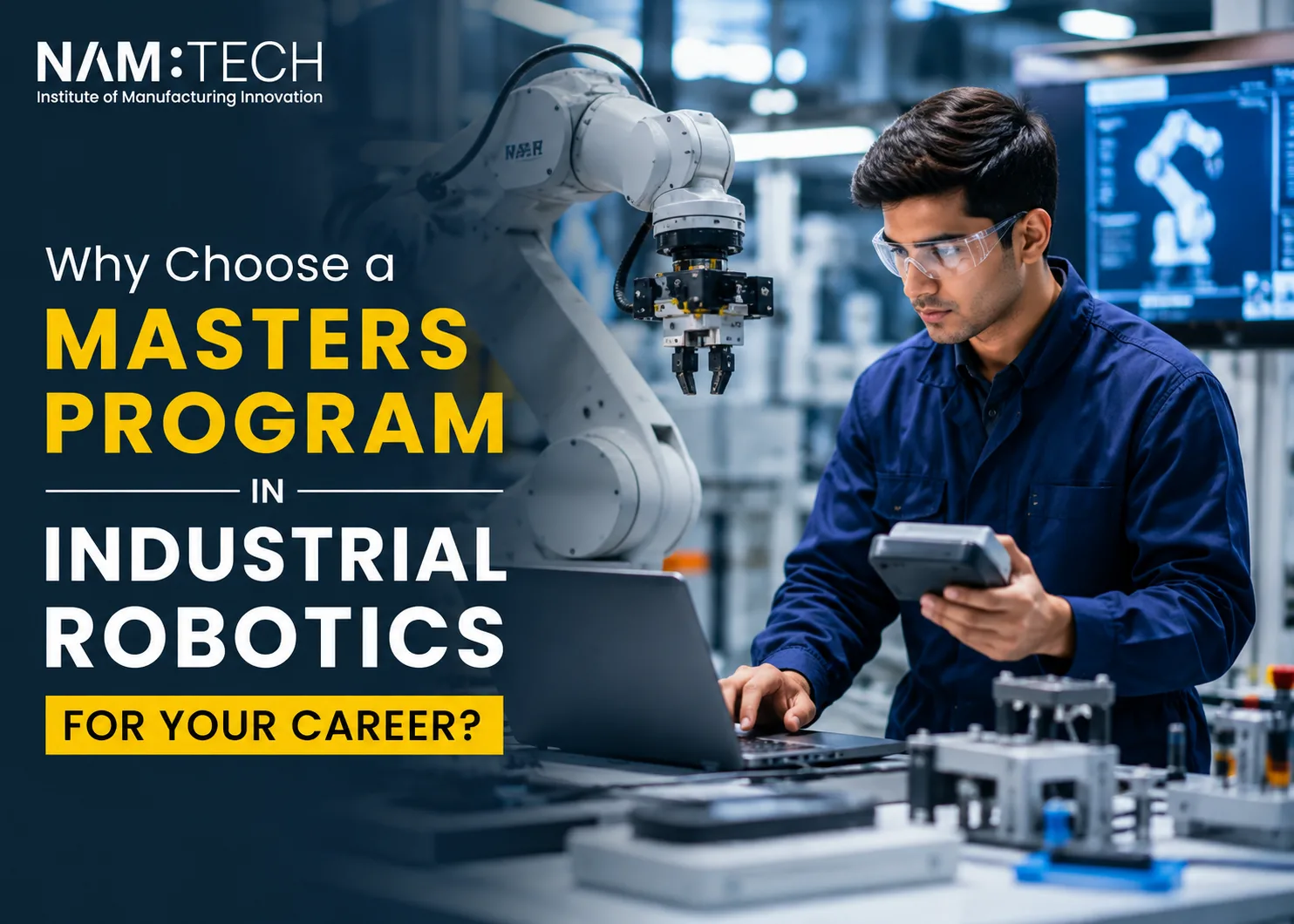
Industrial automation is reshaping how factories produce, inspect, assemble, package, and move products. Robots are no longer limited to performing repetitive tasks behind safety barriers. Modern robotic systems combine mechanical engineering, electronics, sensors, control systems, artificial intelligence, machine vision, industrial software, and connected technologies to perform increasingly sophisticated operations.
For engineering graduates and working professionals interested in advanced manufacturing, a Masters Program in Industrial Robotics can provide the specialized skills needed to participate in this shift. It can prepare learners for roles involving robotic system design, automation engineering, integration, programming, controls, commissioning, maintenance, and smart manufacturing.
At NAMTECH, industry-focused education connects engineering fundamentals with practical exposure, helping learners build capabilities relevant to technology-driven manufacturing environments.
What Is Industrial Robotics?
Industrial robotics focuses on the design, programming, operation, integration, and maintenance of robotic systems used across manufacturing and industrial facilities. These robots can perform tasks requiring speed, repeatability, accuracy, consistency, or operation in challenging environments.
Common industrial robot applications include:
- Material handling
- Welding and joining
- Pick-and-place operations
- Machine tending
- Assembly
- Painting and coating
- Packaging and palletizing
- Quality inspection
- Sorting
- Component positioning
- Production-line automation
The field extends beyond the robotic arm itself. Engineers must consider sensors, controllers, actuators, end effectors, machine vision, safety systems, programmable logic controllers, industrial networks, production equipment, and software platforms.
This multidisciplinary nature is one reason specialized postgraduate education can be valuable for engineers seeking robotics-focused careers.
Why Is Industrial Robotics Becoming Important for Engineers?
Manufacturers continuously look for ways to improve productivity, product consistency, workplace safety, flexibility, and operational efficiency. Automation and robotics support these goals by enabling production systems to perform repeatable processes while collecting valuable operational data.
At the same time, manufacturing systems are becoming more interconnected. A robot may communicate with a PLC, vision system, conveyor, CNC machine, warehouse system, and central manufacturing platform.
As automation grows more sophisticated, organizations require professionals who can work across multiple engineering domains rather than viewing robotics as an isolated machine.
Industrial robotics professionals may need capabilities spanning:
- Mechanical systems
- Electrical and electronic systems
- Robotics programming
- Control engineering
- Industrial automation
- Machine vision
- Sensor technologies
- PLC programming
- Industrial communication
- Digital manufacturing
- Artificial intelligence
- Production engineering
A specialized master's program can bring these disciplines together within an application-oriented learning structure.
Why Choose a Masters Program in Industrial Robotics?
A bachelor's degree builds a strong engineering foundation, but robotics often requires deeper specialization. Students need to connect mathematical concepts and engineering principles with real machines, controllers, automation platforms, and industrial processes.
A Masters Program in Industrial Robotics can help bridge this gap by developing technical depth alongside practical problem-solving skills.
Rather than studying robotics only as a theoretical discipline, learners can examine how robotic systems operate within manufacturing environments. This perspective becomes particularly useful for engineers who want careers in automation, system integration, smart factories, automotive manufacturing, electronics, aerospace, logistics, and related industries.
Build Specialized Robotics Knowledge
One of the strongest reasons to pursue postgraduate education in industrial robotics is the opportunity to develop focused technical knowledge.
Robotic systems involve multiple interconnected components. A robot cannot perform effectively simply because its mechanical structure is advanced. It also needs accurate sensing, effective control, appropriate programming, reliable communication, suitable tooling, and safe integration with other equipment.
Students may encounter subjects related to:
- Robot kinematics
- Robot dynamics
- Motion planning
- Control systems
- Sensors and actuators
- Robot programming
- Industrial automation
- PLCs
- Machine vision
- End-of-arm tooling
- Industrial communication protocols
- Robotics safety
- Manufacturing systems
Studying these areas together helps learners see how individual technologies contribute to complete robotic solutions.
Move Beyond Theory Through Practical Learning
Robotics is highly application-oriented. Reading about a robot's movement is different from programming one to execute a production task accurately and safely.
Practical exposure can help students convert engineering principles into functional systems.
For example, learners may need to determine how a robot should pick a component, calculate its movement path, select an appropriate gripper, integrate sensors, communicate with surrounding equipment, and ensure safe operation.
Hands-on assignments and projects can build abilities such as:
- Programming robotic movements
- Configuring automation sequences
- Integrating sensors
- Working with PLCs
- Testing control logic
- Using simulation tools
- Troubleshooting automation systems
- Optimizing robot cycles
- Evaluating system performance
This type of learning can also strengthen confidence when graduates enter industrial environments where equipment, software, and processes must work together.
Develop Skills for Smart Manufacturing
Modern manufacturing is increasingly connected, data-driven, and automated. Robots form an important part of this environment, but they operate alongside several other digital technologies.
A strong industrial robotics curriculum can expose students to the broader smart manufacturing ecosystem.
This may include areas such as:
Industrial Internet of Things: Connected machines and sensors can collect and exchange operational information.
Machine Vision: Cameras and image-processing systems allow robots to identify, inspect, measure, and locate objects.
Artificial Intelligence: AI techniques can support inspection, predictive systems, optimization, and adaptive automation.
Digital Twins: Virtual representations can help engineers simulate machines, processes, and production systems.
Data Analytics: Manufacturing data can reveal equipment performance, production bottlenecks, quality issues, and maintenance requirements.
Cyber-Physical Systems: Physical manufacturing equipment can interact with computational and communication technologies.
Professionals who can connect robotics with these technologies may be better prepared for smart factory environments.
Gain Exposure to Robot Programming and Control
Programming is a central part of industrial robotics. Engineers must define what the robot should do, how it should move, how it should respond to signals, and how it should interact with surrounding machines.
This involves more than writing commands.
A robotics engineer may need to think about coordinate systems, trajectories, speed, payload, positioning, collision risks, tool orientation, cycle times, sensor feedback, and emergency conditions.
Control engineering is equally important because robotic systems require accurate and stable movement.
Postgraduate study can strengthen the analytical skills needed to work with motion control, feedback systems, actuators, sensors, and automation logic.
These capabilities are valuable for professionals interested in robot programming, controls engineering, automation design, commissioning, and system integration.
Learn How Robots Integrate With Manufacturing Systems
A robot rarely works independently inside a factory.
Consider an automated production cell. A conveyor delivers a component. A sensor detects its position. A vision system checks orientation. A robot picks the component. Another machine performs an operation. The robot transfers the finished part for inspection or packaging.
Every element must communicate correctly.
This makes system integration one of the most valuable skills in industrial robotics.
Students pursuing advanced robotics education can develop knowledge of how robots connect with:
- PLCs
- CNC machines
- Conveyors
- Vision systems
- Sensors
- Industrial networks
- Safety equipment
- Production software
- Automated material-handling systems
The ability to think at the system level can open opportunities beyond pure robot programming.
Prepare for Multiple Career Paths
Industrial robotics is not associated with a single job profile. The multidisciplinary nature of the field creates several possible career directions depending on an individual's technical interests and strengths.
Graduates may consider roles such as:
Robotics Engineer
Robotics engineers may work on designing, developing, testing, programming, or improving robotic systems for industrial applications.
Automation Engineer
Automation engineers develop systems that allow production processes to operate efficiently with limited manual intervention.
Robotics Programmer
These professionals configure and program industrial robots to perform manufacturing operations accurately and safely.
Control Systems Engineer
Control engineers focus on systems that regulate machine behavior, movement, speed, positioning, and process conditions.
Robotics Integration Engineer
Integration engineers connect robots with sensors, machines, PLCs, conveyors, vision systems, and other factory technologies.
PLC Engineer
PLC professionals develop and maintain control logic for automated industrial equipment and production lines.
Manufacturing Automation Engineer
These engineers identify opportunities to automate manufacturing processes and improve productivity, quality, or repeatability.
Machine Vision Engineer
Professionals in this area work with camera systems, image processing, inspection technologies, and robot vision applications.
Robotics Simulation Engineer
Simulation engineers use digital tools to model robot movements, production cells, layouts, and manufacturing processes before physical implementation.
Commissioning Engineer
Commissioning professionals install, test, validate, and troubleshoot automated systems before production begins.
These career paths illustrate why robotics education can appeal to mechanical, electrical, electronics, instrumentation, mechatronics, computer science, and related engineering graduates.
Work Across Diverse Industries
Industrial robotics skills are transferable across several sectors.
Automotive Manufacturing
Automotive factories use robots extensively for welding, painting, assembly, handling, inspection, and material movement.
Electronics Manufacturing
Robotic systems can support high-precision assembly, component handling, inspection, and packaging operations.
Aerospace
Aerospace manufacturing requires precision and process consistency, creating opportunities for advanced automation and robotic applications.
Warehousing and Logistics
Automated handling, sorting, picking, palletizing, and movement systems are becoming important within modern logistics operations.
Metal and Heavy Engineering
Robots can assist with welding, cutting, material handling, machine tending, and other demanding industrial processes.
Pharmaceuticals
Automation can support controlled production, packaging, inspection, and material-handling processes.
Food and Consumer Goods
Robots can perform sorting, packaging, palletizing, handling, and quality-control activities at production scale.
This cross-industry relevance gives robotics professionals the flexibility to develop careers across different manufacturing domains.
Strengthen Engineering Problem-Solving Skills
Industrial robotics involves solving practical problems where several variables interact.
Suppose a robot is unable to achieve the required production cycle time. The problem may not necessarily be the robot itself. The cause could involve inefficient motion paths, slow communication, sensor delays, tooling limitations, conveyor synchronization, control logic, or production-cell layout.
Engineers must examine the entire system before identifying an effective solution.
Project-based robotics education can strengthen skills such as:
- Analytical thinking
- Root-cause analysis
- System-level thinking
- Troubleshooting
- Design evaluation
- Process optimization
- Technical decision-making
- Performance analysis
These abilities are valuable across engineering and manufacturing careers, even when a professional eventually moves into technical leadership or operations management.
Build Experience Through Projects
Projects are an important part of robotics education because they require students to combine knowledge from different subjects.
A robotics project might involve designing an automated cell, programming a robot, developing a machine-vision application, integrating sensors, creating a control sequence, or simulating a manufacturing process.
Through such work, students can experience the engineering cycle from problem definition to testing.
Projects can help learners develop experience in:
- Defining technical requirements
- Selecting suitable technologies
- Designing system architecture
- Developing control logic
- Programming robotic operations
- Integrating hardware and software
- Testing performance
- Identifying faults
- Improving the system
- Presenting technical results
These experiences can also give graduates meaningful technical work to discuss during interviews.
Develop Industry-Relevant Skills
Employers typically need engineers who can apply technical knowledge in operational environments.
For this reason, postgraduate robotics education becomes more valuable when it maintains a strong connection with industry practices.
Industry-relevant learning may involve exposure to industrial equipment, software platforms, automation systems, engineering projects, manufacturing use cases, and practical problem statements.
NAMTECH emphasizes education aligned with modern manufacturing and engineering requirements, helping learners connect academic concepts with industrial applications.
For students evaluating a robotics master's program, the connection between curriculum and actual manufacturing requirements should be an important consideration.
Prepare for Human-Robot Collaboration
Industrial robotics is also evolving through collaborative robots, often called cobots.
Traditional industrial robots commonly operate within controlled or separated areas. Collaborative systems are designed for applications where robots and people may work in closer proximity, subject to appropriate risk assessments and safety measures.
This creates new engineering considerations.
Professionals working with collaborative robotics need to consider:
- Workspace design
- Robot speed
- Payload
- Human movement
- Sensors
- Risk assessment
- Safety standards
- Ergonomics
- Task allocation
Engineers who can design effective human-robot workflows can contribute to manufacturing environments where automation supports workers rather than simply replacing manual operations.
Robotics and the Future of Manufacturing Careers
Manufacturing careers are changing as factories adopt connected machinery, automated production systems, digital platforms, intelligent inspection, and data-driven decision-making.
As a result, engineering roles increasingly require interdisciplinary skills.
A mechanical engineer may need familiarity with programming. An electrical engineer may need knowledge of industrial networking. A software professional working in manufacturing may need to know how physical machines behave.
Robotics sits at the intersection of these areas.
A Masters Program in Industrial Robotics can therefore provide more than specialization in robots. It can help learners build a broader engineering mindset suitable for technology-intensive manufacturing.
Who Should Consider This Program?
A master's program focused on industrial robotics may suit graduates and professionals who enjoy working with machines, automation, programming, manufacturing, and problem-solving.
It can be particularly relevant for students from backgrounds such as:
- Mechanical Engineering
- Mechatronics Engineering
- Electrical Engineering
- Electronics Engineering
- Electronics and Communication Engineering
- Instrumentation Engineering
- Automation Engineering
- Computer Science
- Production Engineering
- Manufacturing Engineering
Working professionals seeking to transition from conventional manufacturing roles into automation, robotics, digital manufacturing, or smart factory functions may also find postgraduate specialization useful.
The best fit is generally someone who enjoys combining hardware and software rather than working exclusively in one domain.
What Should You Look for When Choosing a Program?
Not every robotics program offers the same learning experience. Prospective students should examine the curriculum and learning model carefully.
Look for a program that provides a strong balance of engineering fundamentals, robotics technologies, automation, programming, and practical applications.
Important factors can include:
Curriculum relevance: Does the coursework reflect technologies used in modern manufacturing?
Hands-on learning: Are there opportunities to work with robotics, automation equipment, simulation, or industrial software?
Industry alignment: Does the learning approach connect classroom concepts with actual industrial problems?
Projects: Will students solve realistic robotics and automation challenges?
Interdisciplinary exposure: Does the program connect mechanical, electrical, control, software, and manufacturing concepts?
Faculty and expert interaction: Are learners exposed to people with academic and industrial expertise?
Career relevance: Does the curriculum support roles that match the student's professional goals?
Looking beyond the program title and examining how learning is delivered can help students make a more informed choice.
Why Consider NAMTECH for Industrial Robotics Education?
NAMTECH focuses on preparing engineering talent for advanced manufacturing and technology-driven industrial environments.
For learners interested in robotics, this approach matters because industrial automation requires more than theoretical knowledge. Engineers need exposure to systems thinking, practical problem-solving, interdisciplinary technologies, and manufacturing applications.
An industry-oriented educational environment can help students connect robotics concepts with production challenges and develop capabilities relevant to smart manufacturing.
The objective is not simply to know how a robot operates. The larger goal is to develop the ability to determine where robotics can create value, design appropriate solutions, integrate different technologies, and improve industrial performance.
From Technical Specialist to Future Leadership Roles
A robotics master's degree can also provide a foundation for longer-term career development.
An engineer may begin in programming, controls, commissioning, or integration before progressing toward positions involving project management, automation architecture, manufacturing technology, engineering management, or operations.
With experience, professionals may move toward roles such as:
- Senior Robotics Engineer
- Automation Lead
- Robotics Project Manager
- Manufacturing Technology Specialist
- Smart Factory Engineer
- Automation Architect
- Engineering Manager
- Digital Manufacturing Specialist
- Technical Consultant
Technical depth gained early in a career can be particularly valuable when moving into positions that require decisions about automation investments, technology selection, system design, and manufacturing strategy.
Is a Masters Program in Industrial Robotics Worth Considering?
The answer depends on your career goals.
If you want to work with advanced manufacturing systems, industrial automation, intelligent machines, robotics integration, controls, or smart factories, postgraduate specialization can provide a focused pathway for building relevant capabilities.
The strongest value comes from combining technical education with practical application.
A Masters Program in Industrial Robotics can help you move beyond knowing individual engineering concepts and start seeing how mechanics, electronics, software, control, sensing, and manufacturing processes come together to create functioning automated systems.
That multidisciplinary capability can become a valuable professional asset as industries continue adopting more sophisticated production technologies.
Conclusion
Industrial robotics offers an exciting career direction for engineers who want to work where machines, software, automation, and manufacturing meet. From robot programming and control systems to machine vision, integration, smart factories, and collaborative robotics, the field offers multiple areas for specialization.
Choosing a Masters Program in Industrial Robotics can help engineering graduates develop deeper technical expertise, gain practical exposure, strengthen problem-solving abilities, and prepare for diverse roles across automation-driven industries.
For aspiring professionals looking to build capabilities relevant to advanced manufacturing, NAMTECH offers an industry-oriented learning environment designed around the changing requirements of modern engineering. The right postgraduate education can provide the technical foundation and practical mindset needed to contribute meaningfully to the next generation of manufacturing systems.