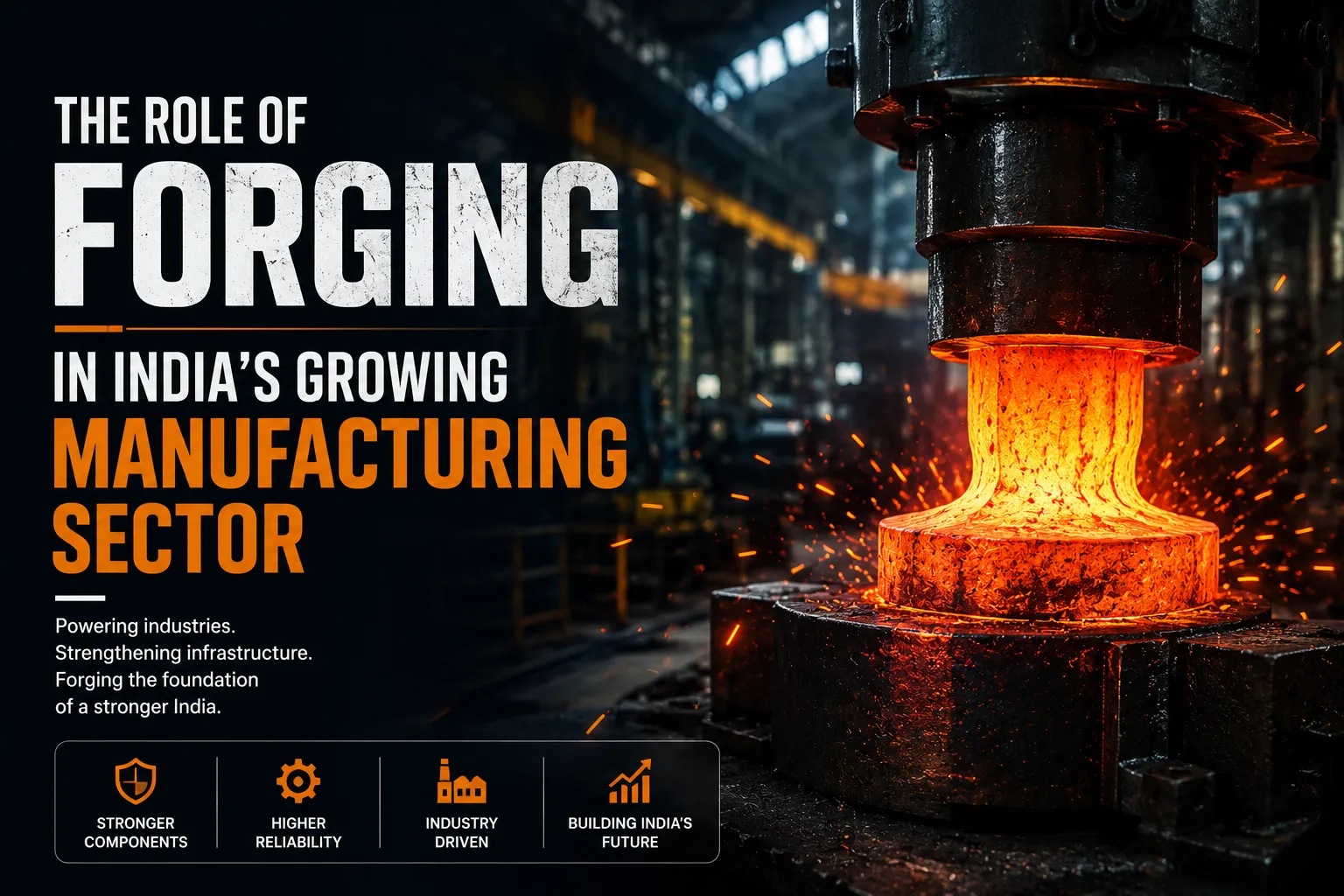
India is no longer viewed merely as a global sourcing destination—it is rapidly transforming into one of the world's most significant manufacturing hubs. From automobiles and railways to defence, renewable energy, aerospace, and heavy engineering, Indian manufacturers are building products that compete on a global stage.
Behind this industrial transformation lies a process that rarely makes headlines but quietly powers nearly every major manufacturing sector: forging.
Every bridge that carries thousands of vehicles, every aircraft engine operating at extreme temperatures, every high-pressure oil pipeline, and every heavy-duty industrial machine depends on components that can withstand enormous stress without failure. Forging provides exactly that level of strength and reliability, making it one of the most trusted manufacturing processes in modern engineering.
Why Forging Continues to Be the Industry's First Choice
Manufacturing today is about much more than producing parts. Companies demand components that last longer, perform consistently under challenging conditions, and reduce maintenance costs throughout their life cycle.
Unlike casting or fabrication, forging reshapes metal under carefully controlled pressure. This process aligns the metal's internal grain flow with the shape of the component, significantly improving its mechanical properties. The result is a part that is stronger, tougher, and more resistant to fatigue than components produced through many other manufacturing methods.
For industries where even a minor component failure can lead to expensive downtime—or worse, safety risks—forged components provide confidence that alternative manufacturing methods often cannot match.
Supporting India's Fastest-Growing Industries
India's manufacturing expansion is creating unprecedented demand for high-quality forged components across multiple sectors.
The automotive industry continues to be one of the country's largest consumers of forgings. Engine components, transmission systems, axle shafts, steering parts, and suspension components all rely on forged metals to handle years of continuous operation.
Railways represent another major growth area. As India modernizes its rail infrastructure and expands high-speed connectivity, forged wheels, couplings, shafts, and braking components play a vital role in ensuring reliability and passenger safety.
The aerospace and defence sectors demand even higher standards. Aircraft engines, landing gear systems, structural rings, and military equipment require components capable of performing under extreme temperatures and immense pressure. Forging offers the precision and structural integrity needed to meet these demanding applications.
Similarly, industries such as oil & gas, mining, construction, marine engineering, and renewable energy continue to depend on forged products because equipment often operates in some of the world's harshest environments.
The Manufacturing Push is Creating New Opportunities
Government initiatives like Make in India, Atmanirbhar Bharat, Production Linked Incentive (PLI) schemes, and large-scale infrastructure investments have accelerated industrial growth across the country.
As global manufacturers diversify their supply chains, India has emerged as a preferred destination for engineering and industrial manufacturing. This shift has significantly increased demand for reliable forging partners capable of delivering precision-engineered components that meet international quality standards.
The forging industry is no longer simply supporting manufacturing—it has become an important driver of India's industrial competitiveness.
Technology is Redefining Modern Forging
Today's forging facilities look very different from those of previous decades.
Advanced simulation software helps engineers optimize die designs before production begins. Automated forging presses improve consistency, while CNC machining ensures exceptional dimensional accuracy. Modern inspection techniques—including ultrasonic testing, magnetic particle inspection, and coordinate measuring machines (CMM)—enable manufacturers to verify quality at every stage.
Digital manufacturing and process automation have transformed forging into a highly precise engineering discipline capable of meeting the expectations of global OEMs.
Quality Has Become the Biggest Competitive Advantage
International buyers are no longer looking only for cost-effective suppliers. They want manufacturing partners who can consistently deliver quality, traceability, timely deliveries, and engineering expertise.
Leading Indian forging companies are investing heavily in advanced manufacturing technologies, quality management systems, skilled engineers, and rigorous inspection processes. This commitment allows them to serve demanding industries where precision and reliability are non-negotiable.
For companies seeking long-term manufacturing partners, these capabilities often matter more than price alone.
The Road Ahead
India's manufacturing ambitions continue to grow, driven by infrastructure development, export opportunities, clean energy projects, and increasing global demand for engineered products.
As these industries expand, the importance of forging will only increase. Every new factory, railway project, wind turbine, industrial machine, or aerospace component represents another opportunity for forged products to demonstrate their unmatched strength and reliability.
At CHW Forge, we believe forging is more than a manufacturing process—it is the foundation of engineering excellence. By combining advanced technology, stringent quality standards, and decades of manufacturing expertise, we help industries build components that perform when reliability matters most.
Final Thoughts
India's manufacturing story is being written today, and forging remains one of its strongest pillars. As industries push for higher performance, greater efficiency, and uncompromising quality, forged components will continue to shape the future of manufacturing—not just in India, but around the world.
How Forging is Powering India's Manufacturing Revolution
India is no longer viewed merely as a global sourcing destination—it is rapidly transforming into one of the world's most significant manufacturing hubs. From automobiles and railways to defence, renewable energy, aerospace, and heavy engineering, Indian manufacturers are building products that comp

Arnav
·
4 min read
·
85 Buzz