
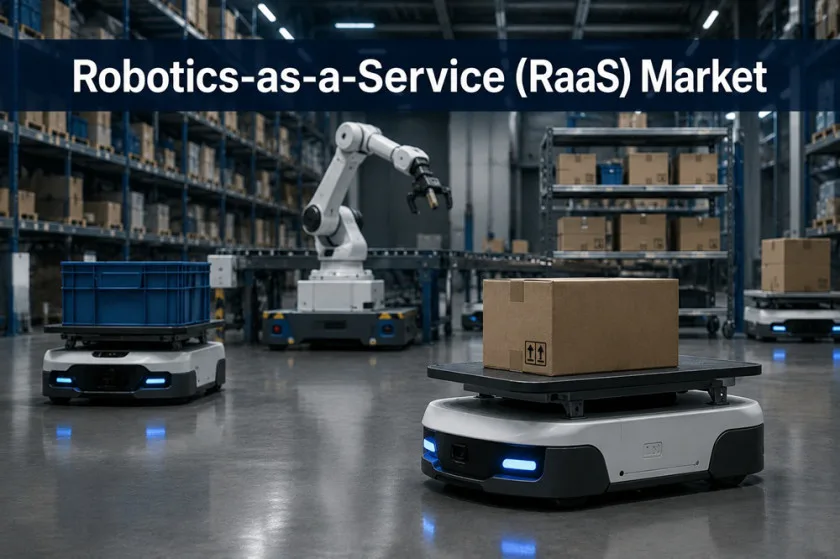
The Robotics-as-a-Service (RaaS) market is transforming how businesses adopt automation by offering robotic solutions through subscription-based and pay-per-use models. By reducing upfront investment and maintenance responsibilities, RaaS makes advanced robotics more accessible to enterprises of different sizes. Growing labor shortages, digital transformation, and demand for operational efficiency are accelerating adoption across logistics, manufacturing, healthcare, and retail industries.
What are the Key Drivers Supporting the Robotics-as-a-Service Market?
- Reduced Capital Investment: Subscription-based deployment eliminates the need for substantial upfront expenditure on robotic equipment, making automation more accessible to small and medium-sized enterprises (SMEs).
- Growing Demand for Industrial Automation: Manufacturing, logistics, and automotive companies are increasingly adopting robotic systems to improve productivity, operational accuracy, and workflow efficiency.
- Increasing Labor Shortages: Workforce constraints across several industries are encouraging businesses to deploy robots for repetitive, labor-intensive, and physically demanding activities.
- Demand for Operational Flexibility: RaaS enables organizations to scale robotic deployments according to business requirements, reducing the financial and operational risks associated with traditional automation investments.
Download ToC for Robotics-as-a-Service Market - Focus on Application, End User, Product, and Country Analysis and Forecast, 2025-2035
What are the Key Trends Shaping the Robotics-as-a-Service Market?
- Artificial Intelligence and IoT Integration: AI and Internet of Things (IoT) technologies are improving robotic intelligence, real-time monitoring, predictive maintenance, and autonomous decision-making.
- Rising Adoption of Autonomous Mobile Robots: Autonomous mobile robots (AMRs) are gaining traction in warehouses, distribution centers, and industrial facilities for material transportation, inventory movement, and order fulfillment.
- Growing Demand for Collaborative Robots: Collaborative robots (cobots) are increasingly being deployed alongside human workers to support assembly, handling, and other precision-oriented industrial activities.
- Expansion of Cloud-Based Robotics Platforms: Cloud connectivity is enabling centralized fleet management, remote monitoring, software updates, and scalable robotic operations across multiple facilities.
How are Applications Influencing the Robotics-as-a-Service Market?
Handling represents a significant application area, driven by increasing requirements for material movement, picking, sorting, and inventory management. Other applications include assembling and dispensing, processing, welding, and soldering. These capabilities support diverse operational requirements across manufacturing plants, automotive facilities, warehouses, and distribution centers. As businesses prioritize productivity and workflow optimization, service-based robotic deployments are gaining wider acceptance.
What is the Regional Outlook for the Robotics-as-a-Service Market?
North America is expected to maintain its leading position, supported by advanced automation infrastructure and strong adoption across logistics, manufacturing, and healthcare. Europe is anticipated to register the fastest regional growth, driven by industrial robotics capabilities and increasing automation investments. Meanwhile, Asia-Pacific is benefiting from expanding e-commerce activities, manufacturing modernization, and government-backed smart manufacturing initiatives in China, Japan, South Korea, and India.
What Challenges and Opportunities Are Emerging in the Robotics-as-a-Service Market?
The market faces challenges related to subscription pricing complexity, long-term cost sustainability, and the scalability of robotic fleet operations. Businesses must also evaluate system integration, maintenance responsibilities, cybersecurity, and compatibility with existing infrastructure before adopting service-based robotics.
However, expanding SME adoption presents significant growth opportunities for RaaS providers. Flexible payment structures can help smaller businesses access automation without major capital commitments. Furthermore, advancements in AI, IoT, and cloud computing are improving robotic performance, connectivity, and remote management capabilities. Providers that develop scalable service models, reliable technical support, and industry-specific solutions are well positioned to address evolving customer requirements.
Conclusion
The Robotics-as-a-Service market is becoming an important part of the global automation ecosystem as businesses seek flexible, scalable, and cost-effective robotic solutions. Increasing labor shortages, technological advancements, and demand for operational efficiency will continue to support adoption. With further improvements in AI, IoT, and cloud-based platforms, RaaS is expected to create new opportunities across industrial and commercial applications.