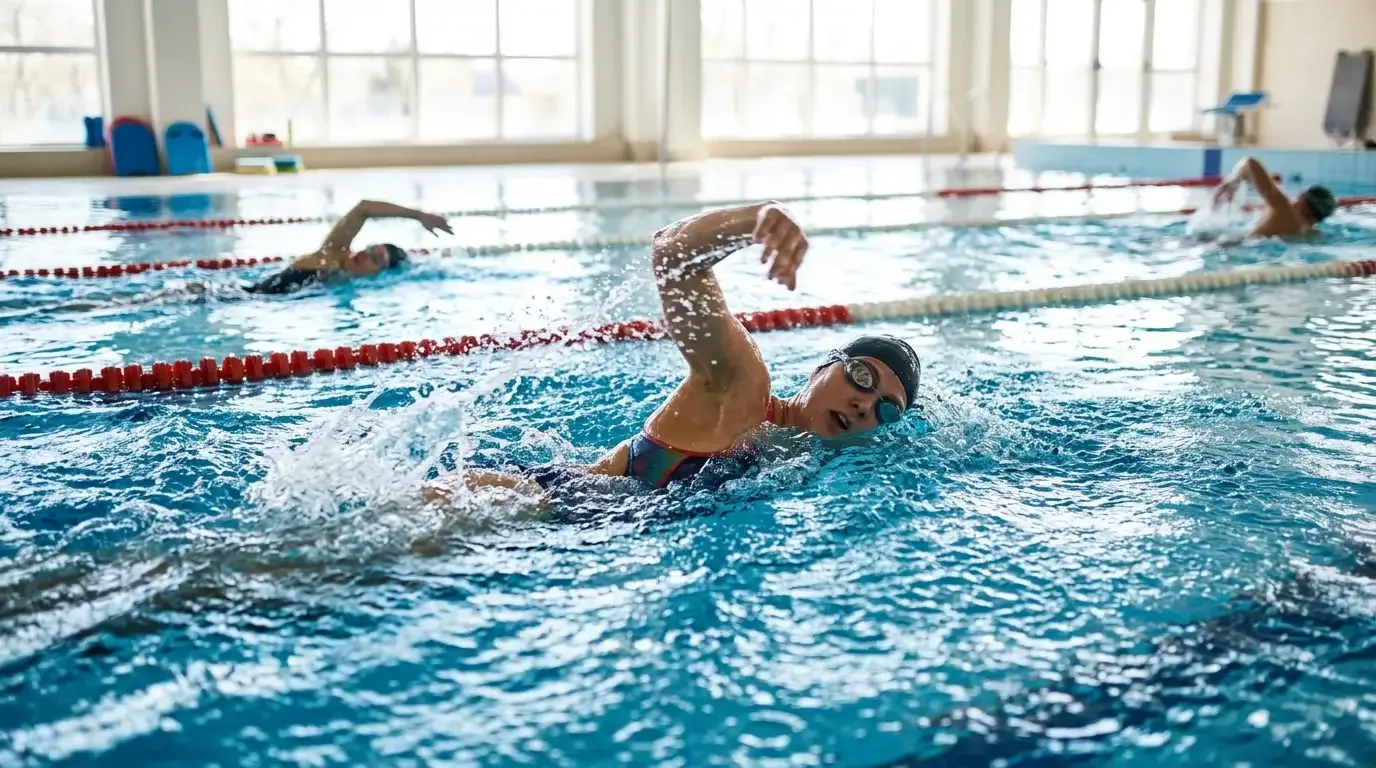
Swimming asks your arms, legs, core and lungs to work at the same time, with the water pushing back on every movement. It is no surprise that “how many calories can I burn by swimming?” is one of the questions adults ask us most often when they start lessons or return to the pool after a long break.
Most adults burn roughly 200 to 400 calories in 30 minutes of swimming and 400 to 700 in an hour. Where you land in that range depends on your stroke, pace and body weight. This guide explains where those figures come from, what changes them and how to use them sensibly.
The Quick Answer
A 70 kg adult swimming freestyle at a steady, comfortable pace burns about 400 to 500 calories an hour. Swim at a hard effort and that climbs towards 700. Easy backstroke sits lower, and butterfly sits far higher. All of these are estimates, and your own figure will shift with fitness, technique and effort.
How Swimming Burns Calories
Water is around 800 times denser than air, so every pull, kick and turn meets resistance. Your shoulders, back, chest, hips, thighs and core all work together, and controlling your breathing keeps your heart and lungs busy too.
Researchers estimate energy use with something called a MET, or metabolic equivalent of task. One MET is the energy you use sitting still. The Compendium of Physical Activities, the reference most fitness calculators rely on, gives gentle swimming a value of roughly 5 to 6 METs and vigorous freestyle close to 10. To get a rough figure, multiply the MET value by your weight in kilograms and by the hours you swim. A 70 kg swimmer at 6 METs for an hour burns around 420 calories.
Heart rate gives a second clue. Harder effort means more calories per minute. One quirk worth knowing is that your heart rate can run a little lower in the water than on land at the same effort, because you are horizontal and the water supports you. Do not worry if your pulse looks modest after a tough swim.
Calories Burned by Stroke
These figures are for a 70 kg adult and cover an hour, with the 30-minute amount in brackets.
- Backstroke (easy to moderate): about 340 to 450 (170 to 225)
- Freestyle (moderate): about 400 to 500 (200 to 250)
- Freestyle (vigorous): about 650 to 700 (325 to 350)
- Breaststroke: about 450 to 700 (225 to 350). The range is wide because technique and pace vary so much between swimmers.
- Butterfly: about 800 to 950 (400 to 475)
- Sidestroke and treading water: a relaxed sidestroke lands near easy freestyle, whilst gentle treading water is closer to 250 an hour.
Butterfly is the most demanding stroke, but very few people can hold it for more than a few lengths. A 20-minute session of tidy, continuous freestyle will often outscore five minutes of struggling butterfly, so choose the stroke you can sustain.
Calories Burned by Body Weight
Heavier bodies move more mass through the water, so they use more energy. Using the same MET values, here is roughly what to expect for an hour of swimming, with light to moderate effort first and vigorous effort second:
- 57 kg (about 125 lb): 330 to 400, rising to around 560
- 70 kg (about 155 lb): 400 to 500, rising to around 690
- 84 kg (about 185 lb): 490 to 580, rising to around 820
Halve those for a 30-minute swim. Muscle mass also plays a part, because muscle uses more energy than fat even at rest.
Calories Burned by Time
For a 70 kg swimmer at a moderate pace, 15 minutes burns about 100 calories, 30 minutes about 200, 45 minutes about 300 and an hour about 400. At vigorous effort, those figures become roughly 170, 340, 515 and 690.
Short swims still count. Fifteen minutes of continuous, purposeful swimming is far more useful than an hour of floating between chats at the wall.
What Changes Your Calorie Burn
Intensity and speed. This is the biggest lever. Swimming faster, or swimming continuously without long rests, raises your energy use quickly.
Skill level. Beginners often burn more calories per length than experienced swimmers, because inefficient technique wastes energy. That sounds like good news, but it also means beginners tire sooner and cannot keep going for long. As your stroke improves, you can swim further and harder for the same effort. If your technique is holding you back, structured swimming programmes for Adults can improve both your efficiency and your confidence in the water.
Body weight and muscle mass. As shown above, both raise the total.
Water temperature. Cooler water makes the body work harder to stay warm, though in a typical heated pool the effect is small. Very cold water is a different matter and not something to chase for extra calories.
Age, gender and fitness. Metabolic rate varies between individuals, so two people of the same weight can burn different amounts doing the same session.
Swimming Compared with Other Exercise
Per hour, a 70 kg adult burns roughly 300 calories walking briskly, 550 to 600 cycling at a moderate pace and around 700 running at 10 km/h. Vigorous swimming lands in the same bracket as running, and moderate swimming sits above brisk walking.
So swimming is not a magic calorie furnace. What sets it apart is that the water carries your weight, which takes the pounding out of the exercise. People with sore knees, back problems or a history of running injuries often find they can train for longer and more often in the pool. A workout you can repeat three times a week will beat a harder one you abandon after a fortnight.
Is Swimming Good for Weight Loss?
It can be, as part of a bigger picture. Weight loss comes from burning more energy than you take in over time, and swimming is a pleasant way to add to the energy you burn. A commonly used rule of thumb is that around 3,500 calories equals half a kilogram of body fat, although real bodies are messier than that sum suggests.
Appetite deserves an honest mention. Plenty of swimmers feel hungry afterwards, and evidence on whether swimming increases appetite more than other exercise is mixed. A sensible snack with some protein is fine. Just be careful not to eat back more than you burned, which is easy to do when a 30-minute swim feels like a bigger effort than it was.
Spot reduction is a myth. Swimming will not melt belly fat on its own, though regular training alongside sensible eating can reduce overall body fat, and the abdomen is often part of that change.
For general health, the World Health Organization recommends 150 to 300 minutes of moderate activity a week for adults. Two to four swims of 30 to 45 minutes is a realistic target for most people.
Tips to Burn More Calories in the Pool
- Use intervals. Swim hard for 25 to 50 metres, rest for 20 to 30 seconds, then repeat. Interval sets raise your average effort without leaving you exhausted.
- Mix your strokes. Alternating freestyle, breaststroke and backstroke works different muscles and keeps your sessions interesting.
- Use equipment. Kickboards isolate the legs, whilst pull buoys put the work on your upper body.
- Try water jogging or aqua aerobics. Both are excellent if you are not yet confident swimming lengths.
- Build gradually. Add a few minutes or an extra session each week instead of jumping straight into long, hard swims.
Safety and Common Mistakes
Warm up with a few minutes of easy swimming and finish with a gentle cool-down. You still sweat in the pool, so bring a drink and sip between sets. Many people overestimate how much they have burned and reward themselves accordingly, which can stall progress.
Speak to your GP before starting if you have a heart or breathing condition, are pregnant or are recovering from an injury. Never swim alone if you are not a confident swimmer, and always follow lifeguard instructions.
Final Thoughts
Swimming can burn a useful number of calories, but the real value lies in being able to keep doing it. Choose a stroke you can maintain, vary your effort and let your technique improve with time. Your calorie burn will rise as a result, and so will your enjoyment.
FAQs
Can 30 minutes of swimming help with weight loss?
Yes, when done regularly alongside balanced eating. Thirty minutes burns roughly 200 to 350 calories for most adults.
How many calories does swimming burn in an hour?
Typically 400 to 700 for adults, depending on stroke, effort and body weight.
Which stroke burns the most calories?
Butterfly, followed by vigorous freestyle and breaststroke. Butterfly is very hard to sustain, so most people burn more overall with freestyle.
Is swimming or running better for burning calories?
Hard swimming and running burn a similar amount per hour. Swimming is much gentler on the joints.
Does swimming reduce belly fat?
It helps reduce overall body fat over time, but you cannot choose where fat comes off.
How long should a beginner swim?
Start with 15 to 20 minutes, with rests as needed, and build up gradually.
Does walking in the pool burn calories?
Yes. Water resistance makes it more demanding than walking on land at the same speed, and it suits those who are new to swimming or recovering from injury.