Quick Answer: Why Are Non-Ionic Surfactants Used in Industrial Cleaning?
Non-ionic surfactants are used in industrial cleaning formulations to improve wetting, detergency, emulsification and dispersion of oily contamination. They help cleaning solutions spread across surfaces and support the removal of grease, process oils and other difficult soils.
Nonoxynol-9 is a non-ionic ethoxylated surfactant associated with wetting, emulsifying, dispersing and detergency functions in industrial formulations.
Why Industrial Cleaning Needs More Than Water
Industrial equipment and production surfaces can accumulate oils, grease, lubricants, polishing compounds and process residues. Water alone has difficulty removing many of these materials because oily contamination does not readily mix with an aqueous cleaning solution.
Surfactants help overcome this limitation by interacting with both the cleaning solution and hydrophobic soil.
A properly designed surfactant system can support:
- Faster surface wetting
- Better oily-soil removal
- Improved grease dispersion
- More uniform cleaning
- Reduced soil redeposition
- Easier rinsing
Cleaning performance still depends on concentration, temperature, mechanical action, contact time and the type of contamination.
Wetting: The First Stage of Effective Cleaning
Before a cleaning solution can remove contamination, it must reach the surface.
Poor wetting can cause the liquid to bead or leave areas untreated. Surfactants reduce surface tension and help the cleaning solution spread more effectively across equipment, components and hard surfaces.
Better wetting is particularly valuable when cleaning:
- Metal components
- Machinery
- Process equipment
- Hard industrial surfaces
- Textile materials
- Manufacturing parts
The required surfactant level depends on the surface, contamination and complete cleaning formulation.
Emulsification of Oils and Grease
Many industrial contaminants are hydrophobic. Once grease or oil is loosened from a surface, it needs to remain distributed in the cleaning solution instead of immediately depositing again.
Non-ionic surfactants can help form and maintain dispersions of oily materials in water.
This supports the removal of:
- Lubricating oils
- Light grease
- Machining residues
- Process oils
- Certain waxy contaminants
- Oily production soils
A stable cleaning system keeps loosened contamination suspended long enough for it to be carried away during rinsing or solution removal.
Nonoxynol-9 in Industrial Cleaning Systems
Nonoxynol-9 combines a hydrophobic nonylphenol-derived portion with an ethoxylated hydrophilic chain. This amphiphilic character accounts for its surfactant behaviour and its use for wetting, emulsification, dispersion and detergency.
ChemicalBull lists Nonoxynol-9 for applications including disinfectants, surface cleaners, detergents and industrial formulations.
Its suitability should be evaluated with the complete cleaning system because performance may change with alkalinity, electrolytes, solvents and other surfactants.
Role in Multi-Surfactant Formulations
Industrial cleaners often contain more than one surfactant.
A formulation may combine non-ionic surfactants with anionic, amphoteric or other specialty surfactants to achieve a required balance of wetting, detergency, foam and soil removal.
Non-ionic surfactants may be selected where formulators need:
- Oil and grease emulsification
- Wetting performance
- Compatibility with other cleaning ingredients
- Controlled foam characteristics
- Improved soil dispersion
The ideal blend depends on whether the product is intended for manual cleaning, spray washing, immersion cleaning or automated industrial equipment.
Factors That Influence Cleaning Performance
The effectiveness of a surfactant cannot be assessed independently from the rest of the formulation.
Formulation FactorWhy It MattersSurfactant concentrationInfluences wetting and soil removalWater hardnessCan affect the overall cleaning systemProduct pHInfluences soil removal and surface compatibilityTemperatureCan change cleaning speed and surfactant behaviourSolvent contentInfluences removal of oily contaminationSoil typeDifferent residues require different cleaning chemistryContact timeDetermines how long the formulation can actSurface materialControls chemical compatibility requirementsManufacturers should perform application trials with the actual contamination and substrate before commercial scale-up.
Selecting Nonoxynol-9 for Manufacturing
Industrial procurement teams should consider both formulation performance and supply requirements.
Important purchasing factors include:
- Required grade
- Product specification
- Appearance
- Active-content requirements
- Application suitability
- Packing size
- Batch consistency
- COA availability
- SDS and TDS support
- Delivery schedule
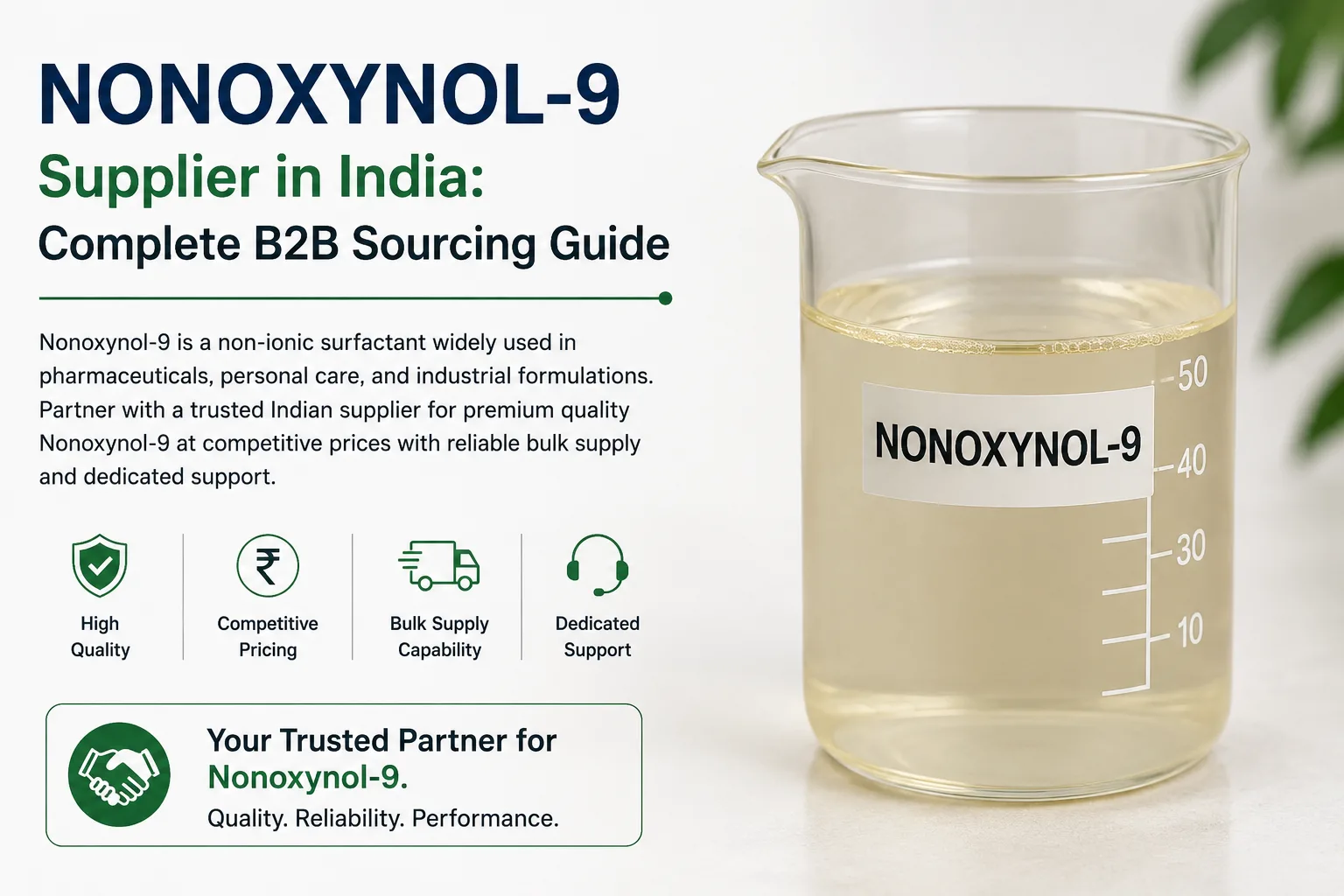
Companies planning regular commercial procurement can review this Nonoxynol-9 Supplier in India: Complete B2B Sourcing Guide for guidance on grade selection, documentation, packing, bulk availability and supplier evaluation.
ChemicalBull's existing product information also highlights bulk and custom packaging and technical documentation for Nonoxynol-9 sourcing.
Regulatory and Formulation Considerations
Nonylphenol ethoxylate-based surfactants require application-specific regulatory review because requirements can differ by geography and end use.
Manufacturers should therefore verify whether the intended application, concentration and destination market permit the selected surfactant before commercial production or export.
Where application restrictions apply, formulators may need to evaluate alternative non-ionic surfactant systems that provide comparable wetting or emulsification performance.
This makes regulatory review an important part of raw-material selection alongside cleaning performance and cost.
Production and Quality Control
Once a surfactant system has been selected, manufacturers should maintain consistent processing conditions.
Production teams should monitor:
- Addition sequence
- Mixing time
- Batch temperature
- Final pH
- Appearance
- Foam behaviour
- Product stability
- Cleaning performance
Raw-material consistency is also important. Changes in surfactant specification can influence clarity, viscosity and finished cleaning performance.
Reviewing the COA for incoming batches helps manufacturers confirm that the material remains within the approved specification.
Conclusion
Non-ionic surfactants play an important role in industrial cleaning by helping aqueous formulations wet surfaces, loosen oily contamination and keep removed soils dispersed.
Nonoxynol-9 provides wetting, emulsification, dispersion and detergency functionality that can be useful in suitable industrial cleaning systems. Its actual performance depends on concentration, soil type, water conditions, formulation chemistry and processing method.
Manufacturers should combine laboratory testing with regulatory review and consistent raw-material specifications before moving to large-scale production.
Chemical Bull supplies Nonoxynol-9 in bulk quantities and exports globally.